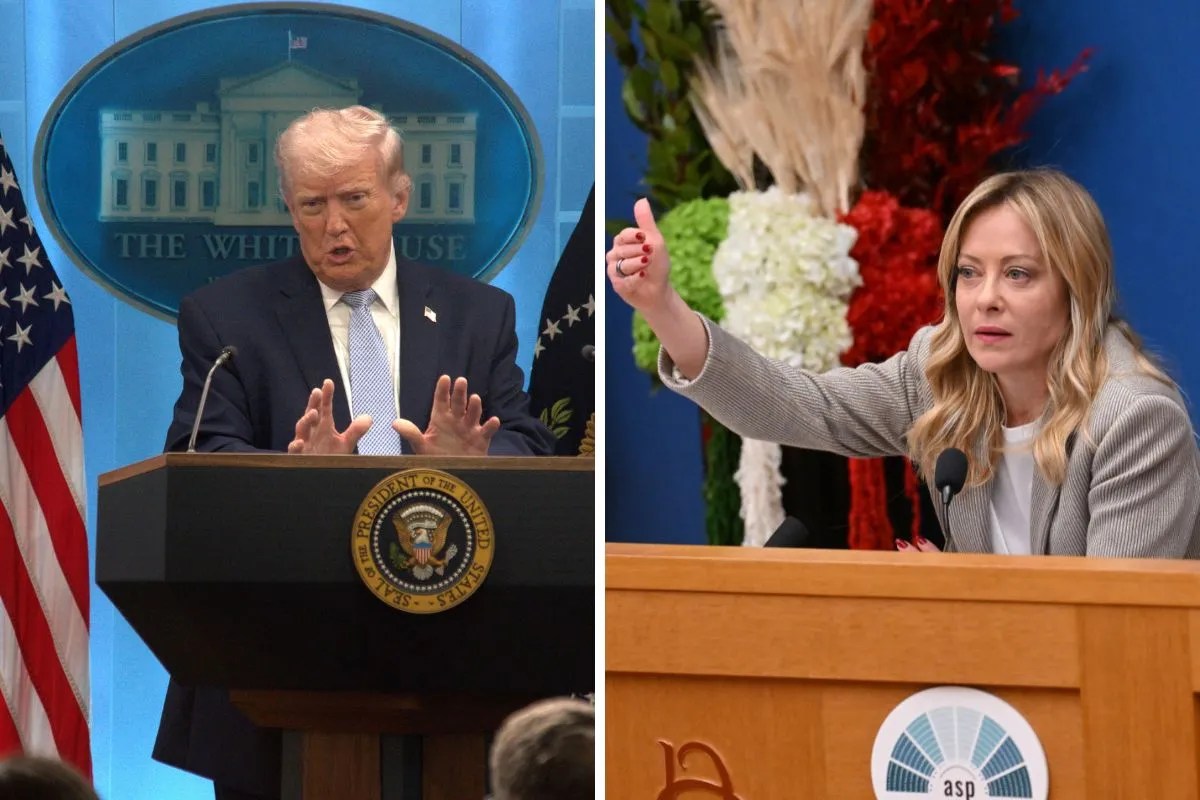
The strategic interaction between Italian Prime Minister Giorgia Meloni and President Donald Trump highlights a critical shift in how middle-power nations navigate asymmetric diplomatic relationships. Media narratives frequently reduce these encounters to personal friction or superficial rhetorical jabs. A structural analysis, however, reveals a calculated exercise in strategic autonomy, where a sub-dominant state leverages domestic political alignment to resist rhetorical subordination by a global superpower figure.
When analyzing asymmetric diplomatic friction, the core issue is not the emotional resonance of the rhetoric, but the underlying power dynamics and the strategic utility of defiance. For a leader like Meloni, responding to external provocations from a high-leverage actor like Trump requires balancing two conflicting imperatives: maintaining structural alliances with the United States while preserving sovereign political capital at home.
The Tri-Lateral Framework of Sovereign Branding
To understand the mechanics of this diplomatic resistance, the interaction must be parsed through three distinct operational pillars.
1. Asymmetric Deterrence
Middle powers lack the material capabilities—whether economic or military—to engage in direct retaliatory posturing against a superpower. Consequently, deterrence must be achieved through rhetorical boundary-setting. By explicitly decoupling her domestic political legitimacy from Trump's external validation, Meloni establishes a psychological boundary. This signals to international observers that alignment on ideological fronts does not equate to structural subordination.
2. Domestic Audience Costs
In modern populist-conservative politics, a leader’s primary asset is the perception of unyielding sovereignty. Submitting to external direction, even from an ideologically aligned foreign figure, incurs a severe domestic penalty. It dilutes the leader's brand from an independent national pioneer to a junior partner in a global movement. The pushback serves as a high-visibility signal to the domestic electorate that national sovereignty supersedes transnational ideological alliances.
3. The Multilateral Hedging Strategy
Italy’s geopolitical positioning requires a delicate balancing act between Washington and the European Union. Total capitulation to Trump’s rhetorical dominance alienates Brussels and weakens Italy’s leverage within European institutions. Conversely, a measured, high-profile assertion of independence allows Rome to position itself as a rational, self-interested actor capable of bridging the gap between Washington's transactional unilateralism and Brussels' institutional multilateralism.
The Mechanics of Rhetorical Arbitrage
The diplomatic friction operates as a cost function where both actors attempt to maximize political capital while minimizing strategic liability. The confrontation follows a predictable sequence of action and counter-action.
[Superpower Provocation: Rhetorical Subordination]
                       │
                       ▼
[Middle Power Evaluation of Domestic & International Risks]
                       │
                       ▼
[Calibrated Defiance: Decoupling Ideology from Subordination]
                       │
                       ▼
[Result: Restored Strategic Equilibrium & Preserved Capital]
Trump’s political strategy relies heavily on establishing a hierarchy within global conservative movements, frequently using public commentary to test the deference of foreign leaders. For a middle-power leader, ignoring these tests creates a precedent of compliance. The counter-strategy relies on rhetorical arbitrage: exploiting the foreign leader's provocation to gain a disproportionate amount of domestic prestige.
The mechanism depends on three specific variables:
- The Medium of Delivery: Utilizing direct, unvarnished communication to match the stylistic cadence of the provocateur, ensuring the message resonates with the target audience without escalating into formal diplomatic sanctions.
- The Decoupling Technique: Isolating the personal or stylistic critique from the broader institutional alliance. The state affirms its commitment to the structural bilateral relationship (NATO, trade intelligence sharing) while aggressively rejecting personal or political oversight.
- The Proportionality Index: The response must be sharp enough to register as a definitive rejection of subordination, but contained enough to avoid triggering a structural retaliatory response from the superpower’s political apparatus.
Structural Bottlenecks and Limitations of Defiance
While high-visibility defiance yields immediate domestic utility, it introduces significant long-term vulnerabilities. This strategy is subject to diminishing returns and structural bottlenecks that can jeopardize national security and economic stability.
The primary limitation rests in the economic imbalance between the two states. Italy’s reliance on capital markets, European recovery funds, and transatlantic trade routes means that rhetorical autonomy exists within a highly confined economic cage. If rhetorical friction crosses the threshold into policy disruption—such as trade tariffs or shifts in security guarantees—the domestic cost of maintaining the defiant posture escalates exponentially, far outpacing the political capital gained.
Furthermore, this strategy risks isolating the nation within its immediate regional bloc. If European partners perceive the friction not as a defense of national sovereignty, but as a erratic performance designed for domestic consumption, the state loses its capacity to act as a credible interlocutor within the European Union. This creates an institutional bottleneck, reducing the country's capacity to shape regional policy on migration, fiscal frameworks, and energy security.
Calibrating the Transatlantic Balance
The stabilization of middle-power diplomacy in an era of polarized superpower politics requires a transition from reactive posturing to institutional insulation.
States navigating this landscape must systematically depersonalize bilateral channels. While leadership-level rhetoric will inevitably fluctuate based on electoral cycles, the core operational components of the alliance—military interoperability, intelligence sharing, and supply chain integration—must be anchored in bureaucratic frameworks that remain insulated from executive whims.
Simultaneously, diplomatic communication must be diversified. Rather than relying on singular points of contact within a foreign administration, leverage must be distributed across legislative bodies, regional governors, and industrial coalitions. This distributed network ensures that even if executive-level rhetoric deteriorates, the structural foundations of the bilateral relationship remain functional, preventing temporary political friction from devolving into systemic strategic liability.