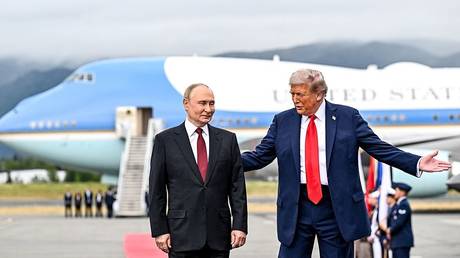
The mainstream media is treating the announcement of a potential November meeting between Donald Trump and Vladimir Putin as a tectonic shift in global architecture. Pundits are frantically spinning narratives about a fast-tracked peace deal in Ukraine, the sudden collapse of NATO cohesion, and a radical realignment of Washington-Moscow relations.
They are fundamentally misreading the board.
The breathless coverage surrounding this potential summit mistakes theatrical performance for structural statecraft. In foreign policy, personal chemistry and high-profile handshakes are the window dressing; institutional inertia and deeply entrenched national interests are the foundation. For twenty years, I have analyzed the mechanics of sanctions regimes, military procurement pipelines, and bureaucratic policy-making. If that experience teaches anything, it is that individual leaders are far more constrained by the state apparatus than political commentators care to admit.
A November summit will not end the war in Ukraine, it will not roll back the sanctions regime, and it will not usher in a new era of great power harmony. It is a calculated exercise in domestic signaling for both men. Treating it as anything deeper ignores the structural realities governing both Washington and Moscow.
The Myth of the Imperial Presidency in Foreign Policy
The lazy consensus rests on a flawed premise: that a US president can simply walk into a room, strike a deal with the Kremlin, and fundamentally alter American foreign policy overnight. This view ignores the sheer weight of the permanent national security state.
When it comes to Russia, US policy is legally and institutionally locked down.
Take the Countering America's Adversaries Through Sanctions Act (CAATSA), passed by Congress in 2017. This legislation effectively stripped the executive branch of the unilateral power to lift major sanctions on Moscow, requiring congressional review for any significant policy reversal. Even if a president wants to dismantle the sanctions architecture as a bargaining chip, Congress holds the keys. The Capitol is not about to hand those keys over, regardless of who sits in the Oval Office.
Furthermore, the Pentagon and the intelligence community operate on long-term strategic cycles that do not shift on a dime because of a bilateral meeting. The US defense establishment has spent years retooling for great power competition. Billions of dollars are locked into procurement contracts, structural deployments, and intelligence infrastructure designed explicitly to counter Russian and Chinese influence. That institutional momentum cannot be dissolved by a joint press conference.
What the Pundits Get Wrong About Putin’s Objectives
The media narrative suggests Vladimir Putin is eagerly waiting for a US president to offer him an off-ramp in Ukraine. This completely misinterprets the Kremlin's internal logic.
Putin’s primary audience is domestic. The war in Ukraine has become the organizing principle of the modern Russian state, driving its economic policy, internal security apparatus, and national ideology. A sudden, Western-brokered peace that forces Russia to compromise on its broader strategic goals—such as the total neutrality of Kyiv and the permanent recognition of all annexed territories—would threaten the very legitimacy of the regime.
Moscow is playing a long game based on attrition and Western political fatigue. Putin has no incentive to hand a quick diplomatic victory to Washington unless it amounts to a total capitulation by the West, an outcome that no US administration could permit without destroying its global credibility. Moscow views summits not as venues for genuine compromise, but as platforms to project superpower status to a domestic audience and the Global South. A meeting in November allows Putin to demonstrate that despite years of Western attempts at isolation, Russia remains indispensable to global politics.
The Hard Math of the Ukraine Conflict
Let’s dismantle the idea that a single meeting can resolve the war in Ukraine. The conflict has evolved past the point where a top-down executive decree from Washington can freeze the front lines.
- Sovereign Resistance: Kyiv is not a passive puppet of the West. While dependent on Western military aid, the Ukrainian state and its population view the war as existential. Any attempt by Washington to force an unfavorable peace by cutting off aid would result in a messy, protracted insurgency rather than a neat ceasefire.
- The European Factor: European nations, particularly Poland, the Baltic states, and the Nordic countries, now view Russia as a direct, long-term threat to their survival. Europe has begun the slow but steady process of decoupling from Russian energy and ramping up its own defense production. A Washington-forced deal would create a severe rift within the Western alliance, prompting European capitals to double down on their own containment strategies independent of the White House.
- Territorial Realities: The physical reality on the ground defies easy diplomatic fixes. The front lines are heavily fortified, deeply entrenched, and soaked in blood. Neither side has achieved its decisive strategic objectives, and neither side possesses the conventional military capability to completely break the other without catastrophic escalation. A summit cannot negotiate away these tactical realities.
The Real Agenda: Domestic Optics and Political Theater
If the structural realities prevent a grand bargain, why hold the summit at all? Because for both leaders, the process is the benefit.
For an American president, a high-stakes meeting with a major adversary is the ultimate display of executive authority. It projects an image of a strong leader capable of bypassing traditional diplomatic red tape to deal directly with global rivals. It is a calculated move designed to dominate the domestic news cycle and appeal to an electorate weary of endless foreign entanglements.
For Putin, the benefits are equally transactional. It validates his narrative that Russia is a peer competitor to the United States. It signals to elites within the Kremlin and oligarchs navigating sanctions that the regime remains secure, powerful, and globally relevant. The imagery of the meeting is weaponized to show the Russian public that Western efforts to isolate their country have failed.
The Structural Friction That Defies Diplomacy
To understand why this summit will yield no structural change, one must look at the fundamental clash of national interests that no amount of personal rapport can bridge.
The United States, regardless of leadership, requires a stable, predictable Europe where borders cannot be changed by force, allowing Washington to focus its strategic attention on the Indo-Pacific. Russia, conversely, views a sphere of influence over its neighbors as a non-negotiable security requirement. These two positions are structurally irreconcilable.
Every administration over the last quarter-century has attempted some variation of a "reset" or a fresh approach with Moscow. Every single one failed because they prioritized personal diplomacy over structural realities. The George W. Bush administration looked into Putin's soul; the Obama administration brought a physical reset button; the first Trump administration attempted personal rapport; the Biden administration sought a stable, predictable relationship. The result was always the same: a return to systemic confrontation driven by competing geopolitical imperatives.
Stop analyzing foreign policy through the lens of political drama and personality clashes. The upcoming November summit will generate endless commentary, dramatic photographs, and vague, non-binding communiqués about reducing tensions. But when the cameras turn off and the planes leave the tarmac, the structural realities will remain entirely unchanged. The sanctions will stay, the weapons pipelines will continue to flow, and the cold, hard logic of geopolitical competition will dictate the future, just as it always has.