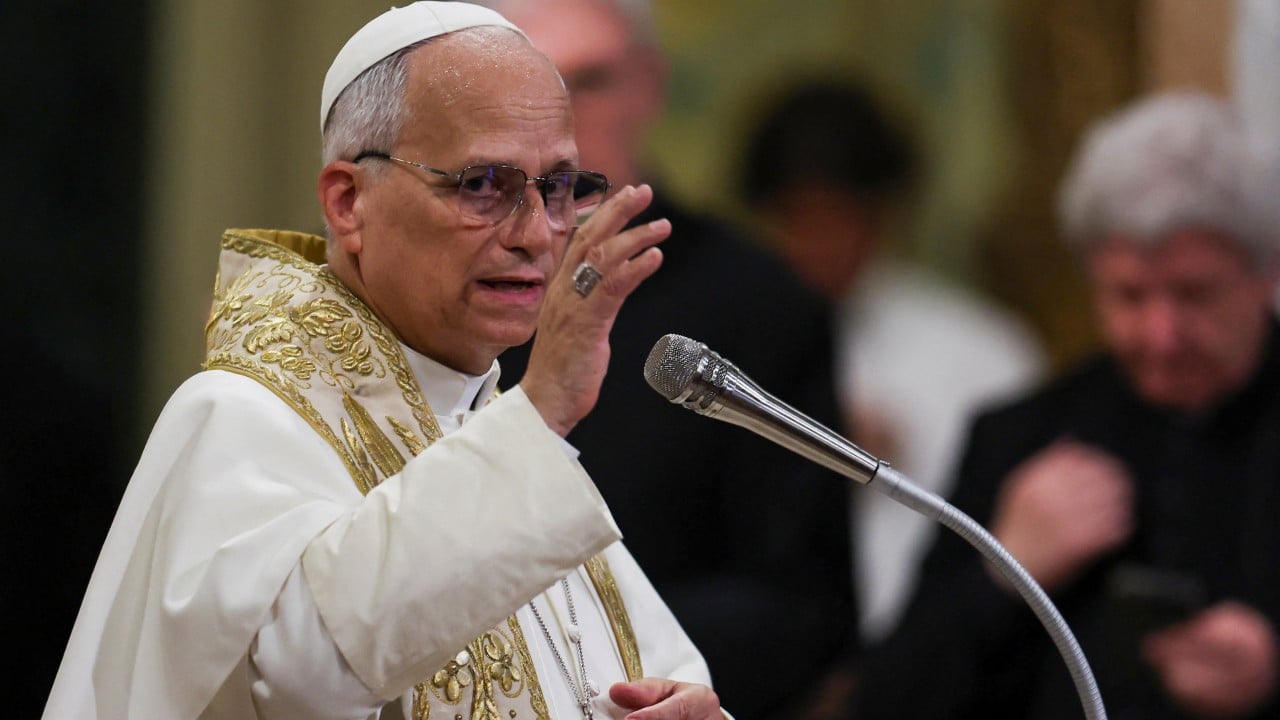
The modern papacy operates less as a static theological repository and more as a global communications network that uses historical precedent to execute contemporary diplomatic leverage. On June 20, 2026, Pope Leo XIV visited Sant’Angelo Lodigiano, Italy, the birthplace of Mother Frances Cabrini, the first naturalized United States citizen canonized by the Catholic Church. Rather than delivering a routine hagiographical address, the pontiff used the structural legacy of the patron saint of immigrants to construct a direct counter-narrative to the migration restriction policies of Western nation-states, specifically targeting the current United States executive administration.
This maneuver exposes a deliberate institutional mechanism: the strategic alignment of past ecclesiastical authority with current macroeconomic and geopolitical friction points. By analyzing the structural variables of this papal tour, we can decode how the Vatican uses historical narrative as an active tool of international diplomacy.
The Tri-Regional Alignment of Papal Itinerary
Papal travel is not merely pastoral; it functions as an agenda-setting mechanism. The visit to northern Italy represents one node in a three-part geographic strategy designed to apply moral pressure on major migration transit and destination zones.
- The Canary Islands (Spain): Earlier in June 2026, the pontiff completed a two-day deployment to this archipelago, focusing on the maritime transit corridor utilized by West African migrants fleeing economic depression and regional conflict.
- Sant’Angelo Lodigiano and Pavia (Italy): The mid-June stop linked the structural roots of historic Italian migration to the United States with the theological framework of St. Augustine—born in modern-day Algeria—establishing a historical cause-and-effect loop between North African origins and European development.
- Lampedusa (Italy): Scheduled for July 4, 2026, this highly symbolic date directly overlaps with U.S. Independence Day. Lampedusa is the primary maritime entry point for irregular migration routes crossing the Mediterranean from North Africa.
This itinerary establishes a clear operational sequence. By visiting the birthplace of a saint who managed transatlantic migrant integration, then immediately transitioning to the frontline entry points of modern maritime migration on a major American holiday, the Vatican strips neutrality from the calendar. It forces a direct comparison between historic Western immigration narratives and current border enforcement frameworks.
The Institutional Architecture of St. Frances Cabrini
To understand why Cabrini is leveraged as a diplomatic symbol, one must analyze her work not through the lens of individual piety, but as an institutional infrastructure project. Between 1889 and her death in Chicago in 1917, Cabrini founded 67 institutions, including schools, hospitals, and orphanages across the United States, Europe, and Latin America.
This institutional model solved a specific structural breakdown in late 19th-century state governance: the inability or unwillingness of host governments to absorb rapid influxes of foreign labor. The "Cabrini Model" operated on three distinct pillars:
- Decentralized Capital Accumulation: Bypassing state funding mechanisms by mobilizing private philanthropic capital from both affluent donors and working-class immigrant mutual-aid societies.
- Parallel Social Infrastructure: Building autonomous parallel networks of healthcare and education that operated outside state-sponsored welfare systems, which frequently barred or discriminated against new arrivals.
- Legal Naturalization Pathways: Utilizing local legal frameworks to secure citizenship status, converting transient labor into permanent, legally protected domestic populations.
Pope Leo XIV’s emphasis on her writings and travel journals is a directive to modern Catholic organizations to shift from reactive charity to the creation of similar parallel structural networks capable of operating independently of hostile state policy.
The Strategic Legacy Chain: Francis to Leo XIV
The current papal stance is a deliberate continuation of institutional priorities. Pope Leo XIV, history’s first U.S.-born pope, is explicitly anchoring his administrative authority in the ideological framework of his predecessor, Pope Francis. This continuity is achieved through a specific logical linkage:
[Francis: Son of Italian Immigrants to Argentina]
                    │
                    ▼
[Core Priority: Global Migration Advocacy]
                    │
                    ▼
[Leo XIV: Chicago Native & First American Pope]
                    │
                    ▼
[Historical Link: St. Frances Cabrini (Died in Chicago, 1917)]
                    │
                    ▼
[Application: Direct Resistance to U.S. Border Crackdowns]
This structural link immunizes the American-born Pope Leo XIV against accusations of foreign interference in domestic U.S. policy. By speaking as a native of Chicago—the very city where Cabrini died and naturalized—the pontiff frames his criticism of U.S. border policy not as an external critique, but as an authentic expression of American religious history.
The Internal Friction: Secularization and the Primacy of Interiority
A critical constraint on this diplomatic strategy is the internal secularization of the European and American populations the Pope seeks to influence. Before praising Cabrini, Leo XIV stopped in Pavia to pray at the tomb of St. Augustine, where he acknowledged a widespread loss of "spiritual appetite" and declining engagement with Christian frameworks in the West.
This admission exposes a fundamental operational bottleneck for the Vatican:
Papal moral authority cannot effectively influence state migration policy if the domestic voting population no longer recognizes ecclesiastical authority.
To counter this systemic weakness, the Vatican is shifting its messaging toward a concept the pontiff termed the "primacy of interiority"—an inward search for meaning that appeals to broader, post-secular humanist values rather than rigid doctrinal adherence. By framing migration through the universal historical lenses of Augustine (an African immigrant to Italy) and Cabrini (an Italian immigrant to America), the papacy attempts to bypass dogmatic gridlock and engage secular state actors on the shared terrain of historical utility and human rights law.
The strategic trajectory of the current pontificate indicates that the Vatican will increasingly decouple its geopolitical directives from purely theological language, opting instead to weaponize historical biography and international law to force state compliance on migration management.
For a deeper visual understanding of this historic context and the contemporary geopolitical implications of this papal deployment, the report Pope Leo honors first American saint analyzes the spatial connections between Chicago, Rome, and the Mediterranean migration corridors.