A young lieutenant named Elias sits in a windowless room outside of Brussels, staring at a screen that displays a thermal ghost. The ghost is a heat signature moving across a dusty road thousands of miles away. In the old days—five years ago—Elias would be the one to decide if that ghost represented a threat or a civilian. He would weigh the pixelated data against his training, his gut, and the heavy burden of his own conscience.
Today, the software does the weighing for him.
A small green box flickers around the heat signature. The algorithm has already cross-referenced the shape’s gait, the object it is carrying, and its proximity to a known insurgent route. The confidence interval sits at 98%. In the logic of a machine, 98% is a certainty. In the logic of a human, that 2% is where the nightmares live.
Europe stands at a precipice where the 2% is being traded for speed. We are currently witnessing the quietest arms race in human history. It doesn't involve the thunder of nuclear testing or the visible silo-building of the Cold War. Instead, it is written in lines of Python and C++, hidden in data centers, and deployed in "black box" systems that even their creators cannot fully explain. The push for autonomous weapons systems (AWS) and military AI is framed as a necessity for modern defense, but we are drifting toward a world where the most consequential decision a species can make—who lives and who dies—is outsourced to an optimization script.
The European Union often finds itself caught between the sheer processing power of the United States and the centralized data-harvesting of China. There is a frantic urge to "catch up." But catching up in this arena often means stripping away the very safeguards that define a democratic society. If Europe follows the lead of those who prioritize lethality over accountability, it doesn't just lose its competitive edge. It loses its soul.
The Math of Murder
Consider the fundamental flaw of a machine-learning model: it is a rearview mirror. It learns from what has already happened. In a laboratory, this is how we get better weather forecasts or more accurate medical diagnoses. In a war zone, the "training data" is soaked in blood and bias.
If an AI is trained on satellite imagery from a specific conflict, it learns that a man standing near a certain type of truck is a combatant. It doesn't understand "context." It doesn't understand that the man might be a mechanic trying to fix a neighbor’s vehicle in a desperate attempt to flee. The machine sees a pattern. It matches the pattern. It executes the command.
We are told these systems are "more precise" than humans. Proponents argue that robots don't get tired, they don't get angry, and they don't seek revenge. This is true. But robots also don't have mercy. They don't have the "moral friction" that makes a soldier hesitate before pulling a trigger. That hesitation is not a bug in the human system; it is a feature of our civilization. When we remove the friction, we turn the theater of war into a factory floor.
The Accountability Gap
Imagine a tragedy. A fully autonomous drone strikes a wedding party because the algorithm misinterpreted the celebratory firing of rifles as a hostile engagement. Who is responsible?
The programmer will say the code was solid but the data was noisy. The commanding officer will say they didn't "order" the strike; the system identified a target within the pre-approved parameters. The manufacturer will point to a disclaimer in the terms of service.
We are creating a vacuum where "the system" did it, and therefore, no one did it. This isn't just a legal headache for international lawyers in The Hague. It is a fundamental shift in how we perceive the value of human life. If no one is responsible for a death, the death becomes a mere statistical variance. An error message.
Europe has a unique opportunity to prevent this vacuum from expanding. By championing a "human-in-the-loop" or "human-on-the-loop" framework, the continent can set the global standard for what it means to be a responsible technological power. It requires more than just high-minded speeches. It requires a rigid, legally binding refusal to deploy any system that cannot explain its own "why" to a human operator in real-time.
The Invisible Stakes of Scalability
The most terrifying aspect of military AI is not a single "Terminator" robot. It is the scalability of violence.
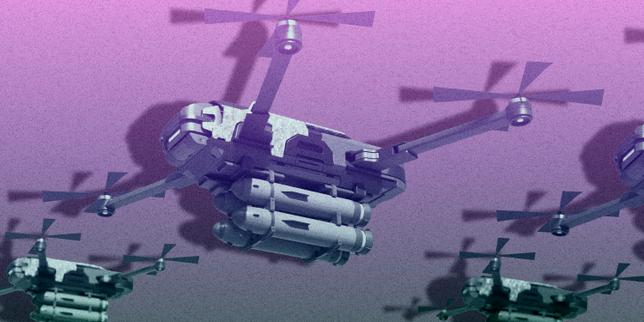
A single human sniper can take one shot at a time. A swarm of five hundred miniature drones, coordinated by a single neural network, can clear an entire city block in seconds. This level of efficiency changes the calculus of starting a war. If a nation can project force without putting its own soldiers at risk, the political barrier to entry for armed conflict drops to near zero.
War becomes a low-cost subscription service.
This is where the European "Third Way" becomes vital. The continent has already led the world in data privacy with GDPR and in AI regulation with the AI Act. But the military sector remains a glaring blind spot, often shielded by the veil of "national security." We cannot protect the digital rights of our citizens in the streets while ignoring the digital lethality of our weapons on the borders.
The Burden of Leadership
True leadership is often the courage to be slower.
In the race to automate the battlefield, the winner might be the one who reaches the finish line first, but the loser will be humanity. Europe must resist the siren song of total automation. It must insist that "meaningful human control" is not a buzzword to be tucked into a white paper, but a hard technical requirement that dictates the architecture of every sensor, every drone, and every command-and-control suite.
We are currently building the ghosts of the future.
Elias, our lieutenant, eventually looks away from the screen. He rubs his eyes. He is tired, he is conflicted, and he is deeply human. He is the only thing standing between a line of code and a life ended. If we remove him—if we decide his "latency" is too high or his "hesitation" is too costly—we aren't just making war more efficient.
We are admitting that we no longer trust ourselves to hold the sword.
The silence in that Brussels control room isn't just the sound of a quiet office. It is the sound of a decision being made in the dark. We have to decide if we want our future to be governed by the cold, unblinking logic of a machine that knows everything about patterns and nothing about people.
The green box is still flickering. The target is still moving. Somewhere in the world, someone is waiting for a human to decide what happens next.