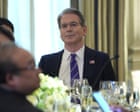
The air in the room didn’t just feel expensive; it felt heavy with the weight of things left unsaid. When Donald Trump sat down with Sanae Takaichi, the former Japanese economic security minister, the cameras caught the surface-level polish of a high-stakes diplomatic meet-and-greet. Two power players. One table. A flurry of flashbulbs. But for those who track the tectonic plates of global finance, the atmosphere was thick with a specific, historical dread. It was the kind of chill that doesn’t come from the air conditioning, but from the realization that we are watching a decades-old tragedy attempt a comeback tour.
Politics often looks like a series of isolated choices. A speech here. A photo-op there. In reality, it is a river. Everything flowing into the present is fed by the runoff of the past. To understand why the markets shivered at the sight of this particular handshake, you have to look past the tailored suits and into the dark water of the 1930s.
The Architect of a Dangerous Miracle
Imagine a man named Korekiyo Takahashi. In the early 1930s, he was Japan’s finance minister, a silver-bearded veteran known as the "Keynes of Japan" before anyone really knew who Keynes was. He pulled off what looked like a magic trick. While the rest of the world was choking on the Great Depression, Takahashi severed the yen’s tie to gold, slashed interest rates, and began a massive program of government spending funded by the central bank.
It worked. Too well.
By the mid-1930s, the Japanese economy was roaring while others remained stagnant. But Takahashi knew the danger of his own creation. He knew that if you keep the taps open too long, the house floods. When he tried to rein in the military spending he had unleashed, he didn't just lose his job. He was assassinated in his bed by radical young army officers during the February 26 Incident of 1936. With the "brake" removed, the Japanese economy became a runaway train fueled by debt and hyper-nationalism, hurtling toward the cliff of World War II.
Now, look back at that meeting between Trump and Takaichi.
Takaichi is a staunch disciple of "Abenomics," the hyper-aggressive monetary policy that sought to jumpstart Japan’s sluggish pulse through massive stimulus and low rates. Trump, meanwhile, has never met a low interest rate he didn't like. During his presidency, he famously leaned on the Federal Reserve to keep the "easy money" flowing, viewing a high stock market as the ultimate scoreboard of his success.
When these two ideologies sit in the same room, the ghost of Takahashi starts to pace the hallway.
The Invisible Strings of the Carry Trade
To a person trying to pay their mortgage or save for a child’s education, "monetary policy" sounds like a sedative in word form. It feels abstract. But it is the most visceral force in your life. It dictates whether your grocery bill climbs by 2% or 20%. It determines if your local factory stays open or moves to a country with a weaker currency.
The meeting in Florida wasn't just about friendship; it was about the potential return of a world where the two largest democratic economies are led by people who believe the central bank should be an arm of the executive branch.
Consider the "carry trade," a piece of financial machinery that sounds complex but is essentially a high-stakes pawn shop maneuver. For years, investors have borrowed money in Japan—where interest rates were effectively zero—and moved that money into the U.S. to buy assets that pay more. It’s free money, provided the exchange rate stays steady.
But what happens when the leader of the U.S. and a top contender for leadership in Japan both signal a desire for weaker currencies and manipulated rates? The machinery begins to grind. The "free money" disappears. The trillions of dollars tied up in these global bets start to move all at once. It’s like everyone in a packed theater trying to exit through a single door because someone whispered "smoke."
The Sovereignty of the Vault
There is a fundamental tension at the heart of modern civilization that we rarely discuss: Who owns the value of your labor?
If a central bank is independent, it acts like a sober designated driver. When the party gets too loud and inflation starts to spike, the bank raises rates. It hurts. It’s the "taking away the punch bowl" moment that politicians hate because it makes them unpopular. But it keeps the currency from becoming worthless paper.
If a politician gains control of that vault, the temptation is always the same. Spend now. Print now. Win the next election now. Leave the bill for whoever is standing in the ruins ten years later.
Trump’s rhetoric has consistently leaned toward a desire for more influence over the Federal Reserve. Takaichi has voiced similar sentiments regarding the Bank of Japan. When these two perspectives align, they aren't just discussing trade deals. They are discussing a fundamental shift in how the world's money is managed—moving away from the "sober driver" model and toward a model where the accelerator is pinned to the floor by the person in the passenger seat.
The Human Cost of a "Strong" Weakness
We often hear politicians talk about wanting a "weak currency" to help exports. It sounds like a win. If the dollar is weak, our cars and wheat are cheaper for the rest of the world to buy. Jobs return. The heartland hums.
But there is a hidden tax. A weak currency means everything you buy from abroad—electronics, medicine, fuel—becomes more expensive. It means the savings account you worked thirty years to build suddenly buys half as much. It is a slow-motion theft of purchasing power, hidden behind the flag-waving of "competitive trade."
The meeting between Trump and Takaichi signaled a shared appetite for this kind of "competitive devaluation." If both sides are racing to the bottom, the winners are the large corporations with the scale to weather the storm. The losers are the people who live on a fixed income, the ones who don't have their wealth tied up in gold or real estate, the ones who rely on the dollar in their pocket being worth a dollar tomorrow.
The Resonance of the Handshake
History doesn't repeat, but it certainly rhymes. The 1930s weren't just about bad luck; they were about a global retreat from cooperation into a "beggar-thy-neighbor" mindset. When nations stop trying to build a stable global floor and start trying to dig a hole for their competitors to fall into, everyone eventually ends up in the dirt.
The meeting at Mar-a-Lago wasn't a policy briefing. It was a vibe shift.
It was a signal to the markets that the era of the "independent technocrat" might be drawing to a close. We are entering a time where money is being repoliticized. This isn't just a concern for day traders in Manhattan or Tokyo. It matters to the person in Ohio wondering why their rent keeps climbing. It matters to the pensioner in Osaka wondering why their yen doesn't cover the heat anymore.
We like to believe that we have evolved past the mistakes of the 1930s. We have better computers, faster data, and more sophisticated models. But models are made of math, and math has no defense against human ego or the desperate need to win an election.
As the sun set over the Florida coast, the two figures stepped away from the table. The cameras stopped clicking. The news cycle moved on to the next outrage. But the ghost of Korekiyo Takahashi remained in the corner of the room, a silent witness to the fact that when you play with the foundations of money, you are playing with the foundations of peace itself.
The markets didn't react to what was said. They reacted to the shadow that the meeting cast across the next decade—a shadow that looks remarkably like a path we’ve walked before, leading to a destination we swore we’d never visit again.
The ledger is being rewritten, and the ink is still wet.
Would you like me to analyze the historical parallels between current U.S. monetary trends and the specific 1930s policies mentioned?