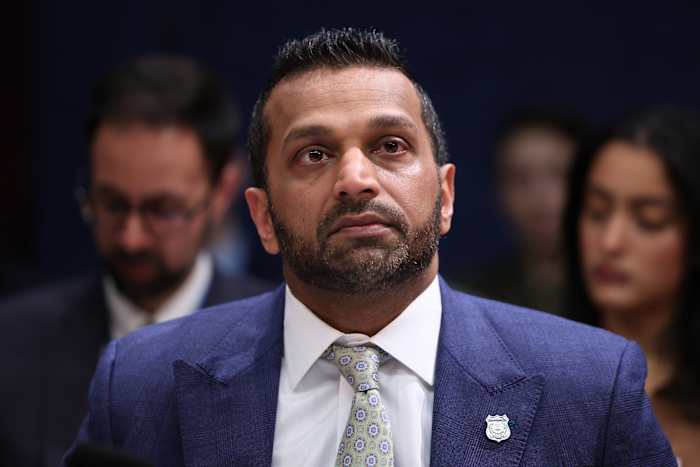
The notification is a quiet thing. A soft chime or a subtle vibration against a mahogany desk. For most people, it represents a spam filter failure or a reminder about a dental appointment. But when you are Kash Patel—a man whose career has been defined by the high-stakes friction of intelligence, national security, and the leadership of the FBI—that chime is a crack in the foundation of a very expensive, very private fortress.
He is the hunter. By trade and by temperament, he is the one who monitors the shadows. Yet, the shadows just spoke back.
A pro-Iranian hacking collective, operating under the digital banner of "Handala," recently claimed they didn't just knock on the door of the FBI Director’s personal digital life. They claim they walked inside, sat at the table, and took whatever they wanted. This isn't just a data breach. It is a psychological surgical strike.
The Myth of the Unreachable Man
We treat our high-level officials like digital deities. We assume they exist behind layers of encrypted obsidian, protected by black-budget firewalls and teams of analysts who breathe binary code. The reality is far more fragile. Even the Director of the FBI uses an iPad. Even the most powerful men in the world have personal email accounts, old cloud storage folders, and the occasional reused password from a decade ago.
The "Handala" group didn't need to hack the FBI’s mainframe. They didn't need to bypass the security of the J. Edgar Hoover Building. Why bother with the front gate when you can follow the target home? By targeting Patel’s personal accounts, they bypassed the multi-million dollar security infrastructure of the United States government and went straight for the man’s pocket.
Imagine the contents of your own personal cloud. It is a mosaic of who you are. There are photos of family vacations, draft emails that were never sent, receipts from mundane Amazon purchases, and perhaps the occasional sensitive document that you "just needed to look at" over the weekend. For a private citizen, a leak is an embarrassment. For the Director of the FBI, it is a map of his vulnerabilities.
Handala claimed to have exfiltrated nearly 500 gigabytes of data. To put that in perspective, that is roughly the equivalent of 350,000 high-resolution photographs or millions of pages of text. They aren't just looking for state secrets. They are looking for leverage. They are looking for the human being beneath the title.
The Mechanics of the Shadow War
Cyber warfare is rarely about the spectacular explosion. It is about the slow, methodical erosion of trust. When a group linked to a foreign adversary—in this case, Iran—claims to have compromised the personal data of a top security official, the primary goal isn't necessarily the data itself. The goal is the headline.
The message is simple: If we can get to him, we can get to anyone.
Iran has spent the last decade refining its "soft war" capabilities. Unlike the kinetic warfare of tanks and missiles, digital incursions are cheap, deniable, and devastatingly effective. They use social engineering, phishing, and "credential stuffing" to find the one loose thread in a target's digital tapestry. Once they find it, they pull.
Consider the hypothetical path of such an attack. It doesn't start with a "Mission Impossible" style break-in. It starts with a link. Or a fake security alert that looks exactly like a Google notification. It preys on the one thing that no firewall can fix: human urgency. Patel, a man constantly under fire and managing a whirlwind of domestic and international crises, is exactly the kind of high-pressure target who might, in a moment of exhaustion, click the wrong button.
Why the Personal Account is the New Front Line
We are living through a period where the line between the "public official" and the "private individual" has entirely evaporated. In the past, if you wanted to compromise a government official, you had to flip a source or plant a bug in a physical office. Today, you just need to compromise their spouse’s iCloud or their child’s gaming account.
This is the "Side-Channel Attack." If the front door is locked with a deadbolt, you check the basement window. For Kash Patel, the basement window was his personal digital footprint.
The Handala group released "proof" of the hack—screenshots and snippets intended to validate their claims. In the world of cyber espionage, this is called "Proof of Life." It serves to embarrass the target and signal to other hackers that the hunt is on. It creates a sense of blood in the water.
But there is a deeper, more cynical layer to this. By targeting Patel specifically, a figure who is already a lightning rod for political controversy, the hackers aren't just attacking a man. They are feeding a narrative of instability. They are counting on the fact that his detractors will celebrate the breach, while his supporters will grow paranoid. In either case, the winner is the entity that caused the chaos.
The Invisible Stakes of 500 Gigabytes
What is actually in that 500GB?
If the hackers are telling the truth, they have a chronological record of a man’s life. They have his contacts. They have his private communications. In the hands of a foreign intelligence service, this is more than just gossip. It is a tool for pattern recognition.
They can see who he talks to when the cameras are off. They can see where he spends his money. They can see his health records, his travel plans, and his private anxieties. If you want to manipulate a leader, you don't look at their public speeches. You look at their private searches.
This is the vulnerability of the modern age. We carry our entire lives in our pockets, protected by nothing more than a six-digit PIN and a prayer. We have traded our privacy for convenience, and the bill is finally coming due for the people who manage our world.
The Iranian-backed group’s claim is a reminder that in the 21st century, there is no such thing as "off the clock." If you hold power, you are a target 24 hours a day. Your phone is a beacon. Your laptop is a witness. Your smart home is a spy.
The Ghost in the Machine
There is a specific kind of coldness that comes with realizing your privacy has been violated. It is a physical sensation—a tightening in the chest, a sudden awareness of how exposed you truly are. For a man like Patel, who has built his reputation on being the ultimate insider, the realization that he was on the outside of his own security must have been a bitter pill.
The Handala group isn't just a collection of teenagers in a basement. They are part of a broader geopolitical chess match. Every byte of data they exfiltrate is a move on a board that spans the entire globe. They are the digital proxies of a nation-state, and their objective is to prove that the American security apparatus is a paper tiger.
They want us to believe that no one is safe. And the uncomfortable truth? They might be right.
If the Director of the FBI can have his personal life ransacked and put on display by a group of state-sponsored hackers, what hope does the average citizen have? We are all living in glass houses. We have simply been lucky that no one has decided to throw a stone at our particular window yet.
The Price of the Hunt
Kash Patel has spent years investigating others. He has declassified documents, chased leads, and unmasked actors in the shadows. There is a profound irony in the hunter becoming the hunted. It is the classic narrative arc of a spy thriller, but this isn't a movie. There are no credits that roll to signal the end of the danger.
Once data is out, it stays out. It is copied, mirrored, and analyzed by algorithms that never sleep. It is sold on the dark web and archived in the servers of foreign ministries. A hack like this isn't a single event; it is a permanent change in the landscape of a person's life.
The breach of Patel’s account is a signal flare. It tells us that the next war won't be fought over territory or resources, but over the contents of our hard drives. It tells us that the most dangerous weapon in the world isn't a nuclear warhead, but a well-timed phishing email.
We are entering an era of "Radical Exposure." The people who lead us are being stripped of their digital armor, revealing the messy, complicated, and vulnerable humans underneath. While some might find a grim satisfaction in seeing the powerful brought low, we should all be wary. The tools used against Kash Patel today will be refined, automated, and used against the rest of us tomorrow.
The chime on the desk wasn't just for him. It was for everyone.
The screen flickers. A password is typed. Somewhere, thousands of miles away, a server hums as it receives a new batch of stolen life. The hunter looks at his phone, and for the first time, the reflection looking back is that of a victim. The glass hasn't just cracked. It has shattered.
Would you like me to analyze the specific cybersecurity protocols that could have prevented a breach of this nature?