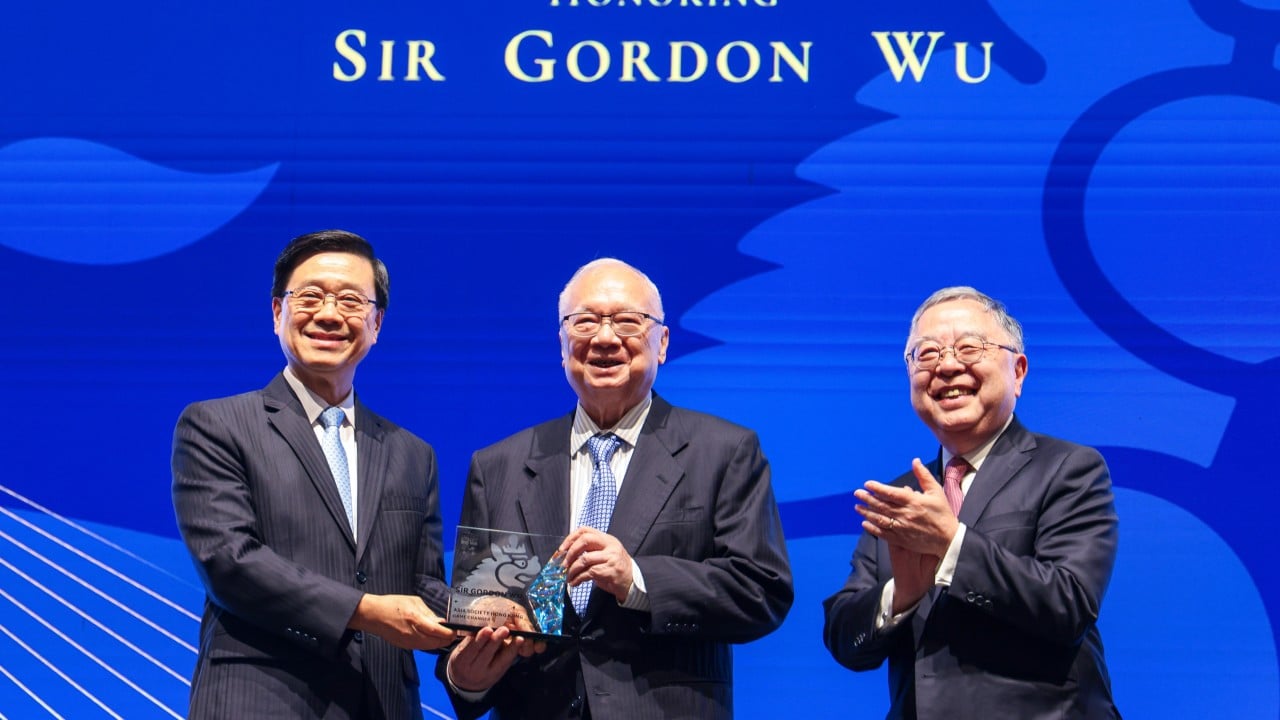
Western boardrooms are sweating over China's economic data, but 90-year-old billionaire Gordon Wu is completely unfazed. While modern fund managers obsess over quarterly GDP blips and shifting supply chains, the founder of Hopewell Holdings remains stubbornly, aggressively optimistic about the mainland's economic future.
His reason is simple. It's not about tech bubbles or real estate speculation. It comes down to basic political stability and an unrivaled national work ethic.
Speaking after receiving a prestigious award from the Asia Society in June 2026, the legendary Hong Kong property and infrastructure tycoon shrugged off the current wave of geopolitical pessimism. "I am very optimistic about the future of China," Wu remarked flatly. "Why? Because these are the people who really work hard."
For a man who has spent nearly five decades pouring billions into mainland infrastructure, this isn't naive corporate cheerleading. It's the calculated perspective of an engineer who built the literal foundations of China's economic miracle.
The Engineer Who Bet on Deng Xiaoping
To understand why Wu doesn't care about the latest media panic, you have to look at what he saw when he first crossed the border. When Deng Xiaoping announced his reform and opening-up policy in 1979, mainland China was an economic wasteland. The preceding three decades had left the country deeply impoverished. Twenty percent of the population lived in agrarian communes, equally poor and entirely cut off from modern technology.
Wu, a Princeton-educated civil engineer, didn't see risk. He saw a massive, untapped labor force that just needed the tools to move.
He realized that if you want a modern manufacturing economy, you can't just build factories. You need roads to ship goods and power plants to keep the lights on. In May 1979, Wu gathered the wealthiest property developers in Hong Kong for a lunch meeting to fund China's first luxury hotel, the Guangzhou China Hotel. It was a chaotic trial run where Hong Kong staff literally had to teach mainland workers how to use modern washing machines and apply makeup.
But his real masterstroke was introducing the Build-Operate-Transfer (BOT) model to Chinese infrastructure. Wu used his own capital to build massive projects, operated them to recoup his investments via tolls or tariffs, and then handed them back to the state.
- The Shajiao B Power Plant (1987): Built in a record-breaking 22 months to solve Guangdong’s crippling electricity shortages.
- The Guangzhou-Shenzhen Superhighway (1994): A 122.8-kilometer arterial toll road that turned the Pearl River Delta into the workshop of the world.
When Wu built these, critics called him crazy. Today, China possesses the most extensive highway network on earth and a high-speed rail grid that handles billions of passengers annually. Wu knows how deep the foundation goes because he poured the concrete himself.
Why Political Consistency Beats Free Market Chaos
The core of Wu's current optimism relies on an argument that makes Western economists deeply uncomfortable: the economic value of authoritarian predictability.
In Wu’s view, Western democratic models often fall into a trap of endless consultation and political paralysis. He has openly criticized Hong Kong's government for being too indecisive on land reclamation and housing policies, arguing that leaders shouldn't retreat the moment they hear voices of opposition. Instead, he advocates for making firm decisions based on the long-term interest of the masses.
On the mainland, the continuous rule of the Communist Party provides a long-term operational horizon that public companies or democratic governments can't match. When Beijing decides to build an industry—whether it's superhighways in the 1990s or electric vehicles and renewable energy grids today—it doesn't worry about the next election cycle.
This structural predictability allows massive capital investments to mature. Wu points to history to back this up. During the 1997 Asian Financial Crisis, neighboring economies like Thailand and Indonesia followed IMF advice, floated their currencies, and watched their societies collapse into chaos. Beijing dug its heels in, held the renminbi steady, and protected its industrial core. Wu saw firsthand that a strong, centralized hand prevents catastrophic market panics.
What Global Investors Get Wrong About the Mainland
The current panic selling of Chinese equities stems from a fundamental misunderstanding of what actually drives the nation's wealth. Wall Street looks at real estate defaults and regulatory crackdowns and sees a broken system. Wu looks at the underlying human capital and sees an economic engine that's still perfectly intact.
The real narrative isn't the death of Chinese growth; it's the shift toward high-value urbanization and industrial upgrades. When Wu started, China's urban population was tiny. Today, it sits well over 60%, heading toward Wu's long-term prediction of 80%. This massive migration creates an insatiable demand for domestic services, healthcare, life insurance, and advanced retirement benefits—sectors that are primed for explosive growth over the next decade.
Furthermore, the idea that global supply chains can easily abandon China ignores structural realities. The country's advantage isn't just cheap labor anymore; it's the unparalleled density of its industrial supply chains and its rapidly falling costs for commercializing new tech, particularly in artificial intelligence and automation.
The Practical Playbook for Navigating the Shift
If you're trying to figure out how to allocate capital or position a business in this environment, stop looking at macro headlines and start looking at structural alignment. Wu’s career teaches us that you make money in China by solving the state's biggest operational bottlenecks.
Right now, those bottlenecks aren't roads and bridges. They are energy transition assets, advanced healthcare delivery for an aging population, and industrial automation software.
Instead of trying to outsmart the regulatory landscape, find the sectors where Beijing is actively desperate for efficiency and private capital integration. The game hasn't changed; the infrastructure has just moved from physical concrete to digital and social systems. If you can align your business with national stability rather than betting against it, the runway remains incredibly long.
For those wanting a deeper dive into how early infrastructure bets shaped this landscape, the documentary Property tycoon Gordon Wu backs reclamation in Hong Kong offers a direct look at his engineering philosophy and his early projects in the Greater Bay Area.