The sky above Jhang is rarely quiet, but on a crisp morning, the sound changes. It is not the familiar, rhythmic drone of commercial turboprops or the distant hum of high-altitude transports. It is a sharp, tearing shriek.
When an engine fails at several thousand feet, the silence that follows is not peaceful. It is violent. It is the sound of physics reclaiming a multi-million-dollar machine that had, until that exact second, defied the earth.
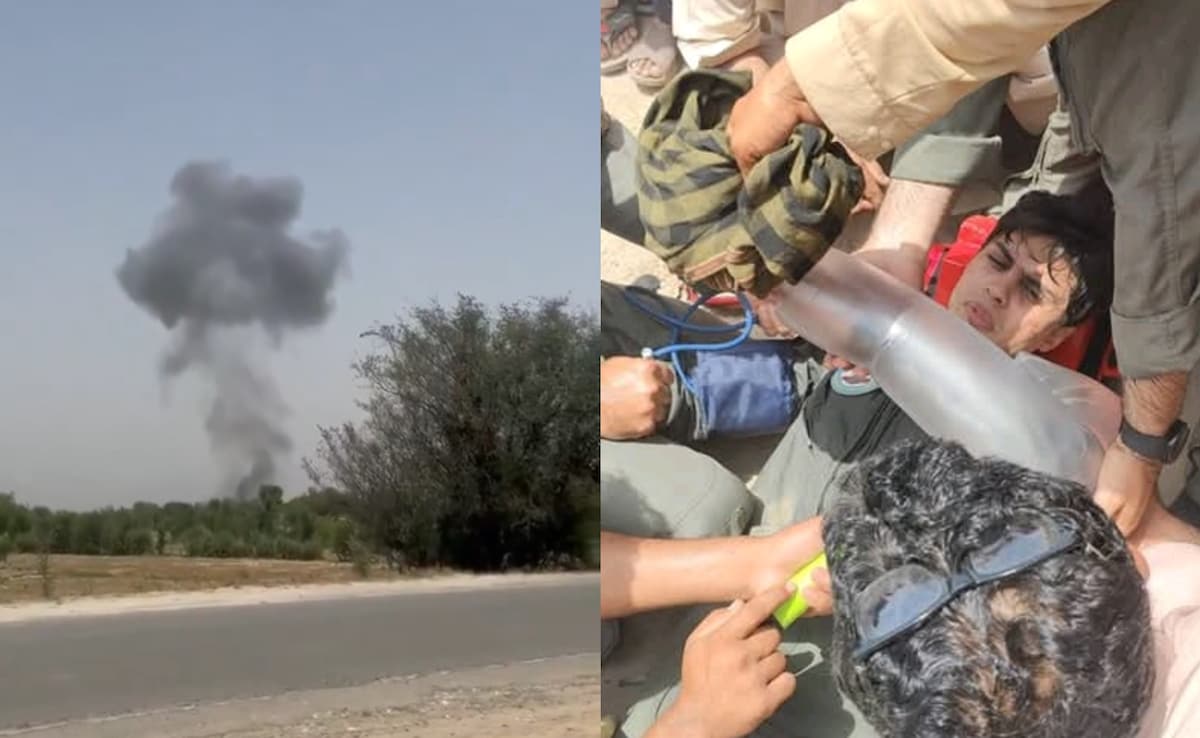
Residents on the ground looked up to see a JF-17 Thunder, a fighter jet born of a deeply strategic, multi-billion-dollar alliance between China and Pakistan, entering its final, unrecoverable descent. A plume of gray smoke traced its trajectory against the blue. Then, two sudden, violent flashes of light erupted from the cockpit. Two small canopies shattered outward. Two nylon parachutes bloomed like sudden flowers against the sky.
The jet struck the earth in a remote field, disintegrating into a fireball of aluminum, carbon fiber, and aviation fuel. The pilots drifted down, landing safely, bruised but alive.
To the casual observer scrolling through a social media feed, it was a momentary blip of breaking news. A video clip captured on a cheap smartphone, shared, liked, and forgotten within twenty minutes. But to those who understand the delicate, razor-thin margins of geopolitical deterrence, that plume of smoke in Punjab was a symptom of a much larger, much quieter friction.
A military aircraft crash is never just an industrial accident. It is a data point in a cold war of logistics, manufacturing integrity, and international trust.
The Chemistry of a Joint Venture
To understand why a single crash in Pakistan ripples across defense ministries from New Delhi to Beijing, you have to look at the metal itself.
The JF-17 Thunder is not just an airplane; it is a diplomatic handshake made of titanium and rivets. Developed jointly by China’s Chengdu Aircraft Industry Corporation and the Pakistan Aeronautical Complex, the aircraft was designed to be the backbone of Islamabad’s aerial defense. It was built to be affordable, adaptable, and, above all, independent of Western supply chains that could be choked off by sanctions at a moment's notice.
Think of it as a house built by two different architects. One provides the blueprint and the specialized materials; the other manages the assembly and the daily upkeep. For decades, this arrangement worked. It allowed Pakistan to modernize its fleet without the astronomical price tag of American F-16s or European Rafales.
But when a machine built under this philosophy falls out of the sky, the finger-pointing begins long before the wreckage cools.
Engineers face an agonizing puzzle during a crash investigation. Did the engine fail because of a manufacturing defect originating thousands of miles away in a Chinese factory? Or did a technician in Kamra miss a hairline fracture during a midnight maintenance shift?
The answers to these questions are rarely purely technical. They are political.
The Human Envelope
We often talk about fighter jets as if they are autonomous gods of war, forgetting the flesh and bone strapped into the ejection seat.
Inside the cockpit of a diving aircraft, time does not flow linearly. It compresses. The human heart rate spikes past 180 beats per minute. The internal monologue vanishes, replaced entirely by conditioned reflex and muscle memory.
Every military pilot is trained for the nightmare scenario: the unrecoverable stall, the catastrophic engine seizure, the sudden loss of hydraulic pressure. They call it "the envelope." As long as you are inside the envelope, you can fight the aircraft. You can flip switches, reset breakers, and attempt to relight the engine.
But there is a line—invisible, shifting, and absolute—where the envelope tears.
When that happens, the pilot stops being an operator and becomes a passenger in a falling brick. The decision to pull the ejection handle between his knees is not a choice; it is an admission of defeat against gravity. The explosive charges beneath the seat fire with a force that compresses the human spine, pushing the pilot through the canopy at a speed that turns the air into a concrete wall.
In the Jhang incident, the system worked. The Martin-Baker ejection seats fired perfectly. The pilots survived.
In the calculus of military aviation, losing an aircraft is a financial wound. Losing a trained pilot is a strategic disaster. It takes years and millions of dollars to train a human being to operate at supersonic speeds, to make split-second tactical decisions while pulling nine times the force of gravity. Hardware can be replaced by printing more money or signing a new trade agreement. Lived experience cannot.
The Market of Perceptions
Beyond the immediate relief of survival lies the cold reality of the global arms market.
The JF-17 was never meant to just defend Pakistani airspace. It was designed to be exported. It was marketed to developing nations across Africa, South America, and Asia as the ultimate budget-friendly, combat-proven fighter jet. Malaysia looked at it. Azerbaijan bought it. Myanmar operates it.
When a product meant to showcase technological parity with the West crashes on video, the footage becomes marketing material for rivals.
Imagine trying to sell a fleet of vehicles to a corporate client when a video of your flagship model burning in a ditch goes viral. The defense industry operates on prestige and perceived reliability. Every successful flight reinforces the narrative of a rising technological superpower. Every crash, recorded by a farmer on a dusty road, chips away at that foundation.
The issue is compounded by a long-standing, quiet debate within aviation circles regarding the powerplants of these joint-venture jets. For years, variants of the JF-17 relied on Russian-designed RD-93 engines, while China worked tirelessly to develop its own domestic engine programs, like the WS-13. Transitioning from one superpower's engine technology to another is like trying to swap the heart of a marathon runner while they are mid-stride. It is complex, plagued by metallurgical hurdles, and prone to unexpected failures.
The true cost of the Jhang crash will not be found in the budget deficit of the Pakistan Air Force. It will be found in the closed-door meetings in capitals around the world, where defense ministers look at the footage and quietly decide to renew their contracts with Washington, Paris, or Moscow instead.
The Silence After the Impact
The smoke clears quickly over the fields of Punjab. The military cordons off the area, the twisted metal is loaded onto flatbed trucks under heavy tarp, and the official press releases are issued with bureaucratic precision. They promise a thorough investigation. They praise the bravery and quick thinking of the pilots. They assure the public that the fleet remains vigilant.
But the anxiety remains.
Every time a pilot walks out to the tarmac, pre-flights their aircraft, and straps into the cockpit, they are making a profound leap of faith. They are trusting that the thousands of people who designed, built, riveted, and maintained that machine did their jobs perfectly. They are trusting that the geopolitical alliances that birthed the aircraft are built on sound engineering, not just political convenience.
The wreckage is gone, the fields will be replanted, and the sky will once again fill with the roar of supersonic engines. But for those who watch the skies, the lesson remains written in the dirt. Technology can bridge nations, sign treaties, and project power across oceans.
But when the metal tires, and the fuel fails to burn, the earth makes no allowances for diplomacy.