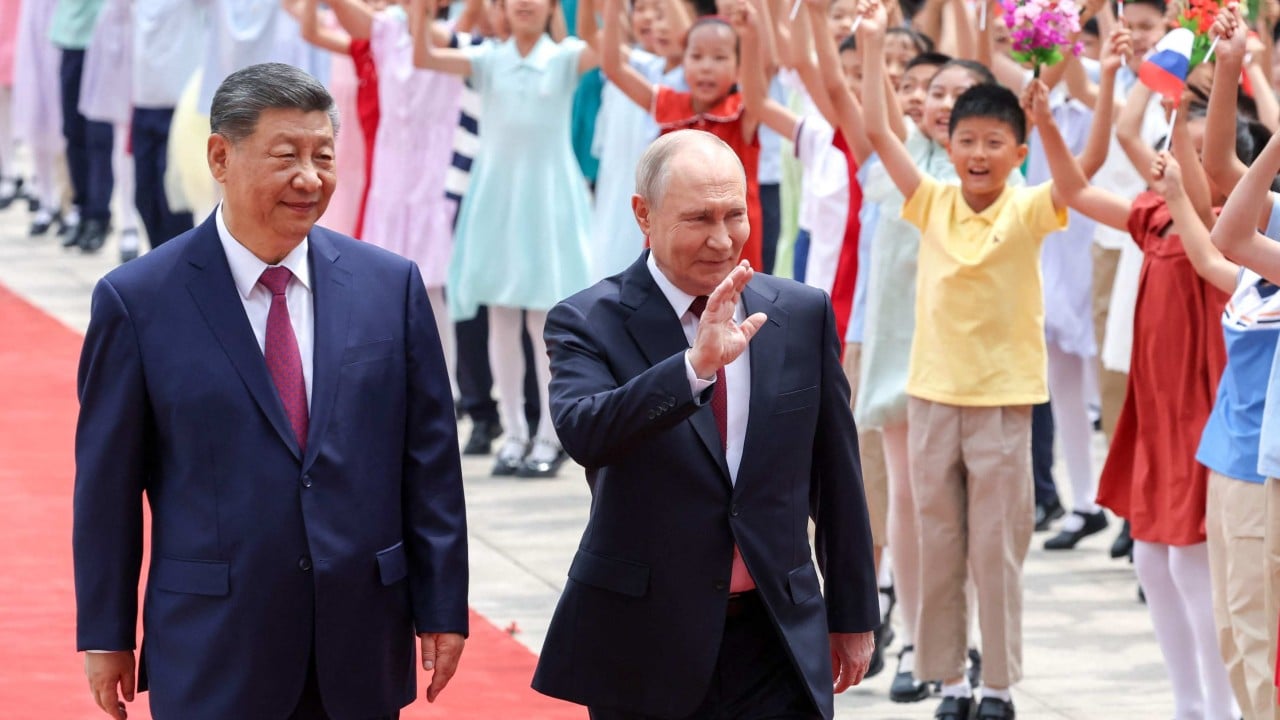
Foreign policy analysts are lazy. They see Donald Trump exit Beijing after exchanging pleasantries over centuries-old rose bushes, watch Vladimir Putin touch down four days later to toast the 25th anniversary of a friendship treaty, and immediately declare the birth of a new global order. The mainstream commentariat is currently obsessed with "trilateral coordination," spinning a fantasy of a neatly balanced Washington-Moscow-Beijing triangle managing global stability.
It is a comforting fiction. It is also completely wrong. In similar updates, read about: The Anatomy of Bipartisan Realignment: How the Beijing Summit Recalibrated Washington Capital Flows and Security Frameworks.
What the world witnessed this May is not the dawn of a three-way diplomatic consensus. It is a masterclass in aggressive, bilateral transactionalism masquerading as a triad. The establishment media looks at these back-to-back summits and sees a structural buffer against war. I have spent decades watching states negotiate multi-billion-dollar energy corridors and trade pacts; the reality is far uglier, more volatile, and highly fragmented. There is no triangle. There are only two desperate suitors trying to leverage a single, deeply cynical superpower.
The Flawed Premise of the Great Power Triangle
The current consensus argues that the tightly sequenced visits of the American and Russian presidents to China represent a "triumvirate" designed to regulate geopolitical rivalry. Pundits point to Trump’s floating of a trilateral nuclear arms control agreement and Putin’s soaring rhetoric about "unprecedented trust" as proof that the three capitals are building a framework to co-manage Eurasia and the Middle East. NPR has analyzed this fascinating topic in extensive detail.
This narrative fundamentally misunderstands the core motivations of all three actors. A true trilateral mechanism requires shared institutional goals or, at the very least, a mutual desire to maintain a static status quo. None of that exists here.
Let’s dismantle the players:
- Washington under Trump does not do multilateral institution-building. It views foreign policy through a ruthlessly transactional, bilateral lens. The White House explicitly stated its goal in Beijing was stabilizing two-way economic ties and preventing a trade war, not building a global governance board with Moscow.
- Moscow is not looking for balance; it is looking for economic survival. Crippled by Western sanctions, Russia’s bilateral trade with China rebounded toward a projected $260 billion this year. Putin did not fly to Beijing to coordinate with Trump; he flew there to ensure that Trump’s recent face-time with Xi did not dilute Russia's economic lifeline or undermine dual-use industrial supply chains.
- Beijing is the only true apex predator in this dynamic. Xi Jinping isn't hosting these leaders to form a club. He is running a classic hedging strategy, acting as the central clearinghouse for global grievances while keeping both rivals dependent on Chinese goodwill.
The Asymmetry Western Academics Ignore
To understand why trilateral coordination is a pipe dream, look at the staggering economic asymmetry that mainstream analysts conveniently ignore.
When Putin talks about a "strategic partnership," he is speaking from a position of profound vulnerability. The Power of Siberia 1 pipeline achieved full capacity at 38 billion cubic meters per year, and Moscow is desperately pushing for progress on the Power of Siberia 2 project to offset lost European markets. Russia has effectively locked itself into becoming Eurasia’s primary gas station, exporting raw hydrocarbons in exchange for Chinese consumer goods, digital finance infrastructure, and automotive components.
"I have seen companies blow millions trying to enter markets based on political declarations of 'eternal friendship.' They always get burned because they mistake a temporary convergence of grievances for a permanent economic alignment."
👉 See also: The Long Road to the Vistula
China knows Russia has nowhere else to go. Consequently, Beijing can afford to string Moscow along on gas pricing negotiations while simultaneously rolling out the red carpet for Trump to talk about tariff reduction and agricultural trade. This is not a balanced triangle. It is a hub-and-spoke model where China is the hub, and the US and Russia are competing spokes.
Dismantling the Nuclear and Regional Fallacies
The establishment media fell over itself praising Trump’s announcement that he proposed a trilateral nuclear arms cap and received a "positive response."
Let’s be brutally honest: a positive response in diplomacy means absolutely nothing. For China, agreeing to "the beginning of talks" is a zero-cost stalling tactic. Beijing is currently expanding its nuclear silo fields and has no intention of capping its arsenal at a level vastly inferior to the US or Russian stockpiles while it still faces a hostile security environment in the Western Pacific. The premise that a casual conversation in the Zhongnanhai gardens will translate into a binding three-way treaty is laughably naive.
The same delusion applies to regional conflicts like the Middle East. Analysts claim that because China remains Iran’s largest oil customer, Trump and Xi can co-manage the fallout of Western military actions. But China’s interest in Iran is commercial and anti-heggemonic; it has no desire to bail out American security commitments or pull Washington's chestnuts out of the fire.
The Perils of Hedging
The contrarian truth is that this hyper-bilateral dance makes the world far less stable, not more.
When a system relies entirely on transactional, back-to-back deals, transparency plummets. Putin spends his time in Beijing probing for leaks about what Trump said regarding Taiwan or Ukraine. Trump relies on personal spectacle and erratic declarations of respect to gauge Xi's intentions. China keeps its cards close to its chest, refusing to act as a formal mediator anywhere unless it receives an explicit, asymmetric advantage.
The downside to this fragmented approach is obvious: miscalculation. When there are no formal, trilateral guardrails, all sides are guessing. If Washington assumes its bilateral trade stabilizing deals give it a free hand to escalate pressure on Russia or Iran without a Chinese reaction, it will be blindsided when Beijing quietly ramps up dual-use exports to Moscow to keep the Americans distracted.
Stop asking if these summits will pave the way for a trilateral coordination mechanism. They won't. The real question is how long China can successfully play both sides against each other before the structural contradictions of the US-Russia-China rivalry force a messy, violent collapse of the entire board.