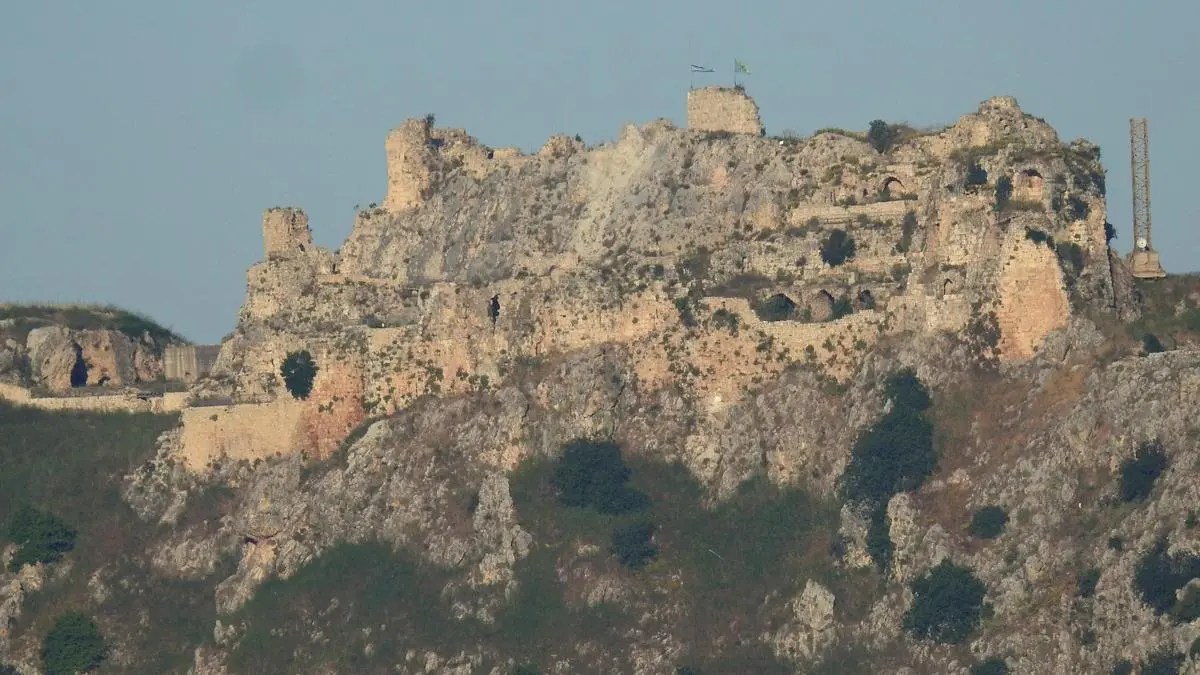
Israel has captured the 900-year-old Beaufort Castle in southern Lebanon, marking its deepest military push into the country in over a quarter-century and shattering a nominal six-week ceasefire. Large ground forces from the Golani, Givati, and 7th Brigades crossed the Litani River to seize the Crusader-era fortress, effectively establishing tactical control over the dominant heights of the Nabatiyeh region.
But this is not just another hill. For the Israeli military, returning to Beaufort Castle is a resurrection of a historic ghost that defined a generation of trauma.
The Geography of Command
Perched on a razor-sharp 300-meter cliff overlooking the Litani River, Beaufort Castle—known locally as Qalaat al-Shaqif—is a masterclass in medieval military architecture that still dictates 21st-century warfare. The site grants an unhindered view across the rolling hills of southern Lebanon and deep into upper Galilee.
From this vantage point, anyone with modern optics and an anti-tank guided missile system can paralyze troop movements for miles around. Hezbollah utilized this ridge precisely for that purpose, embedding launch sites and observation cells into the steep, rocky landscape.
The current Israeli advance represents a major shift. By moving past the Litani River, which long served as a red line for international diplomats, the Israel Defense Forces (IDF) are positioning forces to encircle Nabatiyeh, a critical economic and cultural center of southern Lebanon. The military has already ordered hundreds of thousands of civilians to evacuate further north, past the Zahrani River, signaling that this is not a temporary raid but the formation of a massive new security zone.
The Ghosts of 1982
To understand why the Israeli political right is celebrating the capture as a correction of "national sins," one must look back to June 1982. During the opening hours of the First Lebanon War, taking Beaufort from the Palestine Liberation Organization was deemed a paramount psychological objective by then-Defense Minister Ariel Sharon.
The assault was handed to the elite Golani Reconnaissance Unit. They fought their way up the narrow, heavily fortified trenches in pitch darkness. Six commandos died in the assault, including the unit's charismatic leader, Major Goni Hernik.
The victory was instantly poisoned by politics. Prime Minister Menachem Begin visited the summit the next morning, famously asking if the terrorists had "machine guns" and incorrectly reporting to the public that the stronghold had been taken without Israeli casualties. The gap between the harsh reality on the mountain and the political theater in Jerusalem birthed the modern Israeli anti-war movement.
The Axis of Blood
Between 1985 and 2000, Beaufort transformed from a tactical prize into a meat grinder. The fortress became an isolated, heavily fortified IDF outpost surrounded by a hostile population and a rapidly evolving Hezbollah.
The single, winding asphalt road leading up to the castle became known to a generation of conscripts as the "Axis of Blood." Roadside bombs, mortar barrages, and Sagger missiles turned routine supply convoys into lethal gauntlets. Inside the concrete bunkers built around the medieval stone, soldiers lived under constant subterranean anxiety, listening for the sound of Hezbollah sappers digging tunnels underneath their feet.
When Israel hastily withdrew from Lebanon in May 2000, the military engineers did not just pack up. They packed the Israeli-built concrete outposts with tons of explosives and blew them into dust, determined to deny Hezbollah a ready-made victory photo on the ramparts.
Historical Occupiers of Beaufort Ridge:
├── 12th Century: Crusaders (Built original fortress)
├── 1190: Saladin's Army
├── 1268: Mamluks (Sultan Baibars)
├── 1976: Palestine Liberation Organization (PLO)
├── 1982: Israel Defense Forces (First Occupation)
└── 2026: Israel Defense Forces (Current Incursion)
The Illusory Security Zone
The return to the ridge exposes a deep rift within Israel’s military establishment regarding the ultimate goal of the operation. While Defense Minister Israel Katz hailed the capture as a permanent shield for Galilee communities, veteran analysts see a dangerous repetition of history.
Military historians point out that holding high ground looks excellent on a map but requires an immense, continuous expenditure of blood and material to sustain. A stationary outpost on a ridge eventually becomes a fixed target for asymmetric warfare. Hezbollah’s tactical playbook relies on letting an armored adversary advance into dominant positions, only to bleed their supply lines through decentralized ambush squads operating from the valleys below.
Furthermore, the operation complicates an already fragile geopolitical landscape. The nominal ceasefire brokered in April has completely collapsed, and the push north toward the Zahrani River threatens to completely derail ongoing direct talks between regional powers in Washington.
The flags flying over the Crusader ruins provide a potent image of battlefield success for domestic consumption. Yet, the tactical reality remains unchanged since 1139. Winning the ridge is an achievement of engineering and firepower; surviving the occupation of the valley below is an entirely different war.