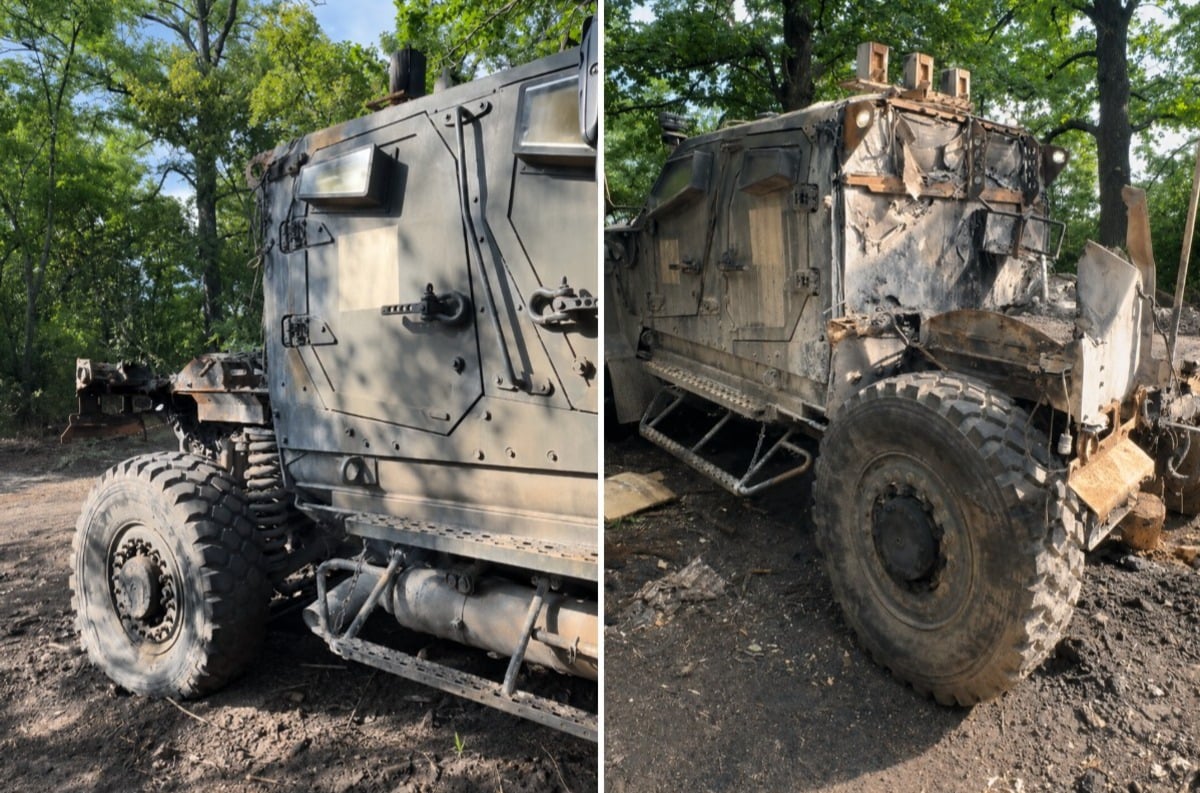
A Russian FPV drone screaming toward a vehicle at seventy miles per hour usually means death. But when a loitering munition slammed directly into a U.S.-built Oshkosh M-ATV carrying Ukrainian infantrymen recently, something else happened. The soldiers walked away without a scratch. The vehicle took the blast, sustained heavy exterior damage, and kept its cabin perfectly intact.
Many military analysts spent the last few years claiming that heavy armor is dead. They argued that cheap, tiny drones made massive armored vehicles obsolete. This strike proved them completely wrong. When cheap explosives meet specialized military engineering, the physics of armor still dictate who lives and who dies.
The reality on the ground in Ukraine shows that light civilian transport is a death trap. Troops need real blast protection. The survival of this crew highlights a massive lesson for modern tactical warfare.
The Moment of Impact and Why the Crew Walked Away
The drone struck the vehicle during a daylight movement near the frontline. These small, explosive-laden quadcopters target vulnerable spots like windows, engine bays, or rear doors. In this specific incident, the drone targeted the side upper hull, hoping to penetrate the crew compartment.
It failed completely. The explosive detonated against the exterior skin, scattering shrapnel across the chassis but failing to punch through the main compartment.
You can buy a drone for five hundred dollars. You cannot buy the decades of engineering required to survive a blast with five hundred dollars. The crew inside experienced a massive shockwave, a deafening noise, and a cloud of smoke. They did not experience shrapnel tearing through their bodies. The vehicle did exactly what it was built to do. It sacrificed its outer components to save human lives.
Tactical movements under constant aerial surveillance require vehicles that can take a punch. If these soldiers had been riding in a standard pickup truck or a civilian van, the explosion would have turned the thin sheet metal into deadly shrapnel. The internal blast pressure alone would have killed everyone inside. Instead, the heavy armored frame absorbed the kinetic energy.
The Anatomy of Oshkosh Engineering
The M-ATV is not just a modified truck. It is a highly specialized Mine-Resistant Ambush Protected vehicle designed during the height of the war in Afghanistan. The United States military needed a platform that combined the off-road agility of a Humvee with the heavy blast survival capabilities of massive MRAPs. Oshkosh defense delivered a machine built around survival mechanics.
The Power of Plasan Composite Armor
The core defense of the M-ATV relies on a specialized armor capsule designed by Plasan. This composite system uses layers of high-hardness steel, ceramic materials, and advanced composites.
- Layered Dissipation: When an explosive jet or shrapnel hits the outermost layer, the hard material deforms or shatters the incoming projectile.
- Energy Absorption: The inner composite layers catch the residual fragments and absorb the remaining energy before it reaches the interior.
- Spall Prevention: Standard steel armor can flake off on the inside when hit, sending hot metal fragments flying into the crew. Composite armor stops this entirely.
This design gives the vehicle the unique ability to withstand directional blasts from anti-tank weapons and drone-dropped shaped charges.
Deflecting Energy with V Shaped Hulls
Drones do not just attack from the top. They often fly low to hit the sides or detonate underneath vehicles. The M-ATV features a pronounced V-shaped hull beneath the chassis.
This shape is mathematically optimized to redirect explosive forces outward and away from the crew cabin. Instead of allowing the blast wave to push directly upward through the floorboard, the angled armor forces the pressure wave to escape through the sides. It protects the legs and spines of the soldiers sitting inside.
The Role of Specialized Blast Seats
People forget that the shockwave itself can kill you even if shrapnel does not pierce the armor. The sudden upward acceleration of a vehicle during a blast can break a soldier's spine or cause severe internal bleeding.
The M-ATV solves this by using suspended blast seats. These seats are not bolted directly to the floor. They hang from the ceiling or attach to the side walls using energy-absorbing attenuation mechanisms. When an explosion occurs, the seat strokes downward, compressing a specialized shock absorber that limits the G-forces transferred to the human body.
The Dangerous Illusion of the Cheap Frontline Vehicle
A weird theory gained popularity in some military circles over the last two years. Some argued that because drones see everything, soldiers should ditch heavy armor entirely. The logic was that if you are going to get spotted anyway, you might as well drive a fast, unarmored civilian car or an open buggy. They thought speed would save them.
That theory is a dangerous illusion. Speed does not protect you from an FPV drone that flies at ninety miles per hour and can hunt you down through trees.
Using unarmored vehicles like the Lada Niva or old European delivery vans for front line transport is a desperate measure, not a sound strategy. These vehicles offer zero protection against shell fragments, sniper fire, or small loitering munitions. A single drone strike on a soft-skinned civilian van results in total catastrophic loss of life.
Heavy military vehicles like the M-ATV provide a buffer against the chaotic reality of artillery-heavy battlefields. They allow troops to make mistakes, survive ambushes, and keep moving forward.
Adapting Western Iron to the Drone Threat
The M-ATV was designed to fight insurgencies in desert environments. It was not originally built to counter thousands of kamikaze quadcopters buzzing in the skies of Eastern Europe. To keep these vehicles effective, Ukrainian forces are adapting them on the fly.
Electronic Warfare Integration
Armor alone is no longer a complete defense system. To survive in modern combat zones, armored vehicles must carry their own localized electronic warfare systems.
Small, vehicle-mounted jamming pods are now common additions to the roofs of these vehicles. These jammers broadcast static signals across the common radio frequencies used by commercial drones. When an FPV drone flies within fifty meters of a jammed vehicle, its video feed cuts out, or it loses connection with its operator, causing it to crash harmlessly into the dirt.
Structural Modification and Drone Cages
Soldiers frequently weld metal mesh cages, often called cope cages, over the top and sides of the vehicle. These cages create a standoff distance.
When a drone hits the metal grid, its contact fuze detonates the explosive payload several feet away from the main armor plating. This simple physical barrier prevents shaped-charge jets from forming correctly, drastically reducing their ability to burn through the Plasan composite layers.
The Real Logistics of Saving Lives
Military victory requires keeping trained soldiers alive. Replacing a vehicle is expensive, but replacing a highly experienced squad of combat veterans is impossible. The M-ATV that absorbed the Russian drone strike might need weeks of depot repairs, or it might be a total loss. That does not matter. The vehicle did its job because the infantrymen inside lived to fight another day.
Western military aid to Ukraine faces constant political and logistical hurdles. Discussions often focus heavily on long-range missiles, fighter jets, and main battle tanks. Those systems are incredibly important for offensive operations.
Tactical transport vehicles like the M-ATV, the MaxxPro, and the Stryker form the day-to-day backbone of battlefield survival. Providing hundreds of these protected platforms directly impacts casualty rates. They give units the confidence to conduct medical evacuations, transport ammunition, and rotate troops under the constant eye of enemy reconnaissance drones.
Moving forward, defense planners need to prioritize heavy tactical mobility. The age of unarmored logistics near the frontline is completely over. Every utility vehicle, ambulance, and transport truck operating within fifteen kilometers of the contact line needs an armored capsule, a V-shaped hull, and an integrated electronic jammer.
If you want your troops to survive the next evolution of mechanized warfare, you build heavier hulls, you install better blast seats, and you stop relying on unarmored commercial workarounds. The physics of survival have not changed. Armor works.


