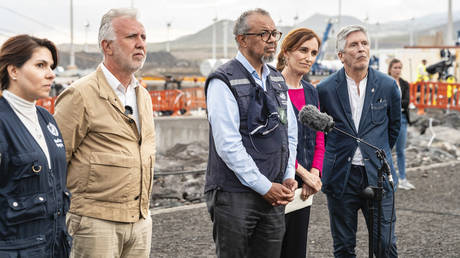
The World Health Organization (WHO) isn’t usually in the business of public call-outs when it comes to US domestic health policy. But the recent decision to fly American passengers from the hantavirus-stricken M/V Hondius cruise ship directly to Nebraska has raised some very serious eyebrows in Geneva. WHO Director-General Tedros Adhanom Ghebreyesus has been uncharacteristically blunt, suggesting that the US approach to handling these passengers carries inherent risks that might have been avoided with stricter adherence to international protocols.
Honestly, it’s a bit of a mess. While the US government is framing this as a routine "safe repatriation," the science of the Andes virus—the specific strain involved here—tells a much more complicated story.
Why the Andes Strain Changes Everything
Standard hantavirus is scary but predictable. You usually catch it by breathing in dust contaminated with rodent droppings. It doesn't jump from person to person. But the Andes virus (ANDV) is the "black sheep" of the family. It’s the only known hantavirus strain that can spread through human-to-human contact.
We’ve seen this before in places like Argentina, where family clusters and healthcare workers became the secondary wave of an outbreak. On a cruise ship like the M/V Hondius, where people are breathing the same air and sharing tight spaces for weeks, the risk profile shifts from "rare accident" to "contained cluster."
The US plan involves taking 17 Americans from the Canary Islands and flying them to Offutt Air Force Base in Omaha, then moving them to the National Quarantine Center. On paper, that sounds secure. But the WHO chief's concern stems from the 42-day incubation and monitoring period. The US has historically been a bit loose with "monitored home isolation" compared to the strict facility-based quarantine the WHO often prefers for high-risk, human-to-human pathogens.
The Logistics of a High-Stakes Flight
Think about the mechanics of this repatriation. You’re moving people who have been exposed to a virus with a roughly 38% case fatality rate. One American passenger has already tested positive. Even if they're asymptomatic now, the Andes virus is famous for a "honeymoon phase"—a period where the patient feels fine before their lungs suddenly fill with fluid.
- The Incubation Gap: Symptoms can take up to eight weeks to show up.
- The Transmissibility Window: We still don't fully know exactly when a person becomes contagious.
- The Treatment Void: There’s no vaccine. There’s no "magic pill" antiviral. It’s just intensive supportive care and hoping the ventilator does its job.
The WHO’s frustration basically boils down to the fact that the US is operating on its own "risk assessment" while the rest of the world is trying to follow a unified playbook. When a superpower decides to shortcut the recommended monitoring period or move high-risk individuals across oceans, it creates a precedent that other, less-equipped nations might try to follow.
Nebraska is the Best-Case Scenario (And it’s Still Risky)
If you're going to have an outbreak of a rare respiratory virus, you want to be near the University of Nebraska Medical Center. They’re the best in the world at this. They handled Ebola, and they’ll handle this. But the WHO chief’s point isn't about the quality of the doctors in Omaha; it's about the travel itself.
Every time you move a potentially infected person—through an airport, on a bus, or in a plane—you increase the "surface area" for a mistake. A seal breaks. A protocol is skipped because of fatigue. A staff member touches their face. These aren't just "what ifs"; they’re the reality of bio-containment.
The CDC claims the risk to the public is "extremely low." They’re probably right. But "low risk" isn't "no risk," and the WHO is essentially asking why the US is taking any gamble at all when the ship was already docked in a location with medical capacity in the Canary Islands.
What This Means for You
You aren't going to catch hantavirus at the grocery store. This isn't COVID-19. It doesn't stay in the air for hours or spread through casual contact at the mall. It requires "prolonged, close contact."
But you should be watching how this plays out for two reasons. First, it shows a growing rift between US health authorities and the WHO. Second, it highlights how vulnerable our "closed-loop" travel systems—like cruise ships—really are to rare pathogens.
If you’ve traveled recently or have family returning from South America, keep a pulse on these symptoms:
- Sudden high fever and muscle aches (especially in the thighs and back).
- Intense headaches and "heavy" fatigue.
- Rapidly developing shortness of breath after a few days of feeling "flu-ish."
If you’re a traveler, don't panic, but do stay informed. If you were on the M/V Hondius or were in close contact with someone who was, you need to be in active communication with your local health department. Don't wait for them to call you. The 42-day clock is ticking, and in the world of Andes virus, early intervention is the only thing that moves the needle on survival.
The US government is betting on its infrastructure to prevent a leak. The WHO is betting that the virus is more unpredictable than the infrastructure is strong. We’re about to find out who’s right.