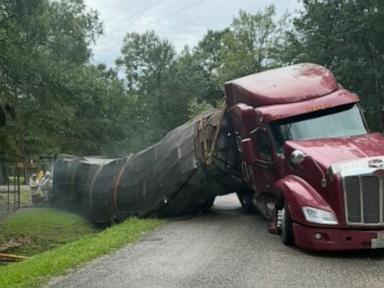
A commercial semitrailer carrying over 40 million honeybees overturned on a Texas highway, releasing a massive, stinging cloud into a nearby residential neighborhood. Emergency crews scrambled to contain the millions of displaced insects, exposing a fragile supply chain that the American agricultural system relies on every single day. While local news outlets focused on the immediate chaos of the swarm, the real story lies in the staggering vulnerability of commercial pollination logistics. This incident is not an isolated freak accident. It is the predictable result of a high-stakes, under-regulated transit network that moves billions of stressed biological assets across state lines to keep the food supply from collapsing.
The Invisible Pipeline Keeping Grocers Stocked
Most consumers view honeybees as localized backyard inhabitants or wild forest dwellers. The reality is starkly industrial.
Modern agriculture requires the rapid, synchronized pollination of massive monoculture crops. To meet this demand, commercial beekeepers load thousands of wooden hives onto flatbed tractor-trailers, driving them thousands of miles under the cover of night.
The California Connection
Consider the annual almond bloom in California, which requires roughly 2 million colonies—nearly 70% of all commercial bees in the United States.
- The Timeline: Every February, hives travel from Florida, Texas, and the Midwest to California.
- The Scale: A single flatbed trailer routinely carries 400 to 500 hives, housing up to 20 million bees.
- The Risk: A single driver fatigue incident or tire blowout can instantly liquefy a multimillion-dollar agricultural asset.
When these trucks crash, the immediate response is containment, often involving local fire departments spraying foam or water to ground the bees. For the commercial beekeeper, this means total financial ruin. Insurance policies for live cargo are notoriously complex, expensive, and riddled with exclusions regarding transit stress and heat exhaustion.
Why These Trucks Are Moving Targets
The physics of transporting live stinging insects requires constant motion. Honeybees generate an immense amount of metabolic heat inside a tightly packed hive cluster.
[Constant Forward Motion] -> Forces Air Through Tarps -> Cools Hive Core
[Truck Stalls or Crashes] -> Airflow Stops -> Hives Overheat within Minutes -> Bees Panic and Escape
If a truck stops for more than a brief fuel break during a hot day, the internal temperature of the hives can skyrocket above 100°F. The wax melts. The brood dies. The bees suffocate in their own honey.
Because of this biological constraint, drivers face immense pressure to keep moving. Federal Hours of Service regulations dictate when a truck driver must rest, but these rules do not account for the needs of live, heat-generating insects. A driver caught in a traffic jam or forced into a mandatory rest break faces a grim choice: violate federal law or watch their cargo cook alive.
Regulatory Blind Spots
The Department of Transportation classifies bees as agricultural cargo, granting certain exemptions regarding transport distance limits during harvest seasons. However, these exemptions fail to address the core safety issue. The drivers are often independent contractors operating on razor-thin margins. They pilot top-heavy loads secured only by nylon straps and specialized netting. When a vehicle swerves, the shifting weight of hundreds of loose wooden boxes creates a pendulum effect that easily flips a rig.
The Economic Sting of a Single Crash
The loss of millions of bees in Texas reverberates far beyond the borders of that neighborhood. The agricultural sector operates on a razor's edge regarding pollination capacity.
When a shipment is destroyed, the immediate loss includes the physical equipment, the queen bees, and the thousands of dollars spent feeding the colonies through the winter. The secondary loss hits the farmers who contracted those specific hives months in advance.
Truck Crash -> Immediate Colony Death -> Missed Pollination Window -> Lower Crop Yields -> Higher Consumer Prices
Without those bees, crop yields drop dramatically. Blueberries, apples, melons, and almonds depend entirely on the precise arrival of these migratory apiaries. A shortage of available hives drives up rental fees for farmers, a cost that eventually registers on supermarket price tags.
The Strained Safety Net
Local municipalities are utterly unequipped to handle insect hazardous materials. Small-town fire departments lack the specialized veils, smokers, and heavy-duty vacuums required to safely clear a highway.
In many cases, the only viable option to protect public safety is the mass extermination of the surviving bees using soapy water or firefighting foam. This creates a tragic paradox. The very creatures we rely on to sustain our food systems are treated as toxic spills the moment human error compromises their transit.
The Industrialization of a Biological Necessity
The reliance on long-haul trucking to move pollinators highlights a deeper systemic failure in American farming. By replacing diverse regional ecosystems with vast expanses of single-crop fields, agriculture has eliminated native pollinator populations.
Farmers can no longer rely on local wild bees because there is nothing for those bees to eat for ten months out of the year. This creates a permanent dependence on the migratory bee network.
We have turned a biological process into a long-haul trucking industry. Until the underlying agricultural model shifts toward regional diversity and reduced reliance on massive monocultures, these highway disasters will remain a recurring cost of doing business. The Texas crash was not a freak occurrence; it was a symptom of a food system running on empty.