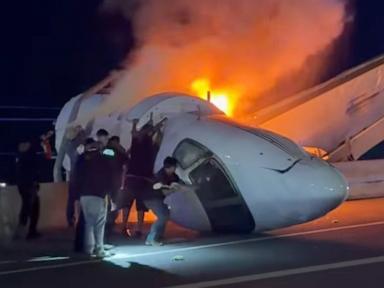
A multi-million dollar private jet lies snapped in half across a concrete barrier on a dark Texas highway, its fuel tanks feeding a rising wall of fire. Five people are trapped inside a pressurized aluminum tube filling with toxic smoke, screaming for help through a door that will only pop open an inch.
When Ivan Franco stopped his tow truck on Loop 20 in Laredo, Texas, he did what any decent human being would do. He grabbed a heavy sledgehammer from his truck's emergency kit and ran directly toward the fire. Beside him, other passing motorists swung shovels and automotive tools against the cockpit windows.
They thought they could smash the glass. They were entirely wrong.
The frantic rescue on June 16, 2026, which ultimately saved five lives but tragically cost the life of Texas tech leader Joshua Baer, exposed a terrifying truth about modern aviation safety. The public is fundamentally unprepared for how corporate aircraft are built, and the tools we rely on in everyday emergencies are useless against the armored engineering of modern aviation glass.
The Illusion of the Shatter Effect
When Franco and other motorists began slamming their tools into the windshield of the Cessna Citation Latitude, they expected the glass to spiderweb and cave in, much like a standard car windshield.
Instead, the sledgehammer bounced off. The shovel did little more than leave faint white surface scratches.
Modern business jet windshields are not just thick glass. They are highly engineered, multi-layered structural components designed to withstand bird strikes at 250 knots and maintain extreme pressure differentials at 45,000 feet.
The Composition of High-Altitude Glass
An aviation windshield is typically built like a dense, transparent sandwich:
- The Outer Layer: A thin pane of chemically strengthened glass or stretched acrylic, coated with hydrophobic materials and anti-icing gold film.
- The Interlayer: A thick, highly resilient sheet of polyvinyl butyral (PVB) or polyurethane that absorbs massive kinetic impacts.
- The Inner Layer: A heavy-duty structural layer of tempered glass or polycarbonate designed to hold the aircraft’s cabin pressure.
When a 20-pound sledgehammer hits this array, the inner polyurethane layers flex and absorb the kinetic energy, dispersing it across the entire frame. You cannot breach a pressurized cockpit with standard hand tools.
The survivors did not escape because the windows broke. They escaped because the rescuers, working through heavy smoke, physically strained to lever the jammed main cabin door open far enough for three teenagers and two pilots to squeeze through.
The Problem with Private Fleet Safety Culture
The aircraft involved was operated by NetJets, a fractional ownership giant. The flight had departed the resort city of San José del Cabo and was bound for Austin when the pilots reported structural or mechanical anomalies and requested an emergency diversion to Laredo.
While commercial airlines operate under massive logistical oversight and rigid airport-bound safety corridors, private business aviation increasingly intersects with public infrastructure. When a private jet suffers a critical system failure, it doesn't always happen over a runway. Sometimes, it happens on a state highway, turning commuting motorists into immediate, untrained first responders.
Private jets present unique hazards that ordinary citizens do not understand:
- Composite Materials: Modern fuselages use carbon-fiber reinforced polymers. When these burn, they release highly toxic microscopic fibers and hydrogen cyanide gas.
- High-Pressure Oxygen: Business jets carry dedicated oxygen systems for passengers and crew. If fire reaches these lines, the localized atmosphere turns into a literal blowtorch.
- Unspent Fuel Load: Unlike commercial liners that can dump fuel, smaller business jets often land heavy, carrying thousands of pounds of highly volatile Jet-A fuel just inches from the cabin floor.
The Blind Spot in Emergency Response
The Laredo miracle—as the local mayor rightly called it—succeeded because of raw, unadulterated human courage, not technical capability. Five police officers were hospitalized for smoke inhalation simply because they lacked the specialized breathing gear needed to fight a composite aircraft fire, yet they refused to step back.
This brings a glaring vulnerability to light. Municipal first responders and highway patrols are routinely trained for automotive extractions, but few receive training on how to handle an emergency landing on a public road.
Standard hydraulic shears used by fire departments to cut through car pillars struggle against the titanium and advanced alloy frames of modern business jets. If the door on that Cessna had been completely deformed by the barrier impact, the tools brought by both civilians and initial police units would have been entirely incapable of cutting a hole into the fuselage before the cabin flashed over.
We rely on the bravery of strangers to fill the gaps left by structural flaws in transit safety, assuming our tools will work when history demands it.
Good Samaritan recognized for helping plane crash survivors near North Perry Airport provides a firsthand look at a separate incident where everyday citizens had to act as immediate first responders, underscoring how often the public is thrust into these high-stakes aviation emergencies without specialized training.


