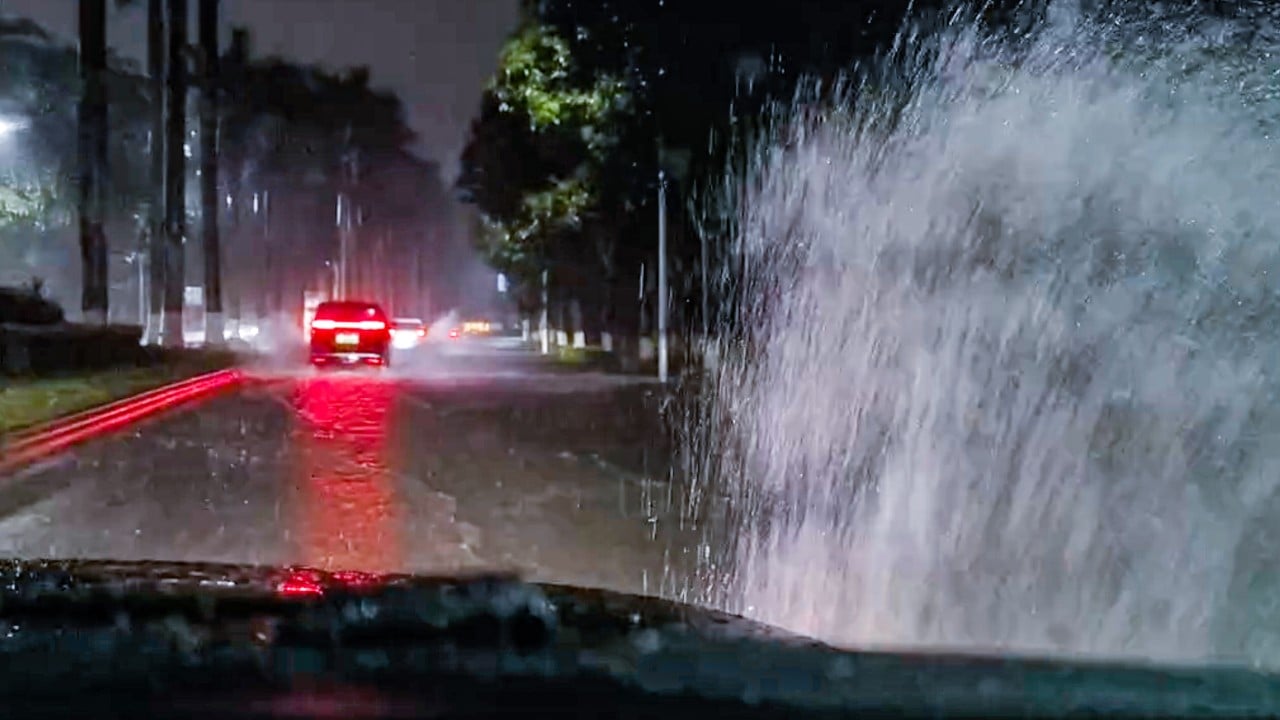
The smell of a subtropical downpour is usually a relief. In Hong Kong, when the heavy summer air gets too thick to breathe, the rain cuts through the humidity like a cool blade. But on a Tuesday afternoon in the northern New Territories, the rain didn’t bring relief. It brought a heavy, suffocating weight.
Within hours, the sky turned the color of bruised iron. The Hong Kong Observatory issued a black rainstorm warning—the highest level of alert, meaning more than 70 millimeters of rain had fallen in an hour, and more was screaming down from the clouds.
To understand the New Territories is to understand a world far removed from the neon-drenched skyscrapers of Central or Tsim Sha Tsui. This is Hong Kong’s rural spine. It is a place of low-lying villages, ancestral farmlands, small container yards, and fish ponds tucked beneath the shadows of steep, green mountains. When a black rainstorm hits this specific topography, those beautiful mountains stop being a backdrop. They become a funnel.
The Speed of Rising Yellow
Consider a hypothetical resident named Mr. Chan. He is sixty-four, a retired mechanic who keeps a small patch of vegetables near his home in Yuen Long. He knows the rhythms of the rainy season. He has seen typhoons. He has seen summer storms that turn the roads into shallow streams.
But this was different.
The water didn't rise from the ground. It seemed to rush in from everywhere at once, a sudden, mocha-colored tide carrying plastic crates, tree branches, and the debris of a hundred small workshops. Within thirty minutes, the narrow alleyways of his village were waist-deep.
Step into that water in your mind. It isn't just wet. It is heavy, thick with topsoil, and deceptively fast. It pulls at your ankles with a terrifying, silent strength. The concrete paths that usually guide you home vanish beneath a murky, opaque mirror. You cannot see where the path ends and a deep drainage ditch begins. One wrong step means disappearing.
The sheer volume of water that fell across Fanling, Sheung Shui, and Yuen Long was staggering. For decades, Hong Kong has prided itself on some of the most sophisticated urban drainage systems in the world. Massive underground attenuation tanks, miles of concrete nullahs, and tunnels bored through volcanic rock designed to intercept water before it hits the city.
Yet, nature possesses a brutal math that laughs at human engineering.
When the saturation point of the soil reaches absolute maximum, the earth can no longer hold a single drop. The hillsides become slick, hydrophobic slides. Every drop of rain that falls on the peaks immediately cascades downward, gathering speed and volume, seeking the lowest point. In the northern New Territories, that lowest point is often someone's living room.
The Invisible Loss Behind the Headlines
The mainstream news reports the facts cleanly: Fourteen instances of flooding reported. Three roads closed. Emergency services deployed.
Those numbers are dry. They lack a pulse.
They do not capture the sound of a refrigerator short-circuiting with a loud, final pop, leaving a family in the dark as water laps against their kitchen counters. They do not capture the smell of ruined drywall and damp upholstery that lingers for weeks, a moldy ghost that refuses to leave.
For the farmers of the New Territories, the damage is measured in heartbeats and history, not just infrastructure. The local agricultural sector in Hong Kong is small but fiercely proud, producing high-quality local vegetables for a city that imports almost everything else. When fields are submerged under three feet of muddy water for twelve hours, the crops suffocate. The roots rot. Months of backbreaking labor under a brutal sun dissolve into a gray slime in a matter of afternoon hours.
Then there are the animals.
In the low-lying areas of New Territories, stray dogs and cats, along with those kept in rural animal shelters, face a desperate scramble for survival. Volunteers often find themselves wading through chest-high water, lifting terrified, shivering dogs onto floating plastic tables or roofs, praying the rain stops before the makeshift rafts give way. It is a frantic, chaotic race against a clock ticked out by falling raindrops.
The Changing Anatomy of the Storm
We often talk about extreme weather as a future threat, a problem for the next generation to solve.
That is an illusion.
The reality is that the atmosphere is changing now. A warmer atmosphere holds more moisture. It is a simple physical law. For every degree Celsius of warming, the air can hold roughly seven percent more water vapor. This means the storms of today are fundamentally different from the storms of thirty years ago. They are denser. They are more volatile. They dump a month’s worth of water in the span of a morning commute.
The infrastructure built in the late twentieth century was designed for a world that no longer exists. Even Hong Kong’s world-class engineering is pushed to its absolute limits when the sky opens up with this level of ferocity. The concrete channels that crisscross the New Territories, built to carry water safely to the sea, look like roaring, terrifying rivers during a black rainstorm. They brim to the very edge, white water churning and spitting foam against the pedestrian railings.
But the real problem lies elsewhere, deep in the unintended consequences of rapid development.
Over the past few decades, parts of the New Territories have transitioned from green fields to paved container storage sites, open-air car parks, and brownfield operations. Concrete does not breathe. Concrete does not absorb water. Every square meter of land that is paved over removes a natural sponge from the ecosystem. The water has nowhere to go but into the old villages that have stood for centuries, villages that rely on the surrounding earth to absorb the shock of the summer monsoons.
When the Rain Stops
The true test of a community doesn't happen when the storm is raging; it happens when the warning signals are lowered and the sky clears to a pale, washed-out blue.
As the flash floods recede, they leave behind a thick, slick coat of gray mud over everything. It coats the streets, the floors of homes, the steps of ancestral halls. It dries quickly under the returning tropical heat, turning into a fine, choking dust that gets into the back of your throat.
Residents emerge with brooms, buckets, and hoses. There is an unspoken, weary solidarity in the air. Neighbors who rarely speak during the dry months exchange tools, help lift heavy, water-logged sofas onto the sidewalks, and clear debris from blocked storm drains so the next downpour has a clear path.
The emergency services move out, their orange trucks rumbling away, leaving the locals to face the quiet, exhausting aftermath of restoration. It is a cycle of resilience that is becoming far too frequent.
Standing in the damp quiet of a post-flood evening, looking at the high-water mark stained onto a brick wall three feet above the ground, you realize that these events are no longer anomalies. They are the new baseline. The relationship between Hong Kong's wild, mountainous geography and its human inhabitants is being rewritten by a changing climate, one torrential afternoon at a time. The hills will turn to water again; the only question is whether the land below will be ready to catch it.