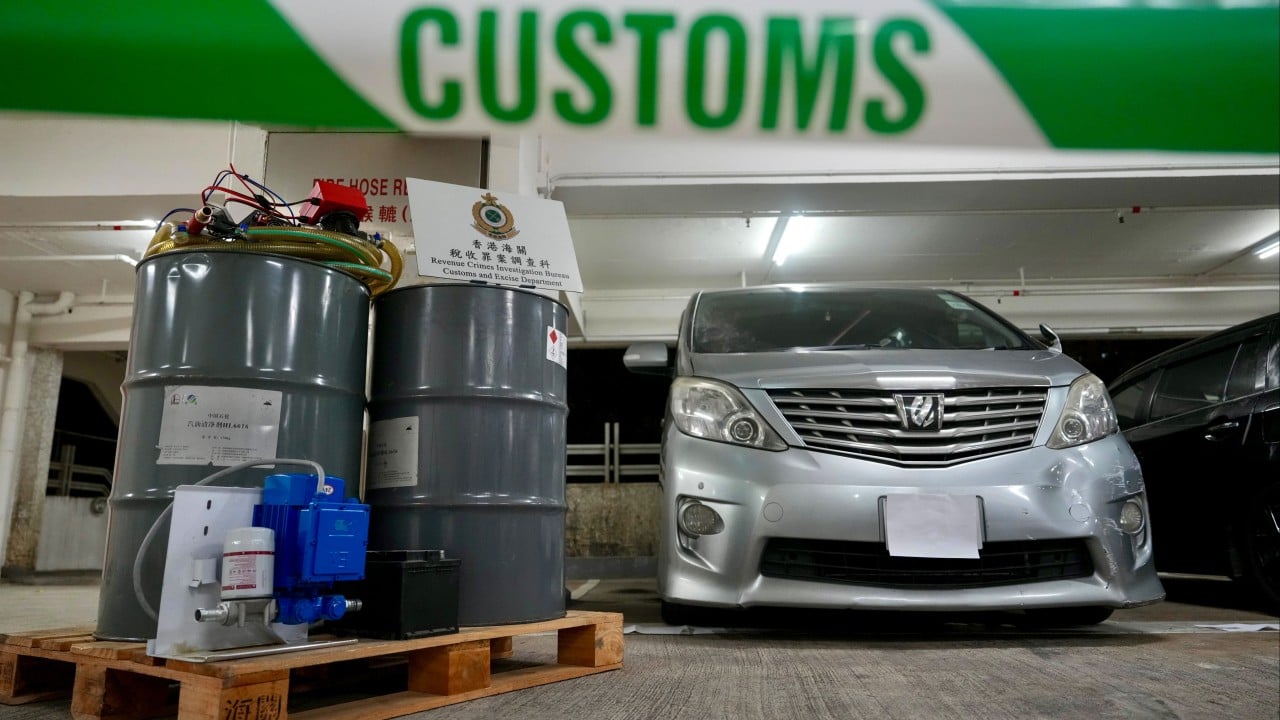
The headlines are predictable. The police raid a "syndicate." Two men are arrested. A few thousand liters of diesel are seized. The media paints a picture of a dangerous underground criminal ring endangering neighborhoods.
They are lying to you by omission.
What the authorities call a "raid on an illegal fuel station," an economist would call a grassroots correction to a broken, monopolistic energy market. Those "illegal" pumps in Tsing Yi or New Territories aren't just there to dodge taxes; they are the only reason some logistics businesses in this city are still breathing.
When you see a pump in a back alley, you aren't looking at a crime scene. You are looking at a desperate, functional protest against a fuel tax regime and a corporate cartel that has strangled the transport sector for decades.
The Myth of Public Safety
The standard narrative relies on fear. We are told these makeshift stations are ticking time bombs, lacking the "stringent safety standards" of the big-brand stations.
Let's dismantle that.
The physical act of transferring diesel from a tank to a truck is not rocket science. It’s a basic mechanical process that has been performed safely in industrial settings for over a century. The "danger" is a convenient rhetorical tool used to justify the protection of tax revenue. If the government actually cared about the safety of these operations, they would provide a pathway for low-cost, decentralized licensing. They don't. They want the $2.89 (HKD) per liter tax on petrol, and they want the massive land premiums paid by the five major oil companies that control every street corner.
The irony? Diesel for commercial use in Hong Kong is technically duty-free, yet the "official" pump price remains staggeringly high compared to the wholesale cost of "marked" or industrial oil. The "illegal" stations are simply bridging the gap that the big players refuse to close because their overhead—bloated by astronomical land costs—won't allow it.
The Cartel in Plain Sight
Hong Kong is a city that prides itself on free-market capitalism, yet its fuel market is one of the most opaque, rigid oligopolies on the planet.
Why do all the major stations change their prices at the exact same time? Why is the gap between Brent Crude fluctuations and the price at the pump in Shatin so wide and slow to close? The Competition Commission has flirted with these questions for years, producing toothless reports that acknowledge "highly similar" pricing while doing nothing to break the stranglehold.
The "illegal" operator is the only true competitor in the room. They have no marketing budget. They have no loyalty cards. They offer one thing: a price that reflects the actual value of the commodity rather than the inflated value of the real estate beneath the pump.
When the government "cleans up" these sites, they aren't protecting you. They are protecting the margins of multi-billion dollar corporations and ensuring that the high cost of living in Hong Kong remains mandatory.
The Taxman’s Shell Game
Let’s talk about "marked oil"—the red-dyed diesel intended for industrial or marine use. It is chemically identical to the stuff you put in a truck, but it’s sold at a fraction of the price because it’s meant for "production."
By criminalizing the use of this fuel in road vehicles, the state creates an artificial scarcity. They are effectively telling the local delivery driver, the construction worker, and the logistics SME that they must pay a premium for the exact same molecule because of the "intent" of the use.
Imagine a scenario where the government taxed electricity differently based on whether you were charging a phone or a laptop. You would call it insanity. In the fuel market, we call it "regulation."
These raids are a tax enforcement mechanism disguised as a public service. By arresting the "operators" of these stations—often just working-class guys trying to facilitate a secondary market—the state is signaling that any attempt to bypass the official toll booths of the economy will be met with force.
The Logistics Death Spiral
Hong Kong’s status as a premier logistics hub is rotting from the inside out. Shipping costs are soaring, and the middle class is being squeezed by the rising cost of goods—a rise directly linked to the cost of transport.
A small trucking fleet operating on thin margins cannot survive $20-per-liter fuel. When a driver goes to an "illegal" station, he isn't trying to fund a criminal empire. He is trying to ensure that his take-home pay after a 12-hour shift is more than a bowl of noodles and a parking fine.
By removing these low-cost fuel options, the government is effectively slapping a hidden tax on every single vegetable, electronic device, and piece of furniture moved across the city. You pay for these raids at the supermarket checkout.
Stop Moralizing Economics
We need to stop viewing these arrests through a moral lens. There is nothing "immoral" about selling a commodity at a price the market wants to pay.
The "illegal" station is a symptom of a sick system. If the legal market were truly competitive, these stations would vanish overnight because no driver would risk a fine for a five-cent difference. They exist because the price delta is massive—often 30% to 40% cheaper than the big-brand pumps.
That gap is the "Incompetence Tax" levied by the government and the oil giants.
If you want to get rid of illegal fuel stations, don't send in the fire department and the police. Break up the land-grant monopoly that prevents new players from entering the market. Decouple fuel station licenses from astronomical property bids. Until then, these raids are just theater—a way to look busy while the people of Hong Kong continue to get fleeced at the pump.
The next time you read about a "successful operation" against a fuel syndicate, don't cheer. Check your wallet. You just lost the only leverage you had against the most expensive fuel market in the world.
Stop calling them criminals. Start calling them the only real competition left in town.