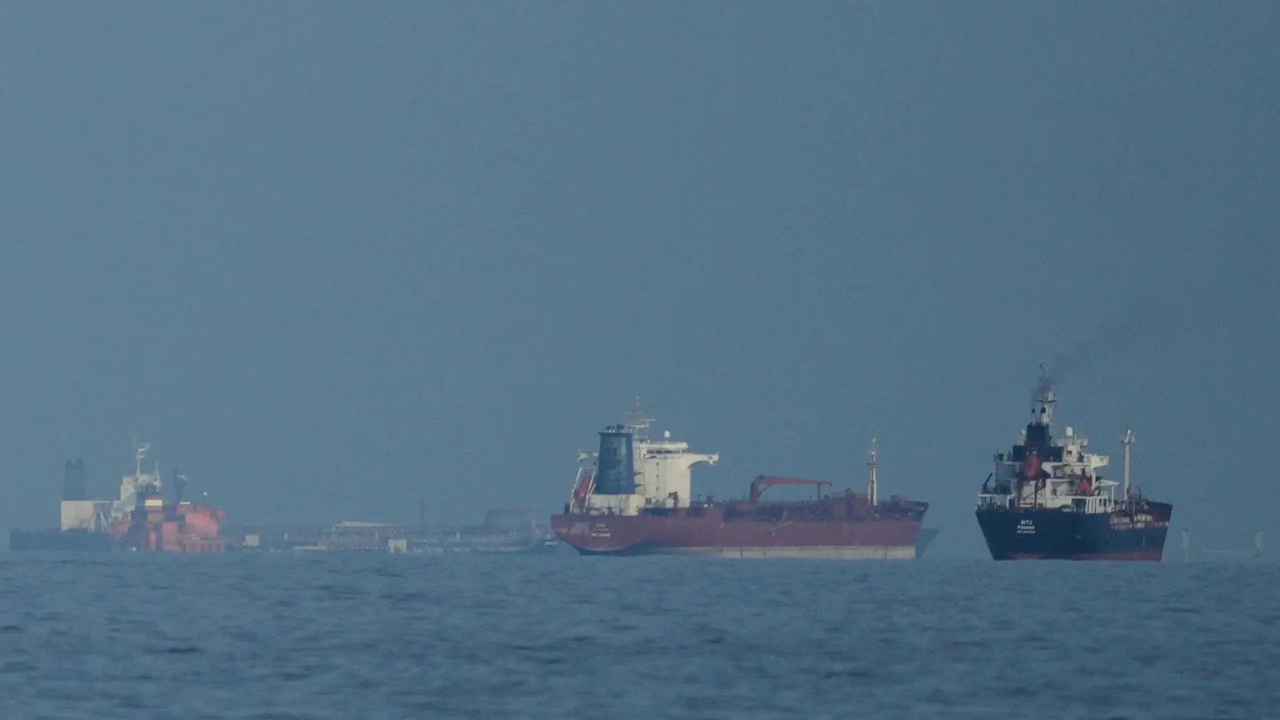
The headlines are predictable. A US Navy destroyer intercepts two oil tankers in the Strait of Hormuz, orders them to turn back, and the media treats it like a victory for global stability. It is a comforting narrative. It suggests that a billion-dollar hull and a few dozen Tomahawks are all that stand between us and $200-a-barrel oil.
It is also a lie.
What the mainstream coverage misses—and what actual maritime logistics insiders are whispering about in Singapore and Geneva—is that these "interceptions" are not a display of strength. They are a glaring admission of a systemic failure. We are watching the slow-motion collapse of 20th-century naval doctrine in a 21st-century economic war. The US Navy isn't "securing" the Strait; it is playing a high-stakes game of whack-a-mole with a mallet that is too heavy and a mole that has already moved to a different field.
The Lazy Consensus of Freedom of Navigation
The standard argument goes like this: The US Navy protects the "freedom of navigation," ensuring that the 20% of the world's oil passing through the Strait of Hormuz moves without friction. When a destroyer stops a tanker from being seized or redirects a ship away from danger, the system works.
This assumes the system is still physical. It isn't.
In the modern era, the threat to a tanker isn't just a physical boarding party. It is the sudden, catastrophic evaporation of insurance coverage. It is the "dark fleet" logistics that allow sanctioned oil to move under the radar while legitimate carriers are paralyzed by risk premiums. When a US destroyer "protects" a tanker, it often does so at a cost that makes the cargo itself economically unviable. The Navy is defending the water while the market is burning the bridge.
I’ve spent years watching how maritime risk is priced. I can tell you that a destroyer in the vicinity does not lower Lloyd’s of London’s war risk premiums as much as you think. In fact, a high-profile naval presence often signals to the market that the region is a kinetic combat zone, driving insurance rates through the ceiling. We are literally paying billions in taxpayer money to maintain a presence that, in some cases, makes the very shipping we’re "protecting" too expensive to operate.
The Technical Illusions of Naval Superiority
Let’s talk hardware. The Arleigh Burke-class destroyer is a marvel of engineering. But against the current threat profile in the Persian Gulf, it is an anachronism.
We are using $2 billion assets to counter $50,000 suicide drones and $200,000 fast-attack craft. This is not "dominance." It is a math problem where the US is losing.
The Asymmetric Math of Hormuz
Consider the cost-to-kill ratio:
- Standard Missile-2 (SM-2): ~$2 million per shot.
- Houthi or Iranian Drone/Fast Craft: ~$20,000 to $50,000.
If an adversary launches a swarm of twenty drones, the destroyer must respond. Even with a perfect hit rate, the US spends $40 million to negate $1 million of "cheap" threat. This isn't sustainable. The "interception" in the news isn't a win; it’s an expensive delay. The true bottleneck in the Strait of Hormuz isn't the physical width of the channel; it’s the depletion of vertical launch system (VLS) cells on our ships. Once those tubes are empty, that destroyer is just a very expensive target that has to retreat to a friendly port for a week-long reload process.
The Myth of the "Rogue Tanker"
The competitor articles love to frame these incidents as the Navy stopping "illegal" or "forced" movements. They paint a picture of tankers being bullied by hostile states and the US Navy acting as the maritime police.
The reality is far more grey. Many of these tankers are caught in a legal limbo of conflicting sanctions, ownership shells, and "flag of convenience" disputes. When the US Navy tells a tanker to turn back, they aren't just "stopping a kidnapping." They are often enforcing US unilateral sanctions that much of the rest of the world—including some of our "allies" who need that oil—privately despises.
We are using the Navy as a debt collection agency and a sanctions enforcer, then dressing it up as "maritime security." This distinction matters because it changes the risk profile for every other ship in the water. When the Navy intervenes in a commercial dispute or a sanctions-dodging operation, it turns every commercial vessel into a potential pawn for retaliation.
The Fragility of the "Just-in-Time" Sea
The global economy is built on the "Just-in-Time" delivery model. Your gas prices, your plastics, and your heating bills depend on a seamless flow of tankers. The moment a destroyer has to intervene, that "seamless" flow is shattered.
- Diverted Routes: When a ship is "ordered to turn back," it doesn't just go home. It sits. It burns fuel. It misses its slot at the refinery.
- Cascading Delays: A 48-hour delay for two Suezmax tankers in the Strait ripples through the global supply chain for months.
- The Shadow Market: This friction doesn't stop oil from moving; it just pushes it into the "dark fleet." These are older, poorly maintained ships with no insurance and "ghost" transponders. By trying to control the Strait with traditional naval power, we are actually incentivizing a more dangerous, less regulated, and more environmentally catastrophic way of moving energy.
Imagine a scenario where the Navy "successfully" blocks 100% of "rogue" tankers. The result wouldn't be a safer world; it would be a massive spike in the use of uninsurable "ghost" ships that are one engine failure away from an Exxon Valdez-level disaster in one of the world's most sensitive ecosystems.
Stop Trying to "Secure" the Strait
The obsession with physical interceptions is a distraction. If we actually wanted to secure the energy flow, we wouldn't be sending more destroyers. We would be changing the way we handle maritime law and energy logistics.
Instead of cheering for the intercept, we should be asking why we are still reliant on a single 21-mile-wide choke point that can be held hostage by anyone with a few naval mines and a GoPro. The real solution isn't "more Navy." It’s the aggressive decentralization of energy transit and the hardening of regional infrastructure that doesn't rely on 1940s-style convoy protection.
We are stuck in a mindset where "security" equals "large grey ship with a flag." But in the age of cyber warfare, drone swarms, and decentralized finance, that ship is increasingly a decorative ornament. It provides the illusion of control while the actual levers of global stability are pulled elsewhere.
The Professional’s Admission
I have spoken with officers who have served on these patrols. They are professional, highly trained, and doing exactly what they are told. But off the record, many will admit the futility. They know they are a high-value target in a low-value environment. They know that every time they "intercept" a tanker, they are exposing their ship's electronic signatures and defensive patterns to adversaries who are taking notes for the "big one."
We are trading our long-term strategic advantage for short-term PR "wins" in the news cycle.
The Brutal Truth About Oil Prices
If you think these interceptions keep your gas prices low, you are wrong. The presence of the US Navy in the Gulf is already "priced in." The market expects tension. What the market doesn't like is the unpredictability of military intervention in commercial lanes.
The "freedom of navigation" missions have become a self-fulfilling prophecy of instability. We stay there because it's unstable, and it’s unstable because we’re there, acting as a lightning rod for every regional actor looking to score a point against the "Great Satan."
The US Navy is trying to police a digital-age economy with industrial-age tools. They are trying to stop a flood with a sword. Every time a destroyer "orders a tanker to turn back," it isn't a victory for the rule of law. It is a signal that the law of the sea is being replaced by the law of whoever has the biggest radar signature—and that is a game we cannot afford to play forever.
The era of the "Oceanic Policeman" is over. We are just the last ones to realize it.