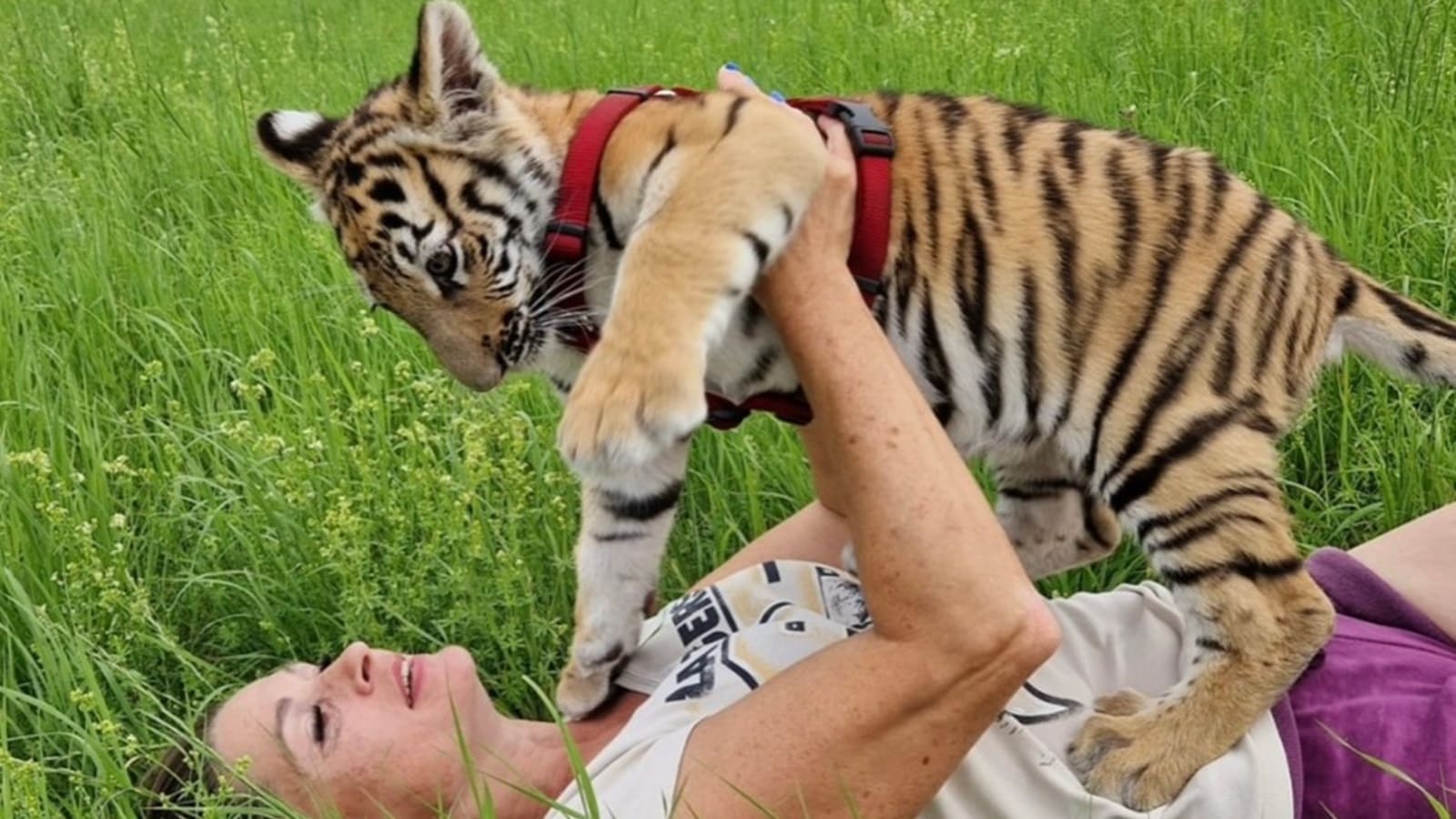
The iron bars of a predator’s cage do not just keep an animal in. They lock a specific kind of human fantasy in place. For years, the private estate in Bergisch Gladbach, a quiet region in western Germany, operated under the spell of that fantasy. Local media dubbed the owner the "Tiger Queen," a title dripping with the glamorous, dangerous allure of subverting nature. Visitors looked at the massive stripes, the heavy paws, and the raw, kinetic power humming behind the fencing, seeing a spectacle. They saw a boundary pushed.
Then, the boundary pushed back.
It happened with the sudden, quiet violence that defines apex predators. A caretaker, a person whose daily routine involved navigating the razor-thin margin between domestic safety and wild instinct, stepped into the enclosure. In a fraction of a second, the illusion of control dissolved. The tiger did what tigers have evolved to do over millennia. It struck.
The caretaker survived, but the meat-and-potatoes reality of the injuries sent shockwaves far beyond the perimeter of the estate. When an ambulance speeds away from a private exotic animal compound, it carries more than a bleeding patient. It carries the shredded remnants of the idea that humans can truly domesticate the wild through sheer force of will or affection.
Now, the silence over the Bergisch Gladbach estate is loud. German regulatory officials have stepped in, moving with the heavy, bureaucratic finality that follows a public safety crisis. The order is clear: shut down the enclosure. The party is over. The "Tiger Queen" moniker, once worn like a badge of eccentric honor, now reads like an indictment.
The Geography of a Delusion
To understand how a tiger ends up in a German suburb, you have to understand the human ego. We are obsessed with scaling walls we shouldn’t even be standing near.
Imagine a standard residential street. You know the sounds. The hum of a lawnmower three houses down. The rhythmic clinking of a dog’s collar as it trots along the sidewalk. The distant whistle of a train. Now, overlay that with a sound that registers in the human chest cavity before it even hits the eardrum: a low, resonant tiger roar. It is a sound designed by evolution to freeze primates in their tracks. It belongs in the dense jungles of Sumatra or the frozen forests of Amur, not next to a manicured German lawn.
Private ownership of exotic animals relies on a fragile psychological contract. The owner convinces themselves that they possess a special connection—a unique, whisperer-like bond that exempts them from the laws of biology. They mistake captivity for compliance. Because the animal accepts food from a bucket, the owner believes the animal has accepted the terms of human residency.
But a tiger is a closed loop of evolutionary perfection. Every muscle fiber, every optical nerve, every claw is optimized for the hunt. You can take the tiger out of the wild, but you cannot breed the wild out of the tiger in a single generation, or ten, or fifty. When the caretaker entered that enclosure, they didn't step into a backyard; they stepped into a territory. And in a territory, the apex predator writes the rules.
The Paper Shield of Bureaucracy
Public safety officials face a peculiar nightmare when dealing with exotic private zoos. Regulations are often a patchwork of historical loopholes and reactive clauses. In many parts of Europe and the West, the laws governing whether you can keep a three-hundred-pound killing machine in your garden are surprisingly murky compared to the laws governing whether you can build a slightly oversized garden shed.
Consider what happens next when an incident like this occurs:
First comes the immediate medical response, a flurry of blue lights and adrenaline. But close behind are the clipboards. The District Administration of Rhein-Berg immediately launched a formal investigation. They didn't just look at the blood on the ground; they looked at the structural integrity of the fences, the shifting permits, and the historical compliance logs.
What they found was an unacceptable risk matrix. The decision to revoke the permit and order the closure of the enclosure isn't just about punishing the owner. It is an act of municipal self-defense.
The real problem lies elsewhere, buried beneath the paperwork. What do you do with a displaced tiger? You cannot simply drop a habituated, captive-born predator into the wilds of Asia. It lacks the survival skills, and more importantly, it lacks the fear of humans—a trait that makes it twice as dangerous. Zoos are often maxed out on space. Sanctuaries are crowded. The logistics of moving a dangerous animal require specialized transport, heavy sedation, and a network of experts willing to take on a liability that just proved its own lethality.
The paperwork is a paper shield. It protects the public after the fact, but it cannot undo the puncture wounds.
The Cost of the Spectacle
We live in a culture that consumes nature through a screen, tilting our perception of risk. We watch documentaries of people hugging lions or swimming with great white sharks, edited with swelling music and sweeping drone shots. We consume these narratives as proof of harmony.
It is a lie.
The people who work closely with these animals in legitimate, accredited institutions don't talk about harmony. They talk about management. They talk about shifting patterns, double-lock systems, and never, under any circumstances, breaking the plane of isolation without a physical barrier between themselves and the animal. They respect the beast by acknowledging its capacity to end them.
The private collector, however, often trades in the currency of proximity. The closer you can get, the higher your status. The more personal the interaction, the grander the myth.
But the myth carries a massive, hidden invoice. When a private enclosure fails, the cost is distributed across the community. It is paid by the first responders who have to enter an unsecure area not knowing if a tiger is loose. It is paid by the neighbors who look at their backyards differently, wondering if a single rusted latch is all that separates their children from a predator. It is paid by the conservation movement, which has to spend time and resources cleaning up the mess of an amateur rather than protecting habitats where these animals actually belong.
The Finality of the Lock
The Bergisch Gladbach enclosure will go dark. The steel doors will be chained, the remaining animals redistributed through the painful, slow grind of international animal welfare logistics. The "Tiger Queen" will likely retreat into the bitter anonymity of legal battles and administrative fines.
But the lesson remains, written in the dirt of the enclosure and the medical reports of a scarred caretaker. Nature does not negotiating with our desire for uniqueness. It does not care about our social media handles, our eccentricities, or our deep, misguided love for its beauty.
When we lock a tiger in a cage, we are not mastering the wild. We are just holding our breath. And eventually, everyone has to exhale.