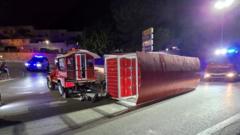
An overturned tourist train at the Cártama tapas festival on Saturday night left 18 people injured, exposing a critical regulatory blind spot in European agritourism transportation. The incident occurred at approximately 9:40 PM on the steep, narrow incline of Santo Cristo street in Cártama Pueblo during the popular Tapa and Cocktail Route. Nine minors, aged between 5 and 17, were among those rushed to nearby hospitals when one of the passenger carriages completely detached and rolled onto its side. While local authorities confirmed none of the injuries were immediately life-threatening, the crash cuts through the festive marketing of European village tourism to reveal a chaotic, unregulated gray market of trackless tourist trains.
Municipalities across Southern Europe routinely lease these "trackless trains" or trenes turísticos to ferry families between historic sites or culinary festival checkpoints. To the public, they look like quaint, low-speed novelties. To engineers and transport analysts, they are high-mass, articulated multi-trailer vehicles operating with highly volatile physics on standard public asphalt.
The immediate emergency response in Cártama required a specialized deployment from the Provincial Firefighters Consortium of Coín to stabilize the overturned metal chassis and administer first aid alongside medical teams. However, the true failure occurs long before emergency services arrive at the scene. The investigation into the Cártama derailment will inevitably focus on driver error or mechanical failure, but the foundational issue is the systemic lack of standardized oversight for vehicles that are neither fully buses nor fully heavy machinery.
The Physics of the Incline
Santo Cristo street is a characteristic Andalusian thoroughfare, narrow and unforgivingly steep. When a trackless train ascends or descends an incline with a heavy passenger load, it faces severe mechanical strain. Unlike standard commercial transit, these vehicles rely on a single lead tractor pulling a series of independent trailers connected by mechanical couplings.
[ Lead Tractor ] === ( Coupling ) === [ Trailer 1 ] === ( Coupling ) === [ Trailer 2 (Overturned) ]
When an articulated vehicle travels over changing topography, a phenomenon known as mechanical surging occurs. If the lead tractor slows abruptly or loses traction on a steep gradient, the unbraked or under-braked weight of the trailing carriages pushes forcefully against the rear of the towing unit. On a narrow street like Santo Cristo, any minor steering correction under these forces can cause a whip effect. The final carriage in the chain absorbs the brunt of this kinetic energy, leading to catastrophic instability and a subsequent rollover.
Furthermore, many of these seasonal tourist trains are modified agricultural tractors wrapped in fiberglass shells. The braking systems on these retrofitted vehicles are rarely designed to manage the kinetic realities of stopping multiple fully-loaded passenger carriages on a downhill slope. The public assumes these vehicles undergo the same rigorous crash-testing and safety validation as a standard transit bus. They do not.
The Regulatory Void
In the European Union, standard passenger buses are subject to stringent type-approval directives governing roll-over structural integrity, electronic stability control, and mandatory seatbelt configurations. Trackless tourist trains, conversely, frequently fall between the cracks of national transport legislation and local municipal ordinances.
In Spain, while the Reglamento General de Vehículos outlines basic operational parameters for these caravans, the actual day-to-day enforcement, route vetting, and operational permitting are punted down to individual town halls. This creates a dangerous inconsistency where a vehicle deemed unsafe for the mountainous terrain of one municipality can easily find a contract in a neighboring town for a weekend festival.
- Weight Distribution Anomalies: Carriages are often loaded on a first-come, first-served basis, completely ignoring maximum payload limits per axle.
- Coupling Deficiencies: Simple ball-hitch configurations without secondary redundant safety chains remain shockingly common.
- The Seatbelt Myth: Many tourist trains lack any passenger restraints whatsoever, relying on flimsy plastic latches or chains to keep children from falling out.
When nine children are loaded into a carriage without side-impact protection or mandatory restraint systems, a simple low-speed rollover changes from a minor traffic mishap into a mass-casualty event. The fact that the Cártama incident did not result in a fatality is a matter of sheer luck, not engineering design.
The Illusion of Slow Speed Safety
Municipal organizers consistently defend the use of trackless trains by pointing to their low operating speeds, usually capped between 15 to 25 kilometers per hour. This argument is fundamentally flawed. In a vehicle devoid of crumple zones, side-impact reinforcing bars, or internal padding, even a sudden stop or a sideways tip at 10 kilometers per hour can generate enough force to fracture bones and cause severe concussions.
When a carriage turns over, the human body is thrown directly against unpadded metal frames or onto concrete paving stones. In Cártama, the suddenness of the overturn meant that passengers in the final carriage were trapped beneath the weight of the vehicle and each other until bystanders and local police managed to lift the structure clear.
The commercial pressure on local councils to provide cheap, novelty transit during events like the Tapa Route overrides basic risk assessment. These festivals generate significant revenue for local hospitality sectors, and the tren turístico is viewed as an essential marketing tool to keep foot traffic moving through the town. This commercial priority incentivizes the selection of the lowest-cost transport contractors, who often utilize aging fleets with minimal maintenance logging.
Municipalities must stop treating trackless trains as amusement park rides and begin regulating them as heavy commercial transport. Until national transport ministries mandate rigid, independent engineering certifications for every route these vehicles operate on, the streets of historic towns will remain inherently hazardous for the families riding through them.