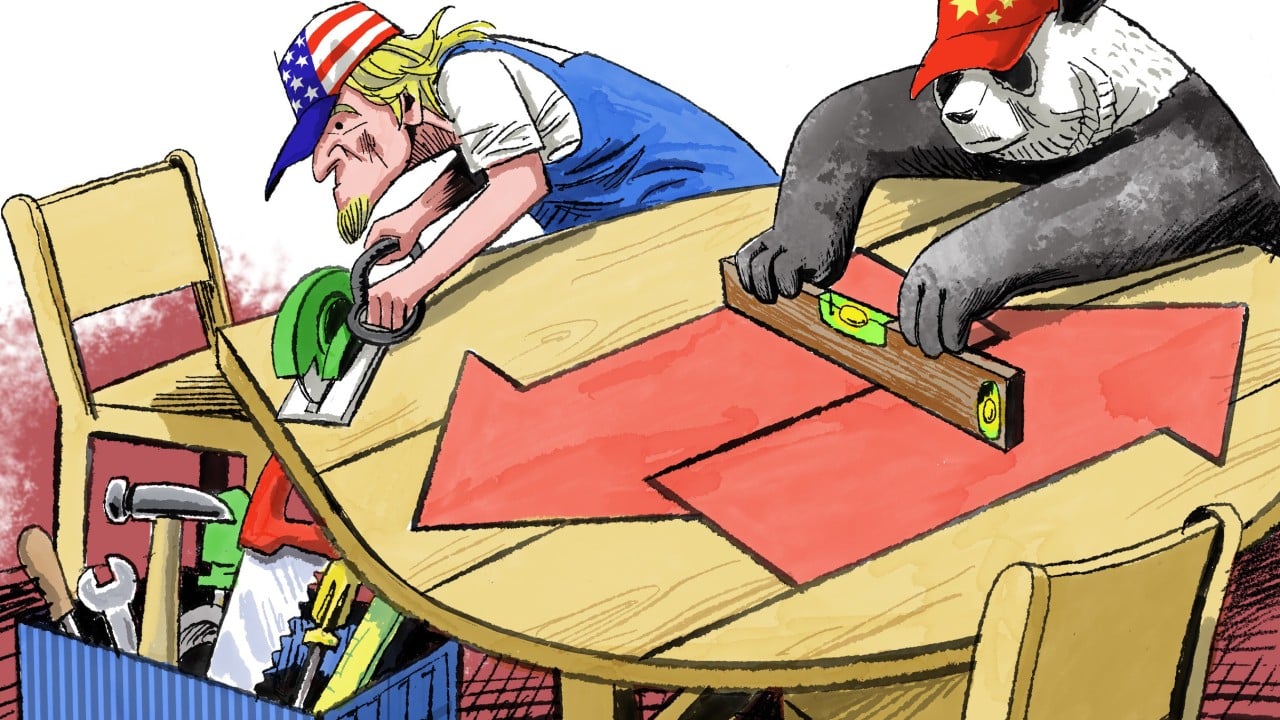
The newly minted US-China Board of Trade will not save globalized commerce because it is built to manage a permanent economic schism, not mend it. While optimists hail the framework as a historic diplomatic breakthrough capable of stabilizing bilateral commerce, the reality is far more transactional and restrictive. The mechanism, negotiated during Donald Trump's high-profile state visit to Beijing, functions as a political release valve for a parallel managed-trade system. By locking in state-directed purchases while preserving massive structural tariffs, Washington and Beijing are not resuscitating free trade. They are formalizing its autopsy.
For corporate strategists who spent the last year drawing up radical decoupling blueprints, the sudden announcement of the Board of Trade and its sister Board of Investment felt like whiplash. US Trade Representative Jamieson Greer lauded it as an unprecedented institutional mechanism to hash out disputes over import controls, export restrictions, and non-tariff barriers. Beijing's Ministry of Commerce chimed in with hopeful talk of mutual tariff reductions on non-sensitive goods.
Examine the fine print and the grand illusion evaporates. This is a cold, calculated truce that splits the economic landscape into two distinct territories. It establishes what veteran trade negotiators are calling a "tariff canyon."
On one side of the canyon sit politically convenient, non-sensitive goods where trade is heavily state-managed. China gets to signal cooperation by agreeing to buy 200 Boeing aircraft—its first major commercial aviation order from the company in nearly a decade—and pledging an extra $17 billion annually in US agricultural goods. This brings its total annual American farm purchase commitments to roughly $27 billion, throwing a massive bone to the US domestic farming lobby. In return, Beijing secures a tentative ceiling on broad punitive tariffs, keeping the effective rate near the 30 percent framework established during previous negotiations in Kuala Lumpur, even as the US Treasury flirts with new import penalties.
On the other side of the canyon lies the real war. Advanced semiconductors, artificial intelligence infrastructure, clean energy technology, and critical minerals remain locked in a permanent, high-tariff state of economic warfare. The Board of Trade completely bypasses these friction points. By design, the framework ensures that while American soybeans and commercial jets flow into Chinese ports, the doors remain firmly shut on the strategic technologies that will define geopolitical dominance over the next half-century.
This managed-trade model shatters the foundational illusions of the World Trade Organization era. For three decades, international business operated under the assumption that global trade was a rules-based game governed by market forces. If a company could build a more efficient, cost-effective supply chain by concentrated manufacturing in Shenzhen or Suzhou, the market rewarded them.
The Board of Trade permanently penalizes that logic. Under this new structure, trade volume is determined by geopolitical quotas and state-directed purchasing agreements rather than corporate supply and demand. It is a system of managed mercantilism.
The collateral damage of this bilateral truce extends far beyond Washington and Beijing. European and Asian industrial economies suddenly find themselves exposed to severe asymmetric risks. When China commits to buying $17 billion in American agricultural goods and hundreds of Boeing jets, it is not expanding its domestic consumption. It is redirecting its capital.
Airbus, European agricultural conglomerates, and Asian industrial exporters are realizing that the Board of Trade does not lower global trade barriers. It simply builds an exclusive economic corridor between the world’s two largest economies, effectively crowding out third-party competitors. It is an aggressive, discriminatory framework masquerading as global stabilization.
Furthermore, the legal and operational foundations of this agreement are remarkably fragile. While the bilateral board plans to evaluate tariff rollbacks on roughly $30 billion worth of goods, the underlying tariff infrastructure of the trade war remains entirely intact. The ongoing legal challenges under the International Emergency Economic Powers Act mean that American corporate compliance teams cannot view this truce as a green light to reinvest in transpacific manufacturing.
Relying on a traditional "China-plus-one" sourcing strategy—where a company keeps its primary manufacturing footprint in China while adding a single satellite factory in Vietnam or Malaysia—is no longer a resilient position. The institutionalized volatility of the Board of Trade forces a shift toward a much more fragmented, complex "China-plus-N" regional diversification model. Multinational companies must construct supply chains that can survive the sudden, arbitrary closure of the tariff canyon whenever political winds shift in Washington or Beijing.
We are witnessing the death of the flat world. The creation of the US-China Board of Trade confirms that the world's two economic superpowers have abandoned the pursuit of structural alignment. They have accepted that their long-term economic trajectories are fundamentally incompatible. Instead of attempting to fix a broken global system, they have built a formalized crisis-management boardroom designed to prevent their inevitable economic decoupling from devolving into an outright kinetic conflict.
For the global business community, the message is clear. Do not mistake the resumption of diplomatic dialogue for a return to normalcy. The Board of Trade is not a bridge back to the old era of seamless cross-border integration; it is the fence that dictates where the new borders lie. Corporate survival now depends on learning how to operate in a permanently divided world, where the state dictates terms, markets are strictly managed, and the next trade shock is always just one boardroom disagreement away.