The inclusion of cricket in the LA28 Olympic program is not a ceremonial gesture of international goodwill but a calculated play to capture the $100 billion American sports media market. For the International Cricket Council (ICC), the United States represents the final frontier for a sport that currently derives over 70% of its global revenue from a single geographic source: the Indian subcontinent. However, the success of this expansion hinges on a single, often overlooked variable: specialized infrastructure. The announcement of a professional-grade cricket stadium in Southern California serves as the first high-fidelity data point in a broader strategy to bridge the gap between amateur participation and commercial viability.
The Structural Deficit of American Cricket
Cricket in the United States has historically operated within an "infrastructure ceiling." While the US boasts millions of cricket fans—driven largely by South Asian and Caribbean diasporas—the lack of dedicated facilities has relegated the sport to converted baseball outfields and public parks. This creates a fundamental physics problem for the game. If you found value in this post, you should look at: this related article.
Cricket is played on a "pitch"—a 22-yard central strip of compacted soil and grass. Standard American turf (Kentucky Bluegrass or Fescue) cannot be mowed or rolled to the density required for a true cricket bounce. The result is a degraded version of the sport where the ball stays low and predictable, preventing the development of elite-level domestic talent. By investing in a purpose-built stadium in California, stakeholders are addressing the Primary Performance Bottleneck. A specialized pitch allows for:
- Consistent Ball Tracking: Essential for high-speed broadcasting and hawk-eye telemetry.
- Specialized Drainage Systems: Reducing "time-to-play" after weather events, which is critical for meeting strict linear television windows.
- Boundary Standardization: Aligning the field of play with international dimensions to ensure that statistical outputs (strike rates, bowling averages) are comparable to global benchmarks.
The Revenue Conversion Function
The stadium project is the physical manifestation of a three-pillar economic framework designed to transition cricket from a niche interest to a top-tier US sporting asset. For another look on this event, refer to the recent coverage from CBS Sports.
- Pillar I: Media Rights Valuation: The Olympic return in 2028 creates a four-year runway for broadcasters like NBC and Willow TV. A stadium provides the "studio" environment necessary for high-definition 4K production, multi-camera angles, and the integration of micro-betting data streams. Without a controlled environment, the product is unbroadcastable at a premium price point.
- Pillar II: Corporate Hospitality and Scalability: Public parks cannot host "C-suite" experiences. A dedicated stadium introduces luxury boxes, tiered seating, and naming rights—revenue streams that are currently non-existent in the US cricket ecosystem.
- Pillar III: The T20 Format as a Minimum Viable Product: Test Cricket (five-day format) is economically incompatible with the American attention span and advertising structure. The stadium is designed specifically for Twenty20 (T20) cricket—a three-hour format that mirrors the duration of an MLB or NBA game.
The Southern California Geo-Strategic Advantage
The selection of Southern California for a major stadium is a decision driven by climate data and demographic density. The region offers a "playing window" that exceeds 300 days per year, a sharp contrast to traditional cricket hubs like the United Kingdom or Melbourne, where rain frequently disrupts play.
Furthermore, the Los Angeles metropolitan area contains a high concentration of high-net-worth individuals within the target demographic. This group possesses the highest propensity to spend on sports subscriptions and live event tickets. The proximity to Hollywood also facilitates a "celebrity-backed" ownership model, similar to the one employed by Major League Cricket (MLC), which uses the social capital of tech titans and actors to manufacture cultural relevance.
Addressing the Olympic Integration Paradox
The 128-year absence of cricket from the Olympics was largely a result of the sport's inability to fit within a two-week multi-sport event. The 2028 solution involves a condensed T20 tournament. However, this creates a logistical strain. Unlike swimming or track and field, cricket pitches require "rest periods" to maintain their integrity.
A single stadium in California cannot support an entire Olympic tournament without significant degradation of the playing surface. The strategy must involve a "Hub and Spoke" infrastructure model:
- The Hub: The flagship California stadium acts as the broadcast center and final venue.
- The Spokes: High-performance training centers and secondary venues (potentially repurposing existing minor league baseball facilities) to handle the group stages.
The Risk Matrix of Infrastructure-First Expansion
While the stadium is necessary, it is not sufficient for long-term growth. The project faces three critical risks:
- Utilization Rates: A stadium that only hosts 10-15 major match days a year is a liability. It must be designed as a multi-use facility capable of hosting concerts, rugby, or corporate events without damaging the central cricket pitch.
- The Talent Pipeline Bottleneck: Infrastructure at the professional level does not automatically create a grassroots movement. There is a risk of creating "cathedrals in the desert"—elite venues with no local players to fill them once the international stars leave.
- Regulatory Friction: Zoning laws and environmental impact reports in California are notoriously rigorous. Delays in the construction timeline could jeopardize the venue's readiness for the 2028 cycle, forcing the ICC to rely on "drop-in" pitches at existing football stadiums, which are notoriously expensive and provide a sub-par experience.
The Mechanics of "Drop-In" Technology
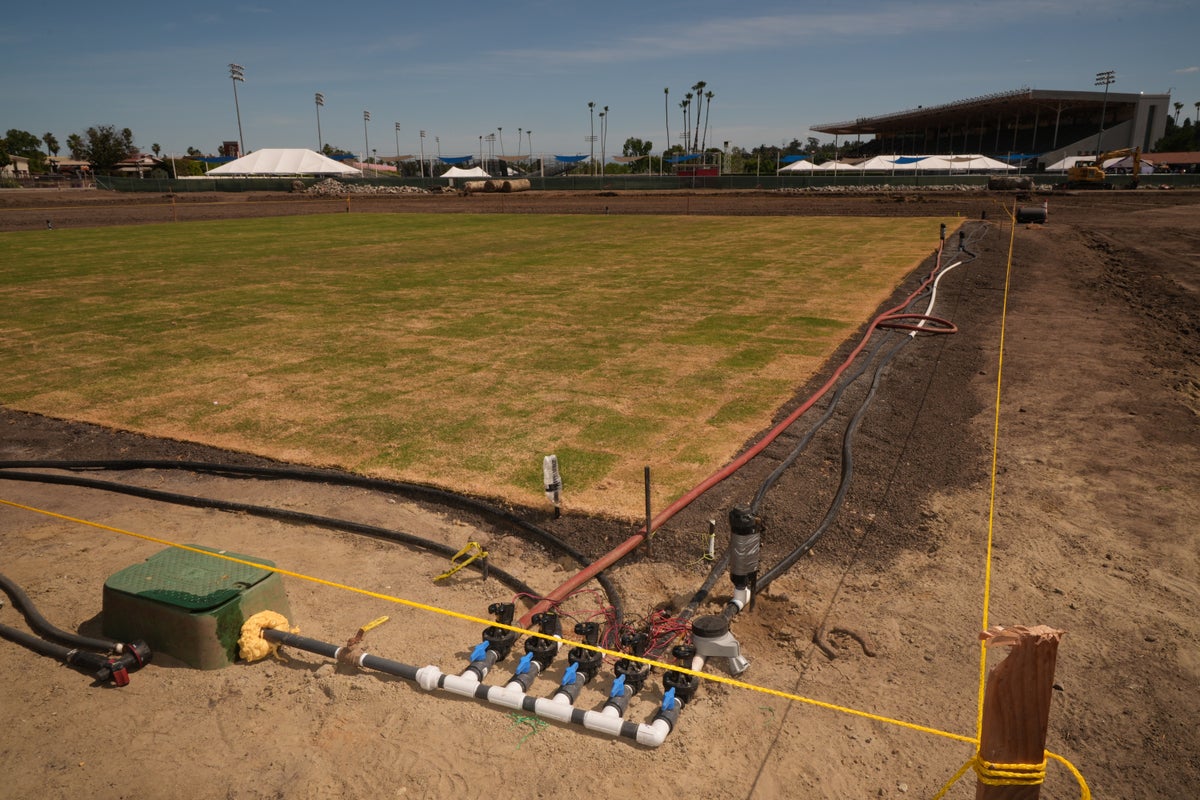
To mitigate construction risks, the California stadium will likely utilize "drop-in" pitch technology. This involves growing the cricket pitch in a steel tray at an off-site nursery and then craning it into the stadium floor.
This mechanism allows the stadium to host other sports until 48 hours before a cricket match. The technical challenge lies in the "settling" of the tray. If the tray is not perfectly flush with the surrounding outfield, it creates a safety hazard for fielders and unpredictable bounce for the ball. The success of the LA28 cricket event relies more on this civil engineering precision than on the marketing efforts of the Olympic committee.
The Shift from Participation to Consumption
The prevailing myth in sports expansion is that you must teach a population to play the game before they will watch it. Modern data suggests the opposite. The rise of Formula 1 in the US occurred without a significant increase in go-kart participation; it was driven by narrative-driven media (Drive to Survive) and accessible viewing windows.
Cricket is following this "consumption-first" model. The stadium is not a community center; it is a content factory. By prioritizing the visual and logistical requirements of television, the ICC is betting that they can convert the "casual curious" viewer into a "digital consumer." The Olympics serve as the ultimate top-of-funnel marketing event to facilitate this conversion.
The Strategic Recommendation for Stakeholders
For investors and governing bodies, the path forward requires a shift in capital allocation from "broad-based development" to "high-fidelity nodes."
- Immediate Action: Secure secondary training sites within a 50-mile radius of the California stadium. The scarcity of turf-standard practice nets will be the first operational crisis during the Olympic lead-up.
- Media Strategy: Transition from "explaining the rules" to "selling the rivalries." American sports fans respond to high-stakes competition and individual stardom, not the historical nuances of the sport.
- Infrastructure Design: Prioritize modular seating. The stadium should be able to scale from a 5,000-person regional match to a 30,000-person Olympic final without looking "empty" on camera, which destroys the perceived value of the media product.
The California stadium is the anchor for a multibillion-dollar arbitrage play. If the infrastructure can deliver a world-class broadcast product in 2028, cricket will successfully decouple its revenue from the Indian rupee and establish a permanent, dollar-denominated foothold in the global sports hierarchy. Failure to execute on these technical requirements will result in a repeat of previous failed expansions, leaving the sport as a permanent expatriate curiosity in the American market.