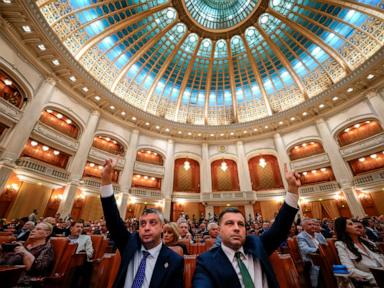
The defeat of prime minister designate Adrian Vestea in the Romanian parliament on Monday evening was not an accident of democratic friction. It was an execution. By securing only 189 votes out of the 233 required to form a new government, Vestea became the latest casualty in a calculated war of attrition that has left Romania without a functioning administration for nearly fifty days. While mainstream analysis frames this as a routine partisan deadlock, the reality is far more dangerous. The collapse of the Vestea nomination exposes a deep, structural rot within Bucharest's political class, where established parties are actively choosing state paralysis over fiscal accountability and democratic stability.
Romania is a frontline NATO and European Union state bordering Ukraine. The complete shutdown of its executive branch occurs at a moment of acute regional vulnerability.
The Manufactured Fall of Adrian Vestea
To understand how Vestea was cornered, one must look at the cynical coordination that occurred on the floor of parliament. Vestea, a regional leader of the National Liberal Party (PNL) and former development minister, was nominated by President Nicusor Dan in an attempt to rebuild a stable pro-Western majority. Instead of receiving support from his own political family, Vestea found himself abandoned.
The National Liberal Party, currently led by interim prime minister Ilie Bolojan, did not even participate in the ballot. Bolojan went so far as to threaten Vestea and his allies with outright expulsion from the party for simply accepting the presidential nomination. This internal betrayal was matched by tactical maneuvers from the opposition. The nationalist-conservative Alliance for the Union of Romanians (AUR), which forms the second-largest bloc in parliament, engaged in a highly visible piece of political theater. After Vestea personally negotiated with AUR leader George Simion to secure votes, Simion instructed his lawmakers to march out of the chamber right as voting commenced.
This left Vestea completely stranded. The final tally of 189 votes in favor and 23 against reflected an empty room rather than a genuine legislative debate.
The strategy behind this sabotage is obvious. By denying Vestea a cabinet, both the traditional left and the rising populist right are attempting to force a second failed nomination. Under the Romanian constitution, if parliament rejects two consecutive prime ministerial nominees within sixty days, the president has the authority to dissolve the legislature and call a snap election. This is the exact outcome the major parties are engineering. They believe a new election will wipe out their rivals and rewrite the balance of power in Bucharest, regardless of the immediate economic cost to the population.
The Legacy of the Bolojan Coalition
The current institutional vacuum did not emerge overnight. It is the direct consequence of the implosion of the previous government led by Ilie Bolojan, which was brought down by a crushing no-confidence motion in early May. That motion, ironically titled "STOP the Bolojan Plan of destroying the economy," passed with an overwhelming 281 votes. It united the center-left Social Democrats (PSD) and the nationalist AUR in an alliance that shocked external observers but surprised few insiders.
The Bolojan administration fell because it tried to manage an economic crisis entirely on the backs of the working class. Facing a massive budget deficit that had become the largest in the European Union, the government implemented ten months of severe austerity. They raised value-added taxes, cut public spending, and restricted local government budgets. Crucially, the administration refused to introduce structural reforms that would target corporate profits, wealth accumulation, or progressive income taxes.
The economic fallout was immediate.
Inflation surged past 9 percent. The economy contracted by 1.9 percent in the final quarter of last year, and unemployment climbed steadily to over 6 percent. By the time the PSD walked out of the governing coalition to trigger the no-confidence vote, the public was exhausted, and the political consensus was completely broken.
What remains is a fragmented legislature where no single party can form a majority, and no party is willing to compromise. The traditional ideological boundaries between liberals, neoliberals, and social democrats have dissolved into pure tribalism. Leaders are focused entirely on self-preservation and the distribution of state patronage.
The Shadow of the Annulled Elections
The institutional breakdown is further complicated by a deep crisis of legitimacy that dates back to the chaotic presidential election cycle. President Nicusor Dan took office after a highly irregular, rescheduled election in May 2025. This rerun was forced by an unprecedented decision by the Constitutional Court of Romania to completely invalidate the initial December 2024 presidential election.
That annulment occurred after a far-right populist candidate won the first round amid allegations of foreign digital interference and campaign irregularities. The court's intervention prevented a runoff, triggered months of mass street protests across major cities, and left a permanent stain on the public's trust in democratic institutions. The far right successfully weaponized this event, framing it as an establishment coup designed to subvert the will of the voters.
When President Dan nominated Eugen Tomac earlier this June, parliament rejected him almost immediately. When Dan turned to Vestea, the legislature repeated the punishment. The current parliament views the presidency with open hostility, treating every nominee not as a partner in governance, but as an adversary to be humiliated.
The Economic Consequences of Deficit and Delay
While politicians play chicken in Bucharest, the Romanian economy is entering a perilous phase. The country has now spent forty-seven days without a functioning government. This is not an abstract bureaucratic problem. It has immediate, quantifiable penalties for the nation's financial health.
Romania is heavily dependent on the European Union's Recovery and Resilience Facility to fund infrastructure, healthcare, and educational modernization. These funds are strictly conditional on achieving specific legislative milestones and maintaining fiscal discipline. Without a government capable of passing laws or issuing emergency ordinances, these funds are frozen. Billions of euros are currently stuck in Brussels because there is no minister authorized to sign the necessary compliance documents.
Furthermore, international credit rating agencies are watching the stalemate with growing alarm. Romania's sovereign debt is already under pressure due to the structural deficit. If the political paralysis continues into July, a downgrade to junk status is a distinct possibility. This would instantly increase borrowing costs for the state, making it even harder to service existing debts and forcing whatever government eventually emerges into an even deeper spiral of austerity.
The Security Risk on the NATO Flank
The geopolitical dimensions of this crisis are frequently overlooked in local political bickering, yet they are deeply troubling to Romania's Western allies. Romania shares a long border with Ukraine and plays a central role in NATO's eastern defense strategy. It hosts thousands of allied troops, serves as a critical transit hub for grain shipments, and acts as a security anchor for the Black Sea region.
A state without a cabinet cannot make rapid, decisive commitments in a crisis. The current interim government lacks the constitutional mandate to make major defense expenditures or alter military deployments. Should the conflict across the border escalate or spill over, Romania's decision-making apparatus would be hobbled by its own legal limitations.
The rising influence of the AUR party adds another layer of concern for Washington and Brussels. While the party has moderated its rhetoric slightly to participate in mainstream coalition negotiations, its core platform remains deeply critical of the European Union and skeptical of foreign military entanglements. By allowing the political vacuum to persist, the traditional parties are giving the far right a permanent platform to exploit public anger over inflation and instability.
The Structural Flaw in the Constitution
The underlying engine of this perpetual crisis is a fundamental design flaw in the Romanian constitution regarding the balance of power between the president and parliament. The system is semi-presidential, meaning both the directly elected president and the legislature claim democratic legitimacy.
When the presidency and the parliamentary majority are aligned, the system functions smoothly. When they are split, the constitution provides no efficient mechanism to break a deadlock. Instead, it incentivizes obstruction. The president cannot easily dissolve a hostile parliament, and parliament cannot easily remove a president without a lengthy, disruptive impeachment process.
Consider a hypothetical scenario where an infrastructure project requires urgent environmental approval. Under normal circumstances, a ministry would issue a standard decree. In the current gridlock, that project halts entirely because the interim minister lacks the legal authority to sign off on new regulations. Multiply this across hundreds of state agencies, and the result is a creeping paralysis that suffocates the economy from the inside out.
The rejection of Adrian Vestea confirms that the political class has accepted this paralysis as a acceptable cost of doing business. The traditional parties are gambling that they can survive the chaos longer than their opponents. In doing so, they are testing the limits of a state structure that is already fractured by economic mismanagement and public distrust. Romania does not merely need a new prime minister. It needs an entirely new framework for political accountability, before the machinery of governance breaks down completely.