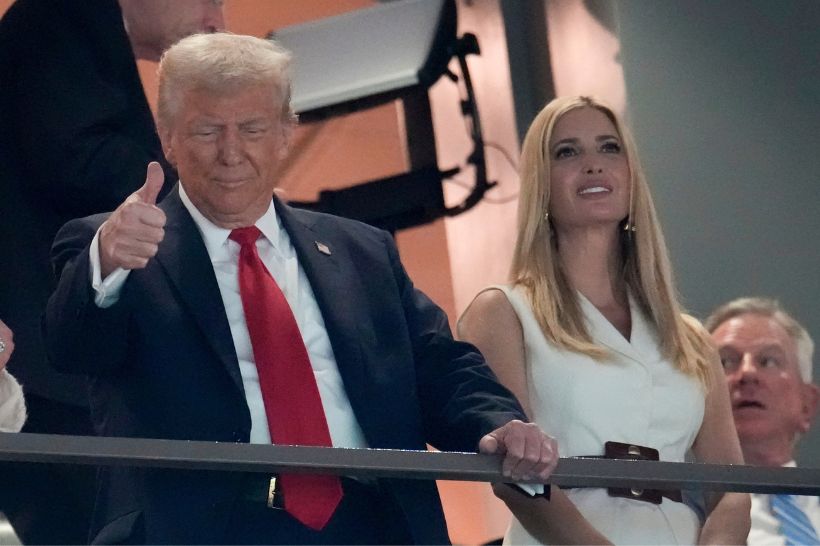
The arrest of an Islamic Revolutionary Guard Corps-trained operative in Turkey exposes an alarming escalation in Tehran's asymmetric campaign against the United States. This was not a generic threat against a military installation or a diplomatic outpost. Mohammad Baqer Saad Dawood Al-Saadi, a 32-year-old senior operative of the US-designated terrorist organization Kata'ib Hezbollah, had a specific target in his crosshairs: Ivanka Trump.
Al-Saadi did not just harbor a grievance. He possessed detailed blueprints of her $24 million Florida residence, shared satellite imagery of her neighborhood on social media, and openly declared to associates that the only way to balance the ledger for the 2020 assassination of Qasem Soleimani was to "burn down the house of Trump the way he burned down our house."
The plot reveals a calculated shift in how foreign adversaries view high-value political targets, moving past the officeholder to strike at the family core.
The Architecture of a Vendetta
To understand how a militiaman from Baghdad ended up with the layout of a heavily secured private estate in Florida, one must look at the unique lineage and psychological grooming of the operative.
Al-Saadi was not a standard-issue insurgent recruited from a local mosque. His father was an Iranian brigadier general, Ahmad Kazemi, who died in 2006. Following Kazemi's death, Qasem Soleimani—the legendary commander of Iran's elite Quds Force—stepped into Al-Saadi's life, effectively becoming a surrogate father.
When a US drone strike obliterated Soleimani outside Baghdad International Airport in January 2020, Al-Saadi's primary motivator transformed from state-sponsored ideology into an intensely personal vendetta.
Western intelligence officials have long warned that Tehran operates on a doctrine of deep patience and precise reciprocity. For years, the assumption was that Iranian vengeance would manifest as a strike on a general, a diplomat, or perhaps a defense research facility. Targeting a President’s daughter, who has transitioned away from a formal political role to focus on her family and her faith, signals a breakdown in the unwritten rules of modern geopolitical conflict.
Why Ivanka Trump? The target selection appears deeply deliberate. She represents the ultimate emotional vulnerabilities of the Trump lineage. Her conversion to Orthodox Judaism in 2009 before marrying Jared Kushner—who currently serves as a special envoy managing highly sensitive diplomatic discussions involving Iran—adds a volatile layer of religious and political symbolism for a hardline Shia operative.
The Blueprint and the Digital Footprint
Security experts are currently dismantling the operational security failures that led to Al-Saadi’s undoing, revealing a glaring paradox. He was a high-level asset capable of coordinating complex transnational operations, yet he maintained an incredibly sloppy digital footprint.
On the public platform X, Al-Saadi posted a map of the Florida enclave where Ivanka Trump and Jared Kushner reside. The accompanying text, written in Arabic, read like a textbook psychological warfare memo:
"I say to the Americans look at this picture and know that neither your palaces nor the Secret Service will protect you. We are currently in the stage of surveillance and analysis. I told you, our revenge is a matter of time."
The possession of actual physical blueprints of the residence indicates a deeper systemic failure. Blueprints of a private celebrity estate in a highly secure neighborhood do not simply leak online. They are obtained through municipal record infiltration, compromised contractors, or deliberate physical reconnaissance.
The Secret Service and federal law enforcement are now forced to re-examine how local architectural data can be weaponized by foreign intelligence networks.
The Extradition and the European Terror Trail
Al-Saadi's capture on May 15 in Turkey and subsequent extradition to the United States disrupted a massive, multi-theater terror campaign. According to unsealed Department of Justice documents, the plot against Ivanka Trump was part of a broader mandate. He is currently charged in connection with 18 distinct attacks or attempted attacks across Europe and North America over a brief three-month window.
The breadth of his alleged operations shows the terrifying versatility of modern state-sponsored proxies:
- Amsterdam: The firebombing of the Bank of New York Mellon building in March.
- London: The targeted stabbing of two Jewish victims in April.
- Toronto: A brazen shooting incident near the United States consulate building.
- The American Homeland: Active coordination to bomb synagogues and Jewish community institutions in New York, Los Angeles, and Scottsdale, Arizona.
The operational undoing of Al-Saadi mirrors the classic tradecraft failures of past Iranian-backed plots on US soil, such as the recently convicted IRGC operative Asif Merchant. Al-Saadi attempted to orchestrate his domestic bombing campaign by hiring what he believed was an domestic operative. He even sent a $3,000 cryptocurrency down-payment to an undercover FBI agent to secure the firebombing of a Manhattan synagogue, messaging the agent: "I wanna see good news tonight… not tomorrow bro."
He relied heavily on an Iraqi service passport—a special travel document reserved for government employees requiring direct authorization from the Iraqi Prime Minister’s office—using a legitimate travel agency as a front to slip across international borders undetected.
The Broken Shield of Deterrence
Al-Saadi now sits in solitary confinement at the Metropolitan Detention Center in Brooklyn. His arrest comes at an incredibly volatile moment, as the White House actively prepares for potential military strikes against Iranian infrastructure following escalating regional friction.
The reality of this foiled plot exposes a profound flaw in domestic protective infrastructure. The United States Secret Service is built around a defensive perimeter mindset. It protects bodies, motorcades, and physical perimeters. It is less equipped to combat decentralized, state-funded intelligence operations that treat municipal records, local contractors, and digital surveillance as an open-source preparation for a hit.
When an adversary decides that family members are fair game, the required security perimeter expands exponentially. It demands an infinite allocation of counter-intelligence resources, constant monitoring of municipal data requests, and a complete re-evaluation of how public figures shield their private domestic lives.
The blueprints found in Al-Saadi’s possession prove that for America's most sophisticated adversaries, the home is no longer a sanctuary; it is simply an unsecured target on a digital map.