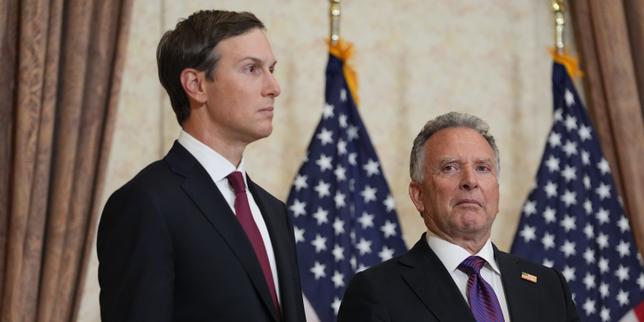
The arrival of Steve Witkoff and Jared Kushner in Islamabad this Saturday marks a calculated shift in American shadow diplomacy. While official channels often move with the glacial pace of bureaucracy, this duo represents a return to the personalized, deal-driven foreign policy that characterized the first Trump administration. They aren't there for a photo op. They are there because Pakistan remains the most vital, if volatile, bridge between the Sunni Gulf monarchies and the hardliners in Tehran. By engaging Islamabad as a neutral ground, the American delegation is attempting to bypass the public posturing of the Iranian regime and find a pragmatic path toward de-escalating the regional firestorm.
Pakistan has spent decades perfecting the art of the geopolitical balancing act. It manages a complex, often strained relationship with Iran while relying heavily on financial lifelines from Riyadh and the Emirates. For Kushner and Witkoff, this makes Islamabad the perfect laboratory for a new "Abraham Accords" style push that seeks to include the broader Islamic world. The goal is to isolate the conflict's most radical elements by offering the regional powers a seat at a very lucrative table. In related updates, read about: Why Taiwan’s Quiet Visit to Zhongzhou Reef Matters More Than You Think.
The Architect and the Real Estate Magnate
Jared Kushner is no stranger to these waters. His previous work on the Abraham Accords was initially dismissed by the foreign policy establishment as a vanity project, yet it resulted in the first significant diplomatic breakthroughs in the region in a generation. He approaches geopolitics not as a diplomat, but as a venture capitalist looking for undervalued assets and points of leverage.
Steve Witkoff provides the tactical reinforcement. A real estate titan and a close personal confidant of Donald Trump, Witkoff brings a "closer" mentality to the proceedings. His presence signals that this mission is sanctioned at the highest levels of the incoming executive branch, even before the formal inauguration. This is transition-period diplomacy at its most aggressive. They are moving to secure commitments before the official State Department machinery can take the wheel and potentially dilute the momentum with traditional caution. NPR has also covered this critical subject in great detail.
The Iranian Silence
Tehran’s refusal to confirm its participation in these talks is a classic piece of Persian diplomacy. By staying silent, Iran maintains its "revolutionary" dignity while keeping the door cracked open for backchannel communication. The Iranian leadership is currently facing a domestic economic crisis and a military reality where their proxies—Hezbollah and Hamas—have been significantly degraded. They need a way out, but they cannot be seen as surrendering to "The Great Satan."
Islamabad offers the perfect "gray zone" for these interactions. If a meeting happens, it can be framed as a routine regional consultation. If it doesn't, no face is lost. However, the intelligence community suggests that Iranian intermediaries are already on the ground. The real work happens in the hotel suites and private villas far from the microphones. The silence from Tehran isn't a "no"; it is a "not in public."
Why Pakistan Matters Now
For years, Washington’s interest in Pakistan was viewed almost exclusively through the lens of Afghanistan. That era is over. Today, Pakistan is being re-evaluated as a bridge to the Middle East’s most stubborn conflicts.
Pakistan’s military and intelligence apparatus, the ISI, maintains deep ties with various factions across the region. They have the ability to deliver messages that no Western diplomat can. Furthermore, Pakistan’s own economic instability makes it highly susceptible to the kind of "prosperity-first" diplomacy that Kushner champions. If the U.S. can promise a stabilization of Pakistan’s economy in exchange for their role as a broker with Iran, the incentive becomes irresistible for the leadership in Islamabad.
The Saudi Factor
The influence of Saudi Arabia hangs over this entire trip. Crown Prince Mohammed bin Salman has shown a willingness to rethink the regional order, but he requires security guarantees that only the U.S. can provide. Pakistan, a long-time military partner of the Saudis, serves as a natural third party to facilitate these discussions. If Kushner can align the interests of Riyadh, Islamabad, and a hesitant Tehran, the entire architecture of the Middle East changes.
The Risks of Personal Diplomacy
This approach is not without its critics. Traditionalists argue that by using personal emissaries, the U.S. risks undermining its own long-term institutional relationships. There is a danger that commitments made in Islamabad might not be honored by a future administration, leading to a cycle of distrust.
Moreover, the "deal" being pursued is inherently transactional. It assumes that every player has a price. While this might work with economic interests, it often fails when confronted with the deep-seated ideological and religious animosities that fuel the Middle East’s proxy wars. You can buy a building, and you can perhaps even buy a ceasefire, but you cannot easily buy a lasting peace between entities that view each other’s existence as a theological error.
The Looming Deadline
The urgency of this trip is driven by the calendar. With the region on the brink of an all-out war between Israel and Iran, the window for a negotiated settlement is closing. Every day of delay increases the risk of a miscalculation that leads to a global energy crisis or a wider military conflagration.
Witkoff and Kushner are operating with the knowledge that the current U.S. administration is in a "lame duck" phase. They are essentially presenting the region with a preview of the next four years. Their message to the leaders in Islamabad and the shadows in Tehran is simple: The old rules are gone. A new deal is on the table. Take it now, or face the consequences of a much more confrontational American stance come January.
The Mechanics of the Deal
What does a potential breakthrough look like? It likely involves a multi-stage de-escalation.
- Step One: A commitment from Iran to restrain its proxies in exchange for a partial easing of specific economic sanctions.
- Step Two: A formalization of security ties between Israel and more Arab nations, facilitated by Pakistani mediation.
- Step Three: Massive infrastructure investment in Pakistan and the wider region, funded by a combination of U.S. and Gulf state capital.
This is the "Peace to Prosperity" model applied on a macro scale. It treats the Middle East conflict as a series of bad contracts that need to be renegotiated. It is a cold, hard look at the reality of power, stripped of the usual diplomatic platitudes.
The Hidden Players
Beyond the primary actors, there are several wildcards that could derail the Islamabad talks. Turkey and Qatar both view themselves as the rightful mediators of the region and may look unfavorably on Pakistan stealing the spotlight. Meanwhile, the Israeli government, currently engaged in active combat, may not be willing to accept any deal that leaves Iran with its nuclear infrastructure intact.
The American delegation has to navigate these competing interests while maintaining a unified front. The choice of Islamabad as the venue is a direct signal to Doha and Ankara that the U.S. is diversifying its diplomatic portfolio. It is a high-stakes game of musical chairs where the music is about to stop.
The Reality of the "New" Diplomacy
We are witnessing the death of the traditional diplomatic cable. In its place is the direct-to-source negotiation. Witkoff and Kushner aren't worried about the optics of meeting in a city that has had its own share of friction with Washington. They are focused on the end result.
This brand of diplomacy is inherently messy. It ignores the chain of command and often relies on personal chemistry over policy papers. But in a region where decades of traditional diplomacy have resulted in nothing but increased bloodshed and failed states, a different approach—no matter how unorthodox—is being given a chance to perform.
The outcome of this Saturday's meetings will determine the trajectory of the Middle East for the next decade. If the Islamabad Gambit works, it will be hailed as a masterstroke of unconventional thinking. If it fails, it will be remembered as a desperate attempt by outsiders to fix a machine they didn't fully understand. The stakes could not be higher, and the world is watching to see if these two men can bridge a chasm that has swallowed so many before them.
The delegation's plane will touch down in a city that knows the cost of war all too well. Whether they leave with the foundations of a new peace or just more empty promises remains to be seen. But the very fact that these talks are happening in Pakistan shows that the map of global influence is being redrawn in real-time.
Watch the backchannels. Ignore the official press releases. The real story is being written in the quiet corners of Islamabad, where the future of the Middle East is being traded for a chance at a new beginning.
Pressure is the only language this region truly understands. Witkoff and Kushner are bringing plenty of it.