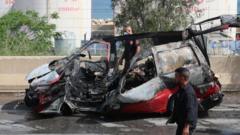
The escalation of cross-border hostilities between the Israel Defense Forces (IDF) and Hezbollah has entered a phase of targeted kinetic attrition, characterized by the systematic use of precision munitions against mobile assets. On May 13, 2026, the Lebanese Ministry of Public Health confirmed 12 fatalities resulting from strikes on vehicles in southern Lebanon. While media reporting often focuses on the casualty count as a static metric, a structural analysis reveals these strikes are part of a broader Israeli strategy to degrade Hezbollah’s logistical elasticity and enforce a de facto buffer zone through "deterrence by denial."
The current operational environment in southern Lebanon is governed by three specific tactical variables: the visibility of the supply chain, the speed of target acquisition, and the political cost of collateral damage. Israel’s reliance on drone-based surveillance and Hellfire-class missiles indicates a shift from broad area bombardment to a surgical focus on the "middle-mile" of Hezbollah’s tactical transport. By striking vehicles—often moving targets—the IDF aims to disrupt the safe passage of personnel and specialized equipment from storage depots to the Blue Line.
The Mechanics of Targeted Attrition
To understand why 12 deaths in a single day signify a shift in intensity, one must analyze the target profile. Vehicles in this theater serve as the primary vector for Anti-Tank Guided Missile (ATGM) teams and tactical commanders. The destruction of these assets creates a "friction tax" on Hezbollah operations.
- Logistical Disruption: Every successful strike on a transport vehicle forces the adversary to rethink its movement patterns. This results in longer transit times, the use of more circuitous routes, and a reliance on less efficient, clandestine methods of movement.
- Information Dominance: The ability to strike a moving car implies a high degree of "sensor-to-shooter" integration. It signals to the adversary that their internal communications or visual signatures are compromised, creating a psychological deterrent that outweighs the physical loss of the asset.
- Personnel Depletion: Unlike broad artillery fire, which may target empty structures, strikes on vehicles almost guarantee the removal of active combatants or high-value specialists from the theater of operations.
The Lebanese Ministry of Public Health's report of 12 dead reflects a high lethality rate per engagement. This density suggests that the targets were not solo operators but rather multi-passenger tactical units or convoys. The concentration of strikes in the south serves as a kinetic enforcement of the demand that Hezbollah withdraw its Radwan forces north of the Litani River.
The Asymmetric Cost Function
In any conflict of this nature, both parties operate under a cost-function model. For Israel, the cost is measured in interceptor missiles (Iron Dome/David’s Sling), international diplomatic capital, and the internal displacement of its northern population. For Hezbollah, the cost is measured in the degradation of its elite fighting force and the erosion of its domestic political standing as southern Lebanese villages face depopulation.
The strikes on cars are a high-efficiency maneuver within this cost function. The financial cost of a precision missile is significantly lower than the cost of a full-scale ground incursion. Conversely, the cost to Hezbollah of losing trained operatives is irreplaceable in the short term. This creates a bottleneck in their ability to maintain a consistent rate of fire against northern Israeli civilian and military targets.
The geographic distribution of these strikes—targeting areas like Tyre, Naqoura, and the Bekaa Valley—indicates a strategy of "layered interdiction."
- The Southern Layer: Immediate tactical response to ATGM launch sites.
- The Intermediate Layer: Striking transit routes to prevent the reinforcement of the front lines.
- The Deep Layer: Targeting long-range missile manufacturing and storage facilities to prevent strategic escalation.
Defining the Conflict Threshold
A critical question for regional stability is whether these strikes represent a prelude to a general war or a sustainable "new normal." The distinction lies in the transition from targeted strikes to infrastructure destruction. As long as the IDF focuses on mobile tactical assets (cars and small teams), the conflict remains below the threshold of total war. However, the cumulative effect of losing 12 personnel in a single day places immense pressure on Hezbollah to escalate their response to maintain their internal doctrine of "equivalence."
The Lebanese state, meanwhile, remains a bystander in this kinetic exchange. The Ministry of Public Health serves as a data aggregator, but the central government lacks the military capacity to intervene or the political leverage to de-escalate. This creates a vacuum where non-state actors and foreign militaries dictate the sovereign safety of Lebanese territory.
Tactical Reality vs. Strategic Objective
The immediate tactical success of eliminating 12 combatants does not automatically translate to strategic victory. The "hydra effect" in unconventional warfare suggests that for every commander removed, a replacement is already in training. However, the rate of attrition is the deciding factor. If the IDF can neutralize personnel faster than they can be replaced or effectively deployed, they achieve a temporary tactical advantage that can be used as leverage in diplomatic negotiations.
The primary limitation of this strategy is the risk of "intelligence decay." Precision strikes rely on real-time human or electronic intelligence. As the adversary adapts—moving toward more primitive communication methods or using civilian "human shields" more aggressively—the window for high-certainty strikes narrows.
The increase in fatalities reported by the health ministry suggests that Israel has either improved its intelligence penetration or has lowered its threshold for engagement. Neither scenario points toward a cessation of hostilities. Instead, they indicate a refinement of the "mowing the grass" doctrine, applied with higher frequency and greater precision.
The Operational Pivot
The next phase of this conflict will likely see an expansion of the "kill zone" to include support infrastructure—repair shops, fuel depots, and communication hubs that facilitate the movement of these vehicles. If Hezbollah cannot secure its mobile logistics, its ability to hold the border becomes untenable. The strategic play for the IDF is to continue increasing the "cost per kilometer" for Hezbollah movement until the organizational risk of remaining in southern Lebanon exceeds the political benefit.
Hezbollah's counter-move will involve diversifying its delivery systems, potentially shifting toward more autonomous or unmanned ground vehicles to reduce the risk to personnel. The conflict is no longer just about territorial control; it is a race between Israeli sensor evolution and Hezbollah’s logistical adaptation. The outcome will be determined by which side reaches its point of exhaustion first—either through the depletion of high-value personnel or the political collapse of the domestic will to sustain a low-intensity war of attrition.
The 12 deaths reported are not merely a statistic; they are a data point confirming that the theater of operations has moved from static positions to a dynamic, high-stakes hunt for mobility. Success for the IDF depends on maintaining this high-pressure environment without triggering a regional conflagration that would negate the tactical gains achieved through these targeted strikes.