The air in Naypyidaw does not just sit; it weighs. In the height of the Burmese summer, the humidity becomes a physical presence, a wet wool blanket pressed against the face of anyone daring to breathe. It is a heat that melts resolve. For a woman of seventy-eight, a woman who has spent the better part of three decades as either a symbol of hope or a prisoner of a shifting political tide, that heat is more than an inconvenience. It is a threat.
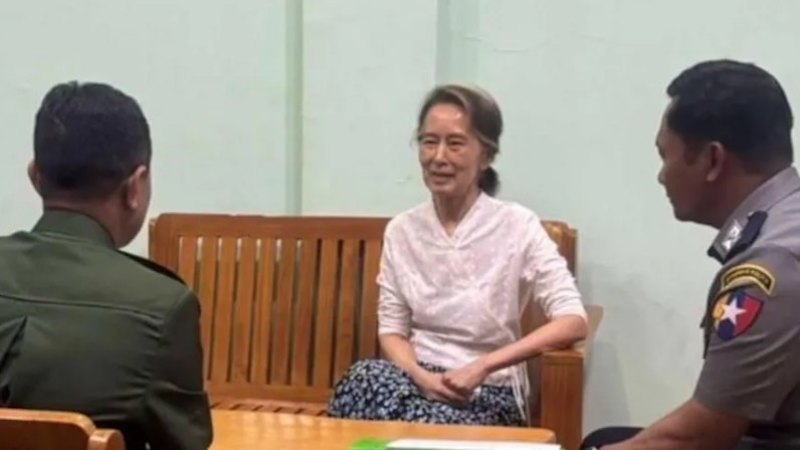
Aung San Suu Kyi is moving again.
The news filtered out through the stiff, controlled channels of the military junta’s state media. It was presented as a gesture of mercy—a concession to the brutal weather. The woman who once led Myanmar, the Nobel laureate who became an international icon before becoming a lightning rod for global criticism, has been transitioned from the stark sterility of a prison cell to the slightly more porous confines of house arrest.
But in the complex, blood-soaked chess game of Myanmar’s internal politics, a change in scenery is rarely just about a thermometer.
The Concrete Silence
Imagine a room where the only sound is the rhythmic, mechanical hum of a fan that lacks the strength to actually cool the air. The walls are thick. The windows are high. In a standard prison, time is not measured in hours, but in the distance a single beam of light travels across a dusty floor. For Suu Kyi, this has been the reality since the dawn of February 1, 2021.
That morning, the world woke up to videos of an aerobics instructor dancing in front of the parliament building while armored vehicles rolled in behind her. It was a surreal juxtaposition that signaled the end of a fragile, ten-year experiment with democracy. Suu Kyi was swept up in the first wave of arrests. The charges followed like a frantic after-thought: illegal possession of walkie-talkies, violation of official secrets acts, election fraud, corruption.
The sentences stacked up until they totaled thirty-three years. For a person in their late seventies, that isn't a sentence. It’s a lifetime.
The move to house arrest is a shift in the physical experience of her detention, but it does little to alter the legal weight pressing down on her. She remains a prisoner of the state. The walls have simply moved a few yards back.
The Geography of Power
To understand why this move matters, one has to look at the ground beneath the soldiers' boots. Myanmar is not a monolithic entity; it is a fractured mosaic of ethnic states and central lowlands, currently locked in a civil war that the rest of the world has largely relegated to the back pages of the news cycle.
The military, known as the Tatmadaw, is currently facing its most significant challenge since it first seized power in 1962. A coalition of ethnic armed organizations and the People’s Defense Forces—mostly young people who traded their laptops for rifles after the coup—has pushed the junta into a corner. They have lost border towns. They have lost trade routes to China. They are losing the young men who used to fill their ranks.
In this context, moving Suu Kyi is a strategic exhale.
It is a signal to the international community, a desperate reaching for a "humanitarian" narrative. By citing the extreme heat—which has indeed been breaking records across Southeast Asia, with temperatures soaring past 40 degrees Celsius—the junta attempts to don the mask of the concerned guardian. It is a way to soften their image without actually softening their grip.
The Ghost in the Machine
There is a specific kind of cruelty in being a symbol. For the protesters who still risk everything in the streets of Yangon or the jungles of Karen State, "The Lady" is a flickering candle. Many of the younger generation have grown disillusioned with her, citing her defense of the military during the Rohingya crisis at the International Court of Justice. They feel she tried to play a game of compromise with men who only understand the language of the gun.
Yet, even for those who have moved past her politically, her physical well-being remains a barometer for the country’s soul.
If she were to die in a prison cell due to heatstroke or neglect, she would become a martyr of such magnitude that the resulting explosion of rage might finally level the walls of Naypyidaw. The junta knows this. They are not protecting her out of kindness; they are protecting their own survival. They need her alive, sequestered, and quiet.
The Invisible Stakes
What does it mean to be moved from a cell to a house?
In the cell, you are a number. In the house, you are a ghost. House arrest in Myanmar’s history—specifically for Suu Kyi, who spent 15 of 21 years between 1989 and 2010 in her family’s lakeside villa—is a strange, liminal space. It is a place where you can hear the birds, where you might see the rain hit the leaves of a mango tree, but where the gate is still locked from the outside.
It is a psychological theater. The move suggests a return to a "status quo" that no longer exists. The Myanmar of 2010, which was full of tentative hope and the opening of internet cafes, is gone. The Myanmar of 2026 is a land of drones, encrypted messaging, and scorched-earth tactics.
The junta’s spokesperson, Zaw Min Tun, couched the move in the language of elderly care. He spoke of the need to prevent heatstroke among all elderly prisoners. It was a masterful bit of bureaucratic theater—treating a political earthquake as if it were a routine health and safety memo.
The Broken Dialogue
The real question is whether this move signals a willingness to talk. For years, regional powers like ASEAN have been pushing a "Five-Point Consensus" that includes an immediate cessation of violence and a dialogue between all parties. The junta has ignored it.
By moving Suu Kyi, are they preparing her for a role as a negotiator? Or is she merely a human shield against international sanctions?
The resistance forces on the ground remain skeptical. They see the move as a distraction. While state media broadcasts images of "mercy," the military continues to launch airstrikes on villages in Sagaing and Magway. The fire from the sky is much more lethal than the heat from the sun.
The Weight of the Sun
Consider the physical reality of the Burmese sun. It bleaches the color out of the landscape. It turns the Irrawaddy River into a shimmering, silver ribbon that looks beautiful from a distance but feels like a furnace up close.
For the thousands of other political prisoners who were not moved this week, the heat remains a daily torture. They are crammed into cells built for four that now hold twenty. They have no fans. They have limited water. For them, there is no state media announcement. There is only the slow, suffocating crawl of the afternoon.
The move of Aung San Suu Kyi is a reminder that in Myanmar, even the weather is political.
Every degree of temperature is a variable in a calculation of power. The junta is betting that a small concession—a change of address for a famous prisoner—will buy them the time they need to crush the rebellion in the hills. They are betting that the world will see "house arrest" and think "progress."
But progress isn't a change of rooms.
Progress is the ability to walk out of the front door and into a street where you don't have to look over your shoulder for a sniper. It is the ability to cast a vote that isn't later burned in a courtyard. Until that happens, the move is just another layer of the long shadow cast by the towers of Naypyidaw.
The Lady is in a house now. The garden might be green, and the air might move a little more freely through the corridors. But the gates are still shut. The guards are still there. And outside, the country is still burning.