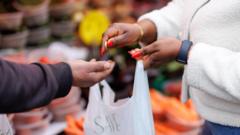
Maria stands in the cereal aisle, her hand hovering over a box of generic toasted oats. It costs four dollars and sixty cents. Two years ago, it was two dollars. She knows the news reports say inflation is cooling. She hears the pundits talk about "stabilization" and "target rates" while she stares at the price tag, waiting for the math to finally make sense. It doesn't. Not yet.
The disconnect between a falling inflation rate and a falling price tag is a cruel trick of linguistics. When the "rate of inflation" drops, things aren't getting cheaper; they are simply getting expensive at a slower pace. To Maria, and to millions of others watching their bank balances dwindle under the weight of a grocery cart, the economic recovery feels like a ghost. You can see it in the charts, but you can’t feel it in your pockets.
We are living through a period of economic "stickiness." It is a phase defined by a stubborn refusal of the world to return to the way it was. The reasons for this delay aren't just found in ledger books. They are buried in the complex, fragile machinery of global logistics and the psychological armor of the people who run the companies we buy from.
The Ghost in the Supply Chain
Think of the global supply chain as a massive, intricate series of water pipes. In 2020 and 2021, those pipes didn't just leak; they shattered. Every major port, trucking route, and processing plant froze. To fix the system, companies had to spend billions. They bought new fleets, signed expensive long-term contracts for fuel, and raised wages to keep workers from walking out during a crisis.
Now, imagine the water is flowing again. The pressure is back to normal. However, the plumber is still paying off the emergency tools he bought to fix the burst.
Businesses operate on a delay. A grocery store chain doesn't buy its milk the morning you drink it. They operate on futures and long-term procurement contracts. If a company signed a contract for fuel or raw materials six months ago when prices were at their peak, they are locked into those costs today. Even if the market price of oil drops tomorrow, the bread on the shelf remains expensive because the flour was transported using yesterday’s expensive diesel.
There is also the matter of "inventory lag." Stores are currently stocked with goods produced at the highest point of the inflationary curve. They cannot—or will not—lower the price until they have cleared out that expensive stock. If they lowered prices today, they would be selling at a loss. They are waiting for the cheaper goods to work their way through the system. It is a slow, agonizing crawl from the warehouse to the register.
The Psychological Ceiling
Economics is often treated like a hard science, but it is actually a study of human behavior. Specifically, it is a study of what we are willing to tolerate.
For decades, the price of a cup of coffee or a gallon of milk stayed relatively predictable. Then, the world broke. We became accustomed to seeing "supply chain surcharge" or "market price" stickers. We grew used to the shock. This created a new psychological baseline.
Retailers are cautious creatures. They watched their profit margins get squeezed to the bone during the height of the crisis. Now that costs are finally dipping, they aren't rushing to pass those savings on to the consumer. Instead, they are rebuilding their "cushion." They are terrified of the next shock—another war, another drought, another shuttered port. They are keeping prices high to insure themselves against a future they no longer trust.
This isn't necessarily a conspiracy of greed, though "greedflation" has certainly been a topic of heated debate in boardrooms. It is more akin to a trauma response. After years of volatility, no CEO wants to be the first to drop prices only to have a sudden energy spike wipe out their earnings. They are waiting for a signal of permanent stability that hasn't arrived.
The Invisible Weight of Energy
Fuel is the hidden ingredient in everything. It is in the plastic packaging of your blueberries. It is in the nitrogen fertilizer used to grow the corn. It is in the refrigerated truck that keeps the yogurt from spoiling on the interstate.
Energy prices have a "long tail." When the price of a barrel of oil drops, it doesn't immediately translate to a cheaper blueberry. The farmer already paid for the fertilizer months ago. The trucker is still paying off a high-interest loan on a rig purchased when the world was in chaos.
The global energy market is currently caught in a tug-of-war. On one side, we have increased production and a shift toward renewables. On the other, we have geopolitical instability in the Middle East and Eastern Europe that keeps the market on edge. As long as the "risk premium" remains high, fuel prices will remain volatile. And as long as fuel is volatile, the cost of moving a box of cereal from a factory in Michigan to a shelf in Florida will remain elevated.
The Wage Floor
There is one factor that almost never goes backward: wages.
During the labor shortages of the last few years, workers finally gained leverage. Service workers, truck drivers, and warehouse staff saw their pay increase significantly. This was a long-overdue correction for many, but in the cold eyes of an balance sheet, it represents a permanent increase in the cost of doing business.
Unlike the price of wheat or the cost of a shipping container, wages are "downwardly sticky." You cannot easily tell your staff that because inflation is down, you are cutting their hourly pay by two dollars. Once the wage floor rises, the price of the service provided by that labor stays high. The person who bags Maria’s groceries is making more than they did in 2019. That is a victory for the worker, but it means the "normal" prices of 2019 are likely gone forever.
We aren't waiting for prices to return to where they were. We are waiting for our reality to catch up to where they are now.
The Ripple in the Pond
Consider the path of a single loaf of bread.
It begins with a grain of wheat. The farmer faced higher costs for seed and equipment. The harvest was affected by shifting weather patterns that made yields unpredictable. The grain was moved to a mill that saw its electricity bills double. The flour was then sent to a commercial bakery that had to raise wages to keep its night shift staffed. Finally, the bread was driven to a store by a logistics company grappling with insurance premiums that have skyrocketed because of the increased value of the goods they carry.
Every one of those steps is a person or a company trying to stay afloat. Each one is holding onto their current pricing structure until they feel certain the ground beneath them won't shift again.
The "normal" we are looking for is a mirage. History shows that after major inflationary shocks, prices rarely "deflate" back to their original starting point. Instead, they plateau. We are currently in the agonizing stretch of that plateau where the shock has worn off, but the relief hasn't arrived.
Maria puts the oats in her cart. She doesn't do it because she's happy with the price. She does it because her kids need to eat before school. She is the final link in the chain, the one who absorbs all the friction, all the delays, and all the "stickiness" of a global economy trying to remember how to be calm.
The checkout bell rings. It’s a sharp, lonely sound. It marks the moment where the abstract theories of the Federal Reserve meet the tangible reality of a bank account. We are waiting for an echo that is taking its time to return, traveling through miles of broken pipes and cautious hearts, while the world learns how to afford itself again.