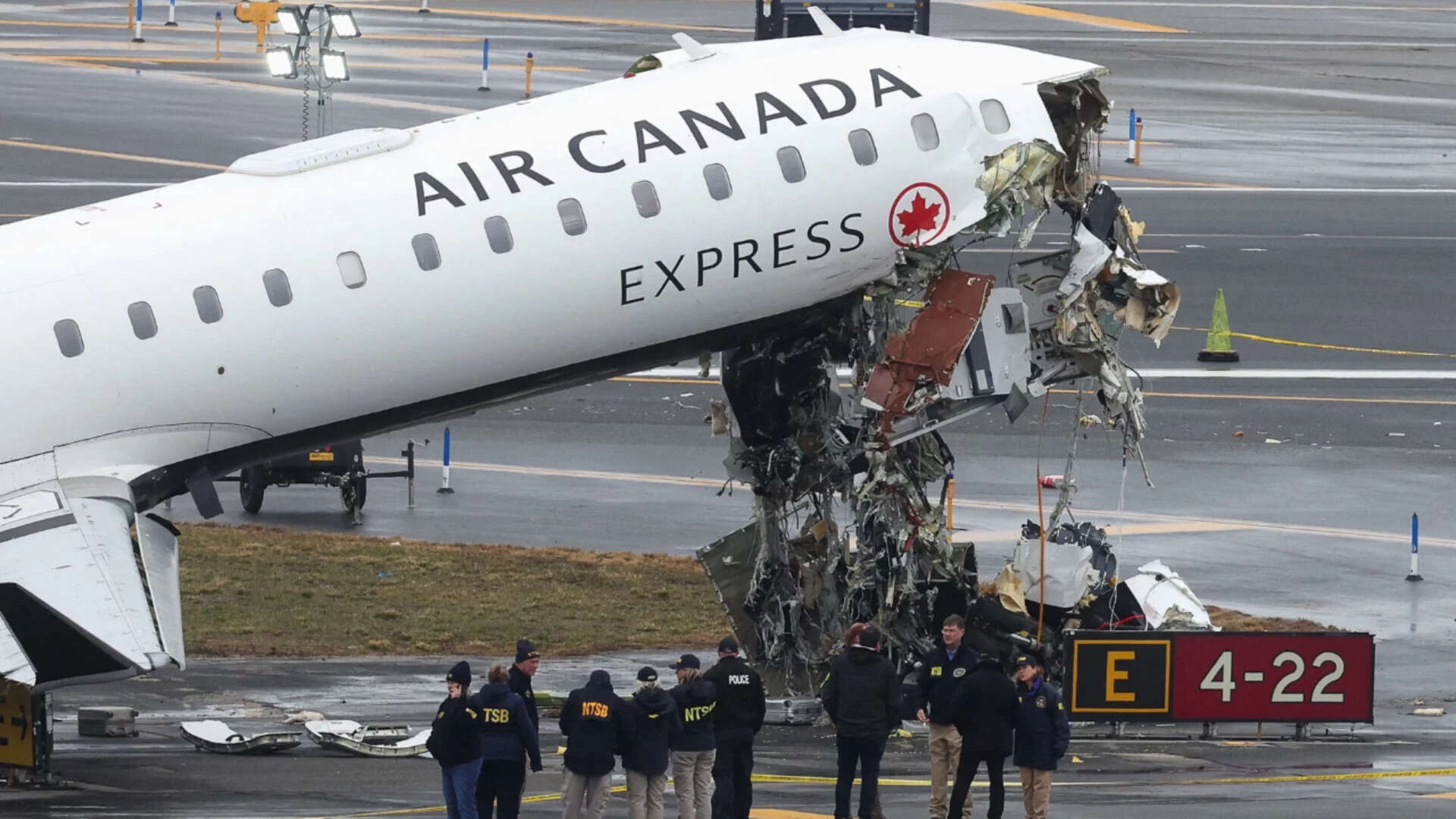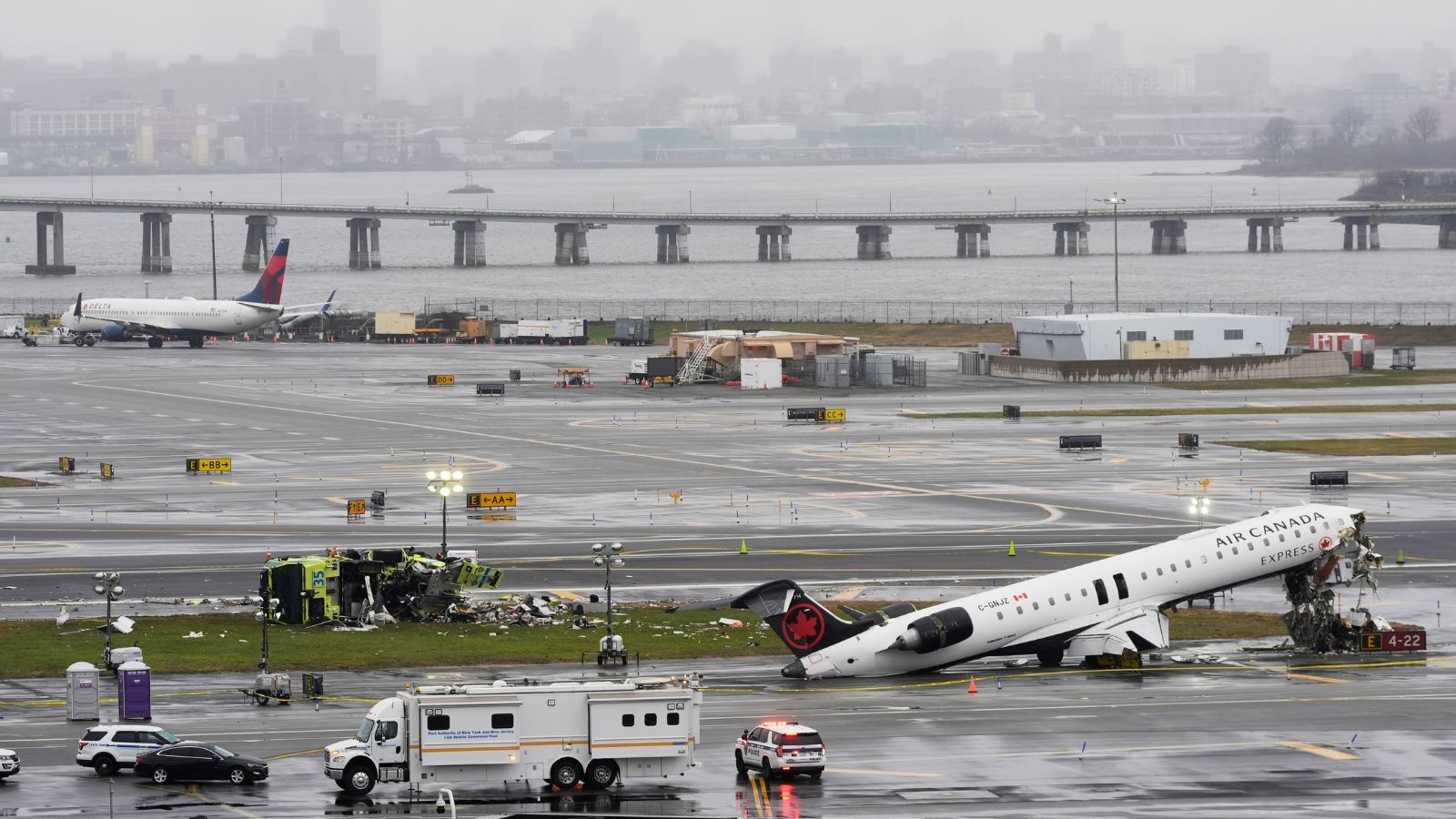
The headlines are predictable. They scream about "tragic accidents" and "heroic responses." They focus on the smoke, the twisted metal of the fire truck, and the heartbreak of two pilots lost on a New York runway. But the mainstream media is missing the point. This wasn’t a freak accident. It was an inevitability born of a system that prioritizes legacy radio tech over basic digital spatial awareness.
Stop calling it a tragedy. Call it a systems failure.
While we obsess over the "human error" of a fire truck driver or a cockpit crew, we ignore the reality: aviation ground safety is operating on a wing and a prayer. We have self-driving cars navigating the chaos of Manhattan, yet we can't keep a multi-ton jet from hitting a bright red truck on a closed strip of tarmac. If you’re looking for a "who to blame" narrative, you’re asking the wrong question. The question is why we allow a billion-dollar industry to rely on 1940s-era voice commands to prevent metal-on-metal carnage.
The Myth of the Sterile Runway
The competitor reports will tell you that LaGuardia is a "tight" airport. They’ll mention the short runways and the congested taxiways. They use these facts to excuse the collision. That’s a lie.
Physical space wasn't the problem. Data visibility was.
In every modern logistics hub—think Amazon fulfillment centers or automated ports—every moving asset is tracked with sub-meter precision. In aviation, we still rely on ASDE-X (Airport Surface Detection Equipment, Model X). It’s a Frankenstein’s monster of primary radar, multilateration, and ADS-B. It’s better than nothing, but it’s reactive. It tells a controller there’s a conflict after the trajectories have already intersected.
The industry acts like a runway is a sacred, empty space. It’s not. It’s a high-stakes intersection. When an Air Canada jet accelerates for takeoff, the pilots are looking at their V-speeds, not scanning for a stray ARFF (Aircraft Rescue and Firefighting) vehicle that shouldn't be there. They shouldn't have to. The fact that a truck can even enter a "hot" runway without an automated, hard-kill ignition cutoff or a cockpit override is a staggering indictment of FAA stagnation.
Stop Blaming the Firefighters
The easy target is the driver of that fire truck. "Why were they there?" "Did they miss a radio call?"
I've spent years looking at "incursion" data. Here is the uncomfortable truth: human beings are biologically incapable of maintaining 100% situational awareness in high-stress, high-noise environments over a thirty-year career. If your safety protocol relies on a guy in a truck hearing a specific string of alphanumeric code over a crackling radio frequency while sirens are blaring, your protocol is garbage.
We treat "Radio Discipline" as a religion. It’s actually a liability.
Voice communication is the single greatest point of failure in aviation. It is slow. It is prone to "expectation bias" (hearing what you expect to hear). It is susceptible to "stepping over" (two people talking at once).
- The Problem: The truck driver thinks they have clearance.
- The Reality: The controller gave it to someone else.
- The Result: Two dead pilots.
We don't need better training. We need Digital Taxi Clearances for ground vehicles that physically lock the brakes if the vehicle enters a restricted zone without a digital handshake from the tower. If your Tesla can stop itself before hitting a pedestrian, a $1 million fire truck can be programmed to not drive into the path of a departing Airbus.
The LaGuardia Bottleneck is a Choice
LaGuardia is often mocked as a "third-world airport." The recent multi-billion dollar terminal renovations were nice for the passengers, but they were a coat of paint on a rotting fence. The "airside"—the actual pavement where planes move—is still a nightmare of 1950s geometry.
The industry likes to talk about "Safety Management Systems" (SMS). It sounds sophisticated. In practice, it’s a way for administrators to shuffle paperwork and prove they followed "process." If the process results in a jet hitting a truck, the process is flawed.
We tolerate these risks because the cost of a "total digital overhaul" of ground movements is higher than the occasional payout for a hull loss or a wrongful death suit. That is the cynical math of the industry. We are trading pilot lives for legacy infrastructure savings.
The False Security of ADS-B
You’ll hear "experts" talk about ADS-B (Automatic Dependent Surveillance–Broadcast) as the savior of the skies. It’s not. Most ground vehicles are equipped with "squitters" that transmit their position. But here is the catch: that data often doesn't feed directly into the cockpit's primary flight display in a way that generates a meaningful "Conflict Alert" for takeoff.
The pilots are blind to the ground threats that the tower might see. We’ve bifurcated the responsibility. The tower sees the board; the pilots fly the pieces. When the link between them—the human voice—fails, the system collapses.
Imagine a scenario where the Air Canada jet had an independent, AI-driven optical system. A set of high-definition cameras combined with LiDAR that scans the runway during the takeoff roll. If it detects a non-biological mass on the center-line, it triggers an automated rejected takeoff (RTO) faster than a human can process the image.
Why don't we have this?
- Certification lag: The FAA takes ten years to approve a toaster.
- Weight/Cost: Airlines hate adding hardware that doesn't generate "revenue."
- Union pushback: There is a deep-seated fear of taking "discretion" away from the cockpit.
But discretion is what killed those two pilots. They didn't see the truck until it was too late. Discretion failed. Automation would have saved them.
The "Human Factors" Trap
Every time this happens, the NTSB will spend two years writing a report on "Human Factors." They’ll look at sleep cycles, training records, and cockpit gradients. They’ll find a "probable cause" that points to a specific person's mistake.
This is a distraction.
By focusing on the "Human," we ignore the "Factors." The factor is the environment. If you design a kitchen where the stove is next to the ice dispenser and wonder why people get burned, the problem isn't the cook.
The runway at LaGuardia is a poorly designed "kitchen." It requires perfection from every player, every time. In any other field of engineering, that is considered a "single point of failure." In aviation, we call it "professionalism."
It’s time to stop expecting pilots and ground crews to be perfect. It’s time to start demanding that the infrastructure be idiot-proof.
The Hard Truth About Airport Rescue
There is a dark irony here: the very people tasked with saving lives in the event of a crash are the ones who caused this one. ARFF crews are under immense pressure to meet "response time" mandates. They have to get to any point on the airfield within minutes.
This creates a culture of "rush." When you combine a culture of "rush" with a communication system based on 80-year-old radio tech and a physical layout that resembles a plate of spaghetti, you don't get safety. You get a collision.
We need to rethink the "Fire Truck" model entirely. Why are we driving massive, heavy vehicles across active runways? Fixed fire-suppression systems, remote-controlled drones, and automated "water cannons" positioned at high-risk points could perform the initial knockdown of a fire without putting a single vehicle in a taxiway conflict.
But that would require a radical reimagining of the airfield. And the aviation industry doesn't do "radical." It does "incremental"—and incrementalism is why people are dying.
The Actionable Pivot
If you’re a traveler, stop looking at the "Safety Rating" of the airline. Start looking at the "Tech Integration" of the airports you frequent.
The industry will tell you that flying is safer than ever. Statistically, they are right. But that's a "lazy consensus." It’s safer because engines don't fail as often and GPS is better than VOR. It is not safer because we’ve solved ground incursions. In fact, as traffic density increases at airports like LGA, the risk of a "surface event" is actually climbing.
We need to demand three things immediately:
- Mandatory Geofencing: Every ground vehicle at a Class B airport must have GPS-linked geofencing that kills the engine if it crosses a "hold short" line without an active transponder handshake.
- Cockpit Ground Radar: Pilots need a top-down, real-time digital map of all surface traffic fed directly to their tablets or HUDs, independent of the tower's voice.
- End of Voice-Only Clearance: If it’s not on a screen, it didn't happen. No more "cleared for takeoff" via a radio call that can be misheard.
The "tragic accident" at LaGuardia was a choice. We chose to keep using old tools because they were "good enough." They weren't.
Stop waiting for the NTSB report. We already know what it will say. It will blame the people. I’m telling you to blame the system that gave those people no chance to succeed.
The "status quo" in aviation isn't a safety net; it’s a blindfold. And until we rip it off, more pilots will pay the price for our refusal to modernize the tarmac.
The metal doesn't lie. The system broke. Fix the tech, or get off the runway.