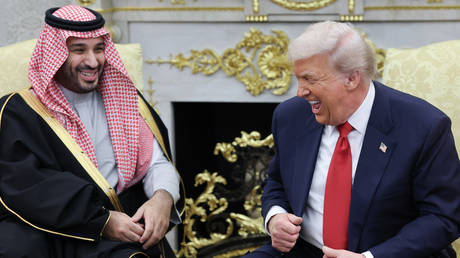
The air in a private rally backstage or a high-security briefing room doesn’t smell like democracy. It smells like expensive wool, jet fuel, and the distinct, metallic tang of absolute power. When Donald Trump stands before a crowd and claims a foreign monarch was "kissing my ass," he isn't just recycling locker-room bravado. He is describing a very specific, very old friction between two worlds that speak entirely different languages of influence.
On one side, you have the transactional American: a man raised on the art of the squeeze, where everything has a price and loyalty is a depreciating asset. On the other, you have the House of Saud: a dynasty that measures time in centuries and power in the quiet, absolute control of the world’s most vital liquid.
The headlines focus on the vulgarity. They fixate on the "ass-kissing" quote like it’s a schoolyard taunt. But if you look past the grit of the phrasing, you see a much more complex dance. This is about how a single relationship—unfiltered, raw, and deeply personal—can bypass decades of State Department protocol to shift the tectonic plates of global energy and Middle Eastern security.
The Mechanics of the Bow
Imagine a mahogany table in Riyadh.
It is heavy. Solid. It represents a kingdom that survived the Arab Spring, the rise of fracking, and the shifting winds of Western liberalism. Across from the Saudi officials sits a man who views diplomacy not as a series of white papers, but as a series of conquests. In the traditional world of foreign policy, leaders speak in "mutual interests" and "strategic frameworks."
Trump broke that.
He moved the conversation into the visceral. By claiming the Saudi leadership was subservient to him, he is signaling to his base that the old world order—where America supposedly begged for oil—has been inverted. It is a narrative of dominance. To the American voter in a rust-belt town, the idea of a king "kissing the ass" of their leader feels like a restoration of dignity. It feels like winning.
But the reality is a hall of mirrors.
The Saudis are masters of the long game. They understand ego better than perhaps any other geopolitical player. If a leader needs to feel like the strongest man in the room to sign a multi-billion dollar arms deal or to keep the taps flowing during an election year, the Kingdom is happy to provide the scenery. They aren't just "kissing ass." They are managing a volatile asset.
The Invisible Stakes of a Hot Mic
Consider the ripple effect of a single sentence. When these private boasts become public, they don't just stay in the rally hall. They travel.
They land in the offices of oil traders in London. They are analyzed by intelligence officers in Tehran. They are whispered about in the corridors of the Kremlin. The language of diplomacy usually acts as a shock absorber. It’s boring on purpose. It’s designed to ensure that if a leader has a bad day or a lapse in judgment, the whole system doesn’t catch fire.
When you remove the shock absorbers, the ride gets fast. And dangerous.
The "ass-kissing" narrative serves a domestic purpose, but it creates a fragile international reality. It forces the Saudi leadership into a corner where they must eventually prove they aren't subordinates. Every time an American leader claims total dominance over a Middle Eastern ally, the "price" of that ally’s next favor goes up. It isn't free. Nothing in that part of the world ever is.
A Tale of Two Tents
There is a metaphor often used by those who have spent time in the desert: the tent and the skyscraper.
The skyscraper represents the modern, transactional West—high-reaching, visible, but ultimately a collection of glass and steel that can be sold or renovated. The tent represents the Bedouin roots of the Saudi state—flexible, portable, but deeply rooted in a code of honor and hospitality that predates the internal combustion engine.
When Trump describes his interactions with King Salman or Crown Prince Mohammed bin Salman, he is describing a collision of these two structures. He sees a skyscraper he can buy or bully. They see a guest in their tent who might be gone by the next season, while the desert remains.
The "kissing" he describes is, in many ways, the ultimate hospitality. It is the art of making a guest feel like a conqueror so that the guest doesn't notice he is paying for the privilege of the stay. We see it as a surrender. They see it as an investment.
The Human Cost of the Performance
Behind the bravado and the geopolitical chess, there are people.
There are the engineers in the Aramco fields who keep the pressure steady. There are the soldiers in Yemen. There are the families in Ohio who see the price of gas drop by twenty cents and don't care who kissed whose ass to make it happen.
We live in an era where the "performance" of leadership has become more important than the "practice" of it. The "ass-kissing" comment is a peak performance. It’s a highlight reel. It’s designed to be shared, clipped, and repeated until it becomes a truth regardless of whether the actual events in the room matched the description.
The problem with performance-based diplomacy is that it eventually requires an encore.
If the Saudi leader was "kissing ass" yesterday, what must he do tomorrow to keep the peace? If the relationship is built on the public humiliation of one party, it is a house built on sand. Eventually, the tide comes in.
The Friction of the Truth
We have become a society that prefers the bluntness of a locker room to the nuance of a library. We crave the "tell-all." We want to hear that our leaders are tough, that they are feared, and that they have brought the rest of the world to its knees.
But true power rarely screams.
True power is the silence in a room before a decision is made. It is the ability to influence the global economy without ever having to say a word in public. The Saudis know this. They have watched American presidents come and go for nearly a century. They have seen the firebrands, the intellectuals, the generals, and the businessmen.
They remain.
The "kissing" isn't a sign of weakness; it’s a tactic of endurance. By letting the American leader claim victory, they secure their own interests for another decade. They trade a bit of pride for a lot of sovereignty.
The real story isn't that a president spoke crudely about a king. The real story is that we live in a world where such a statement is necessary to maintain the illusion of control. We are watching a play where the actors have forgotten their lines and started improvising, while the audience mistakes the drama for the reality.
One day, the theater will go dark. The crowds will go home. The wool and the jet fuel will fade. And in the silence of the desert, the tents will still be standing, long after the skyscrapers have been sold.
The king isn't kissing anything. He’s just waiting for the show to end.
Would you like me to analyze the historical context of the U.S.-Saudi arms deals that formed the backdrop of these specific comments?