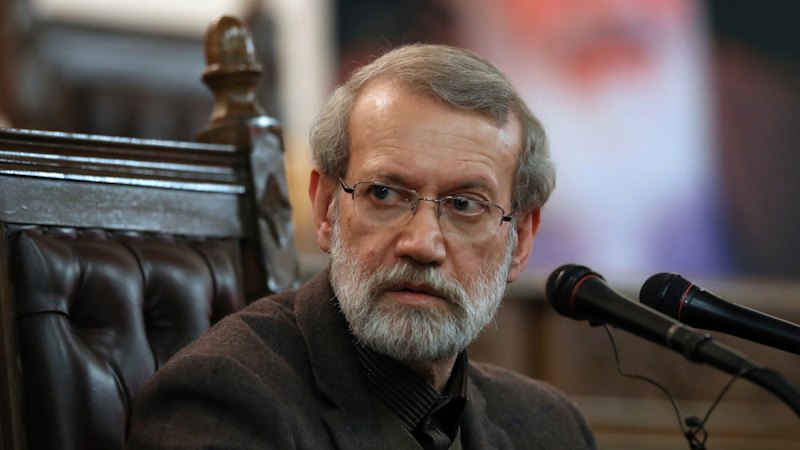
Ali Larijani wasn’t a "de facto ruler." He was a pressure valve.
The Western foreign policy establishment is currently mourning the loss of "stability" following the death of the former Iranian parliament speaker. They are terrified. They see the vacuum left by a "pragmatic conservative" and assume the Middle East just became a more dangerous place because the "reasonable" guy is gone.
They are wrong. Dead wrong.
Larijani represented the most dangerous element of the Islamic Republic: the illusion of a negotiable partner. His presence allowed the West to indulge in the fantasy that the regime could be reformed, contained, or incentivized through traditional diplomacy. With Larijani out of the picture, the mask doesn’t just slip—it dissolves. For the U.S. and Israel, this isn't a crisis of instability. It is the arrival of long-overdue clarity.
The Myth of the Iranian Pragmatist
Western analysts love the word "pragmatist." They use it to describe any Iranian official who doesn't actively scream "Death to America" while eating breakfast.
Larijani was the quintessential face of this deception. He was a creature of the system, a man who spent decades perfecting the art of the stall. I have watched diplomatic circles in Brussels and D.C. fall for this act for twenty years. They believed that if they just found the right "moderate" faction, they could strike a deal that would stick.
This is a fundamental misunderstanding of how power works in Tehran.
The Iranian power structure isn't a see-saw between moderates and hardliners. It is a monolithic entity that uses "moderates" as a shield against international sanctions. Larijani’s job was to make the regime look palatable enough to prevent a total economic blockade while the IRGC (Islamic Revolutionary Guard Corps) continued to build its missile program and fund its proxies.
By dying, Larijani has done the world a favor. He has removed the shield.
The IRGC Inherits a Graveyard
The "lazy consensus" suggests that Larijani’s death empowers the IRGC and the ultra-hardliners, making a kinetic conflict more likely. The logic follows that without a civilian statesman to pump the brakes, the military will drive the country off a cliff.
Here is the nuance the "experts" missed: The IRGC was already driving.
The only difference now is that they no longer have a civilian layer to blame for their failures. When Larijani was alive, the regime could play "Good Cop, Bad Cop." If a deal failed, it was the fault of the "obstructionist parliament." If the economy tanked, it was "mismanagement by the moderates."
Now? The hardliners own the wreckage.
In any corporate turnaround, the first step is identifying where the buck stops. In Iran, the buck now stops at the feet of the Supreme Leader and his praetorian guard. This is a massive strategic advantage for the U.S. and Israel. It simplifies the target. It removes the ambiguity that has paralyzed Western policy since 1979.
Why Instability is a Strategic Asset
We need to stop fearing Iranian instability. We should be courting it.
The status quo under Larijani was a slow-motion disaster. It allowed Iran to achieve near-breakout nuclear capability while maintaining enough diplomatic "noise" to prevent a unified global response. The "stability" Larijani provided was actually a protective shell for nuclear enrichment.
True disruption requires the removal of the middleman. Without Larijani, the internal contradictions of the Islamic Republic will sharpen.
- The Legitimacy Gap: Larijani was one of the few remaining figures who could bridge the gap between the old revolutionary guard and the technocratic elite. His absence leaves a void that cannot be filled by an IRGC commander with no political finesse.
- Economic Accountability: The regime can no longer pretend that "better relations with the West" are just around the corner if the right people get elected. The people of Iran now see a government that is 100% hardline and 100% incapable of fixing the rial.
- The Succession Crisis: This is the big one. Larijani was a dark horse candidate for Supreme Leader. His removal from the board doesn't just simplify things for the U.S.; it turns the internal race for Khamenei’s seat into a knife fight.
The Israel-Sunni Pivot
Israel and the Abraham Accords nations aren't worried about Larijani’s death. They are salivating.
The "Larijani doctrine" was about soft power—using diplomacy to drive wedges between the U.S. and its regional allies. He was good at it. He could sit down with European diplomats and make them feel like the "reasonable" Iranians were being bullied by the "Zionist-influenced" Americans.
With that voice gone, the threat is purely military. And a military threat is something the Israel-Sunni alliance knows how to handle. It’s quantifiable. You can build an Iron Dome for a missile; you can’t build an Iron Dome for a sophisticated diplomatic lie.
The Silicon Valley of Geopolitics
In the tech world, we talk about "failing fast." The West has been failing slowly in Iran for four decades. We have spent billions on "democracy promotion" and "diplomatic engagement" with people who had no intention of changing.
Larijani was the king of the "slow fail."
His death forces a pivot. It forces the U.S. State Department to stop looking for a "Persian Gorbachev" who doesn't exist. It forces the intelligence community to focus on the reality of the IRGC's grip rather than the fantasy of a parliamentary resurgence.
If you are an investor, a policy-maker, or a strategist, you should be looking at this as the ultimate "clear the decks" moment. The middle ground has been liquidated.
Stop Asking the Wrong Question
The media is asking: "Who will replace Larijani?"
That is the wrong question. It assumes the role he played—the bridge-builder, the moderate face—is still necessary for the regime's survival. It isn't. The regime has decided it no longer needs to pretend. It is moving into a phase of pure, unadulterated survivalism.
The real question is: "Now that the mask is gone, does the West have the stomach to face what’s behind it?"
The "pragmatist" is dead. The "negotiable" Iran is a corpse. The board is finally clear.
Stop mourning the man who spent his life making sure the Islamic Republic survived its own incompetence. Start preparing for the moment the regime is forced to stand on its own, without a civilian shield to hide behind. The era of the "Grand Bargain" died with Larijani.
Good riddance.
Don't look for the next Larijani. Look for the cracks in the IRGC's armor, because they no longer have anyone left to weld them shut.