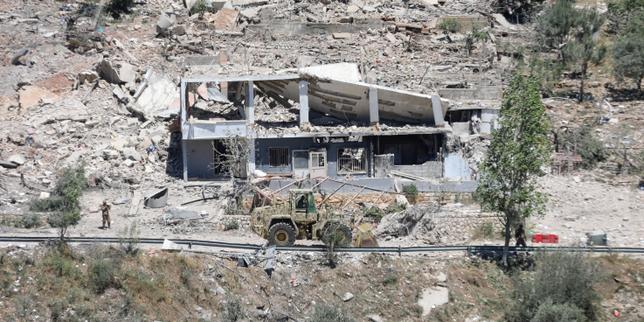
Lebanese Prime Minister Nawaf Salam wants you to believe that a breakthrough just happened in Washington. Following a freshly brokered ceasefire framework, he announced that the Lebanese Armed Forces (LAF) will start deploying into specific "pilot zones" in the south. The plan sounds great on paper. Israel withdraws from select pockets, the Lebanese army moves in, and the state establishes exclusive military control. Troops have already started trickling into the town of Debbine.
But let's look at reality. Hours after this grand announcement, Hezbollah leader Naim Qassem completely rejected the Washington agreement. He explicitly stated that his group hasn't committed to refraining from resisting aggression. Shortly after, rockets flew toward Israeli positions. Israel replied with heavy airstrikes near Tyre.
We need to call this what it is. A fragile geopolitical gamble. The pilot zones scheme aims to insert the state military as a buffer to avoid direct confrontation, but it ignores the elephant in the room. You can't establish exclusive state authority when an heavily armed, Iran-backed militia refuses to hand over the keys.
The Illusion of Exclusive Control
The logic behind these pilot zones—initially targeting areas like Debbine, east and west Zawtar, Yohmor, and the historic Beaufort Castle near Nabatieh—is clever but desperate. The US and Lebanese officials who structured this plan know the Lebanese army cannot disarm Hezbollah by force. Doing so would spark a catastrophic civil war inside Lebanon.
So, the strategy pivots. Instead of a head-on clash, the plan uses geographical phasing. The idea is simple. Israel vacates a specific town, and the Lebanese army rushes in before Hezbollah can reoccupy it.
"The next step is practical and tangible: the deployment of the Lebanese army in pilot zones as a first phase," Prime Minister Nawaf Salam stated during a cabinet meeting.
Politicians claim this strategy doesn't hurt Lebanon's right to a total Israeli withdrawal. They view it as a stepping stone. In reality, it creates a Swiss-cheese map of authority. You have areas under fragile state control bordered immediately by territory dominated by Hezbollah operations. It's a logistical nightmare that relies entirely on a voluntary withdrawal that Hezbollah has already refused to grant.
A Weak Military Caught in a Political Trap
Lebanon's military faces immense pressure. The international community, led by the US and France, repeatedly demands that Beirut enforce UN Resolution 1701. This resolution requires the area south of the Litani River to be completely free of unauthorized weapons.
The Lebanese government technically declared Hezbollah’s independent military actions illegal at the start of this conflict cycle in March. But words don't mean much without enforcement. The LAF is a multi-confessional force of about 80,000 soldiers. If the military leadership orders troops to forcibly disarm Shiite militants in the south, the army itself could fracture along sectarian lines.
Retired Lebanese General Khalil Gemayel hit the nail on the head when analyzing the military's strict limitations. He made it clear that the army won't fight any internal Lebanese faction because it refuses to trigger a civil war. He noted that disarming the group requires a broad domestic political decision, much like the disarmament of militias after the 1975–1990 civil war under the Taif Agreement.
Right now, that political consensus doesn't exist. The Lebanese state is broke, politically paralyzed, and functionally incapable of dictating terms to its most powerful military actor.
Why Washington Framework Is Already Cracking
The entire pilot zone initiative hinges on a ceasefire agreement reached in Washington. But the terms of that agreement contain massive loopholes that both combatants are already exploiting.
- No immediate Israeli withdrawal: Israel isn't required to pull out of southern Lebanon all at once. The IDF maintains it will continue operating against threats in the south.
- Hezbollah outright rejection: Because Hezbollah wasn't a direct signatory to the Washington talks, it feels zero obligation to respect the terms.
- Regional complications: The Islamic Revolutionary Guard Corps (IRGC) issued a statement declaring there will be no peace until Israel completely leaves Lebanese soil, signaling continued Iranian backing for the escalation.
Look at the numbers. The human toll is already staggering. The Lebanese Public Health Ministry confirms that the death toll from Israeli strikes since March has topped 3,500 people. Millions are displaced. The Lebanese public desperately wants the state army to take over and bring stability, but sending under-equipped troops into an active war zone with zero backing from local militants is a recipe for disaster.
What Needs to Happen Next
If this pilot zone strategy has any chance of surviving the week, the Lebanese government must pivot immediately. Sitting in Beirut reading cabinet statements isn't enough.
First, the Lebanese administration must leverage its diplomatic channels to secure explicit security guarantees for the deploying soldiers. The LAF cannot become sitting ducks for Israeli drone strikes or Hezbollah retaliatory rockets.
Second, international donors need to step up funding specifically for the units deploying south. These soldiers lack basic logistical support, communication gear, and fuel.
Don't expect a sudden outbreak of peace. The deployment to towns like Debbine is a minor tactical shift in a deeply volatile conflict. Watch the border closely over the next 48 hours. If the Lebanese army is forced to retreat from even one pilot zone due to local friction, the entire Washington framework will collapse before the ink even dries.


