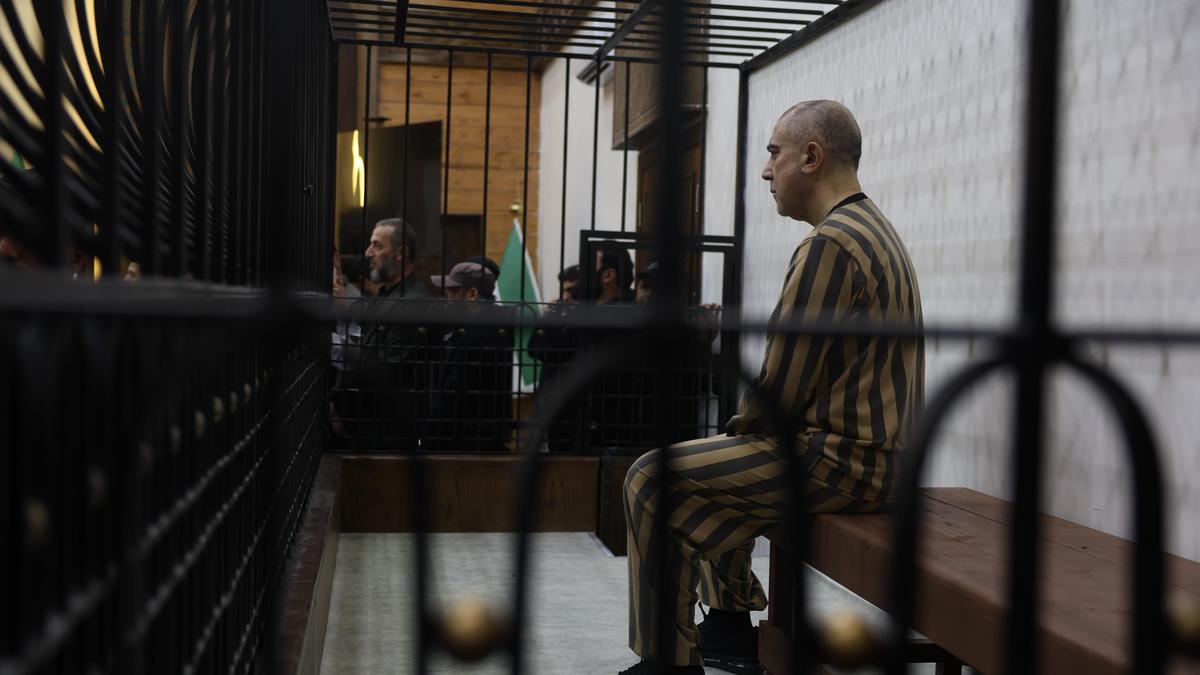
The air in a courtroom is supposed to be heavy with the scent of old paper and wood polish, but for those watching the proceedings against Bashar al-Assad and his inner circle, the air carries something else. It carries the metallic tang of blood spilled a decade ago. It carries the dust of pulverized cinderblocks from Homs, Aleppo, and Ghouta.
Legal documents are often viewed as dry, sterile things—stacks of A4 paper bound by clips and filled with Latin phrases that distance the reader from the reality of the crime. Yet, as the Syrian judiciary moves through these unprecedented proceedings, the papers aren't just evidence. They are a roll call of the missing.
For years, the world watched the Syrian conflict through the shaky lens of smartphone cameras and the frantic dispatches of activists. We saw the white helmets, the orange glows of nighttime shelling, and the haunting, vacant stares of children pulled from the rubble. But the transition from a war zone to a courtroom is a shift from chaos to the cold, unrelenting logic of accountability.
The Architecture of Silence
Consider a woman named Amina. She is a hypothetical composite of the thousands who have stood on the periphery of this story, her life bifurcated by a single afternoon in 2012. Before the war, she was a teacher. After the war began, she became a seeker of names. Her husband disappeared into the maw of the state security apparatus, a system managed by the very men now facing the scrutiny of the law.
In a standard news report, Amina’s husband would be a statistic. He would be one of the 150,000 estimated detainees. In a courtroom, he becomes a case file. This is the agonizingly slow alchemy of justice: turning a scream into a testimony.
The proceedings against Assad and his allies aren't merely about the acts of soldiers on a battlefield. They target the architects. They target the men who sat in air-conditioned offices in Damascus, signing orders that authorized the "cleansing" of neighborhoods. These legal maneuvers are stripping away the sovereign immunity that has long acted as a shield for the elite.
The defense often relies on the fog of war. They argue that in the heat of a rebellion, lines are blurred and mistakes are inevitable. But the evidence being presented tells a different story—a story of systematic, industrial-scale cruelty. It is the difference between a spontaneous fire and an arsonist’s blueprint.
The Invisible Stakes of a Verdict
Why does this matter now, years after the front lines have largely frozen?
The stakes are found in the precedent being set for the next century. If a head of state can orchestrate the displacement of half his population and the torture of thousands without ever facing a judge, then the international concept of "human rights" is nothing more than a polite suggestion. It is a fairy tale we tell ourselves to sleep better at night.
The Syrian court proceedings represent a crack in the wall of impunity. When we talk about "proceedings," we are talking about the slow, methodical process of verifying that what happened was not an accident. We are talking about satellite imagery that shows the growth of mass graves. We are talking about the "Caesar" photographs—the 55,000 images smuggled out by a military photographer that document the sheer scale of the state’s brutality.
Imagine sitting in a room where a judge looks at a photograph of your brother, identified only by a number etched into his skin, and asks a general to explain the protocol for that numbering. That is the reality of this legal journey. It is a confrontation between the absolute power of the past and the objective truth of the present.
The Logic of the Ledger
There is a specific kind of horror in the bureaucracy of the Syrian state. It is not just the violence; it is the fact that the violence was recorded, filed, and stamped.
The prosecution’s case relies heavily on the state’s own obsession with paperwork. In many ways, the regime’s meticulous record-keeping has become its greatest liability. Every detention, every interrogation, and every "final disposition" left a paper trail. These documents are the ghosts that have come back to haunt the banquet.
The transition from a military conflict to a legal one changes the language of the struggle. On the battlefield, the goal is to survive. In the courtroom, the goal is to remember.
The regime’s allies—those who provided the jets, the fuel, and the political cover—are also finding their names written into the ledger. The scope of the proceedings is widening to include the network of enablers who made the survival of the Assad government possible. This isn't just about one man; it is about an entire ecosystem of repression.
A Mirror for the Rest of Us
We often look at Syria as a tragedy that happened "over there." It is easy to view it as a distant, insoluble mess of Middle Eastern geopolitics. But these court cases force us to look in the mirror. They ask us: what is the value of a life when the cameras stop rolling?
For the survivors, the courtroom is the only place where their reality is validated. For years, they were told their suffering didn't happen, or that it was a necessary sacrifice for "stability." Now, under the fluorescent lights of a legal chamber, their stories are being entered into the permanent record of humanity.
There is no "win" in this scenario. There is no sentence long enough to bring back the dead or un-burn the cities. There is only the recognition of the truth.
The process is grueling. It is often bogged down by jurisdictional hurdles and political maneuvering. There are those who say these trials are symbolic, that the accused will never actually spend a day in a cell. They might be right. But symbols are what civilizations are built upon.
When a judge reads out the charges of crimes against humanity, the silence that follows is the sound of a wall finally beginning to crumble. It is the sound of a teacher like Amina finally hearing her husband’s name spoken by someone who cannot simply turn away.
The ledger is open. The ink is drying. And for the first time in a generation, the men who thought they were gods are being reminded that they are merely men, and that men can be held to account.
The gavel falls, not with the thunder of a bomb, but with the terrifying, quiet finality of a period at the end of a very long sentence.