The air inside the Washington briefing room always smells faintly of stale coffee and expensive wool. It is a sterile environment designed to compartmentalize chaos. On the projector screen, a map of the Persian Gulf glows in sharp blues and greens. To the analysts sitting in the leather chairs, the lines across the Strait of Hormuz are just vectors of geometry. They represent shipping lanes, throw-weights, and missile envelopes.
But if you zoom in close enough, past the satellite resolution, the geometry dissolves into sweat.
Consider a twenty-year-old sailor stationed aboard a destroyer in those waters. Let us call him Marcus. He does not think about grand strategy. He thinks about the unnatural hum of the ship’s ventilation, the way the salt air corrodes the exposed steel, and the heavy, suffocating heat that hits his face the moment he steps onto the deck. For Marcus, the geopolitical tension between Washington and Tehran is not a chess game. It is a sudden, sharp spike in his heart rate every time an unidentified radar blip flickers on the console.
Recently, the rhetoric surrounding Marcus’s world shifted. Donald Trump, speaking with the casual certainty of a man accustomed to signing tall buildings into existence, laid out a stark calculus regarding a potential conflict with Iran.
"Militarily or on paper," he stated, the United States would win.
It is a phrase that demands scrutiny. It splits reality into two distinct columns. On one side, the ledger of paper—the contracts, the GDP calculations, the sheer, staggering asymmetry of American military spending. On the other side, the ledger of powder—the unpredictable, chaotic friction of actual combat.
To understand what happens when these two columns collide, we have to look past the bluster. We have to look at the quiet shifts in power happening behind closed doors in Tehran, and the realization that wars are rarely decided by the math we do before the first shot is fired.
The Fiction of the Flawless Equation
Paper is comforting.
On paper, the United States possesses an overwhelming advantage that borders on the absurd. The American military budget hovers near a trillion dollars. It funds stealth bombers that can slip through radar like ghosts, carrier strike groups that command the oceans, and satellite networks that see through clouds. Iran’s military budget is a fraction of that. On a spreadsheet, any confrontation looks like a mathematical certainty. A foregone conclusion.
But history is a graveyard of flawless equations.
Think back to the Millennium Challenge 2002. It was a massive, $250 million war game conducted by the United States military to simulate a conflict in the Persian Gulf. The blue team represented the U.S., loaded with cutting-edge technology and doctrine. The red team, representing a Middle Eastern adversary modeled closely on Iran, was commanded by a retired Marine Corps Lieutenant General named Paul Van Riper.
Van Riper did not play by the paper rules.
When the blue team knocked out his electronic communications, he did not surrender. He used motorcycle messengers and light signals from mosques to pass orders. When the blue team expected conventional naval maneuvers, he swarmed them with small, fast-attack boats and commercial vessels loaded with explosives. Within the first few days of the exercise, Van Riper’s asymmetric tactics sank sixteen major American warships, including an aircraft carrier.
The simulation was stopped. The rules were rewritten. The red team was ordered to behave predictably, and the blue team ultimately "won."
That is the danger of relying too heavily on the ledger of paper. It assumes the adversary will cooperate with your spreadsheets. In the real world, Iran has spent three decades studying American vulnerabilities. They know they cannot match a carrier strike group head-on. So, they invested in thousands of anti-ship cruise missiles, low-cost suicide drones, and naval mines. They built an architecture designed to turn the narrow, shallow waters of the Persian Gulf into a meat grinder.
For Marcus on his destroyer, a conflict would not look like a clean, high-tech victory. It would look like a chaotic saturation attack, where fifty cheap drones rush the ship simultaneously, trying to overwhelm the radar systems. It takes only one to break through.
The Shadow in the Assembly
While the public focus remains on the hardware, the more critical shift is happening in the human landscape of Iranian leadership. Wars are not just fought with missiles; they are guided by the psychology of the people holding the launch codes.
For decades, the West has dealt with Ayatollah Ali Khamenei, the aging Supreme Leader of Iran. His worldview was forged during the brutal Iran-Iraq war of the 1980s, a conflict defined by trench warfare and chemical weapons. But the political gravity in Tehran is shifting toward his son, Mojtaba Khamenei.
Mojtaba is a figure long shrouded in the shadows of the holy city of Qom. He is highly influential within the Islamic Revolutionary Guard Corps (IRGC), yet rarely seen in public. He represents a new generation of Iranian leadership—one that did not fight in the trenches against Saddam Hussein, but instead came of age during the post-9/11 era of American intervention in the Middle East.
In his recent remarks, Trump dropped a significant hint: a willingness to meet with Mojtaba Khamenei directly.
This gesture is more complicated than a simple diplomatic overture. It recognizes that the old guard is fading. To sit across a table from Mojtaba is to acknowledge the transition of power before it formally occurs. It is an attempt to read the mind of a man who may soon command the state apparatus.
But diplomacy with a figure like Mojtaba requires understanding the internal pressures he faces. In Tehran, showing weakness to the West is politically fatal. The IRGC derives its legitimacy from its stance of resistance. If a young leader takes the reins, his first instinct will not be to compromise; it will be to prove his mettle to the hardliners who surround him.
Imagine the tension at that hypothetical table. On one side, an American president who views geopolitics through the lens of transaction and leverage. On the other side, an Iranian heir raised in a culture of martyrdom, ideological defiance, and proxy warfare. They would be speaking two entirely different languages. One talks of deals; the other talks of destiny.
The Invisible Toll of the Blockade
When leaders talk about winning "on paper," they often mean economic warfare. Sanctions. Maximum pressure. The systematic strangulation of an economy until the regime collapses from within.
This approach has a human cost that rarely makes it into the policy white papers.
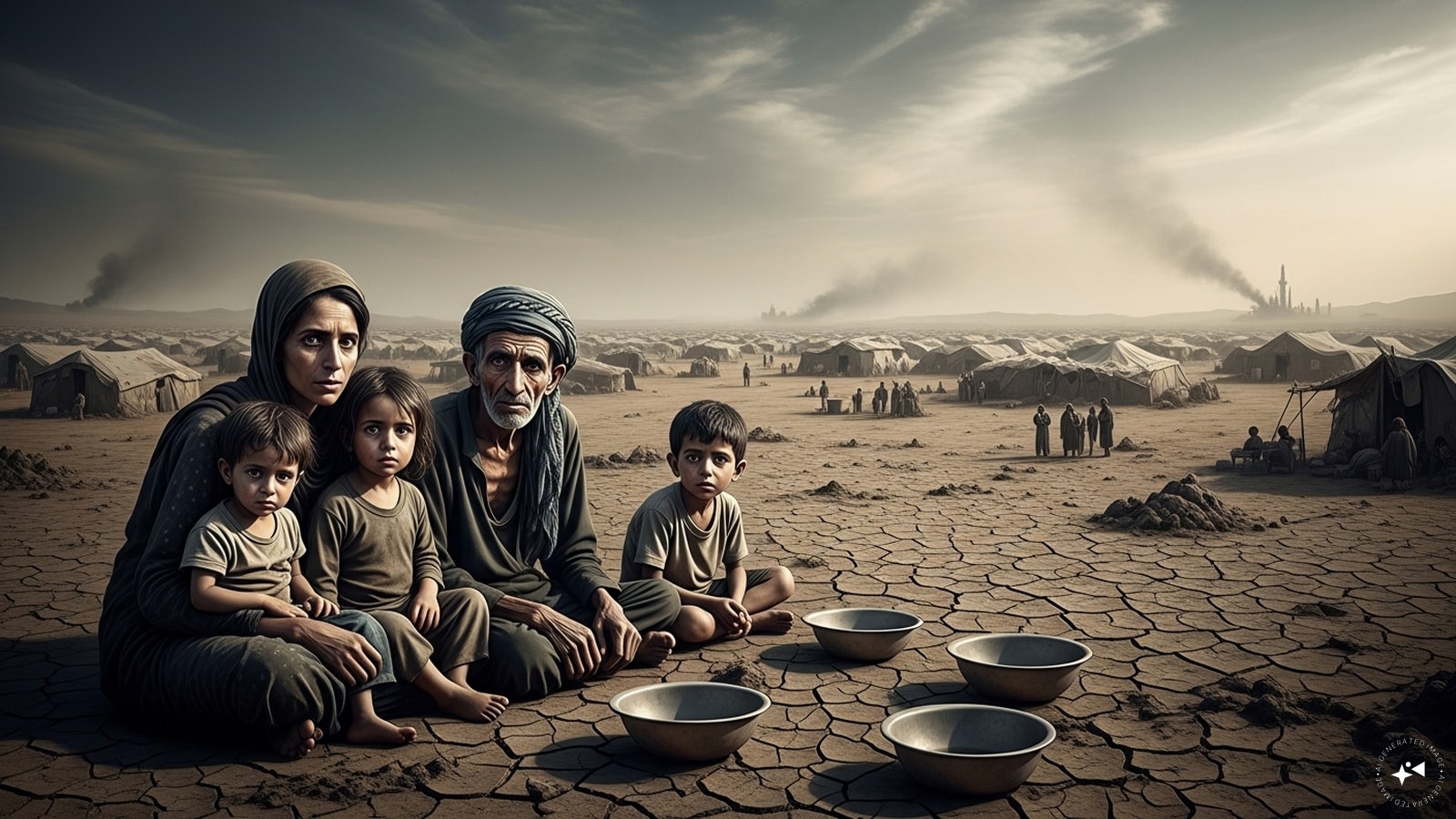
Let us step away from the warships and the palaces of Qom, and look into a small pharmacy in central Tehran. A woman stands at the counter, holding a prescription for her son’s leukemia medication. The pharmacist shakes his head. The drug, manufactured by a European pharmaceutical company, is out of stock.
Technically, medical supplies are exempt from Western sanctions. That is what the paper says. But in reality, international banks are so terrified of American fines that they refuse to process any financial transactions involving Iran. Shipping companies refuse to dock at Iranian ports. The supply chain snaps.
The medicine disappears.
The woman leaves the pharmacy empty-handed. Her frustration does not turn against her own government, as the architects of sanctions hoped. Instead, it hardens into resentment against the distant superpower that signed the decree. This is the paradox of economic warfare: it inflicts deep, structural trauma on the civilian population, but it rarely weakens the grip of the ruling elite. In fact, it often gives them a convenient scapegoat for their own corruption and mismanagement.
The regime survives by building a "resistance economy." They develop smuggling networks, illicit oil transfers, and black-market financial systems. The IRGC, which controls much of Iran’s underground economy, actually grows wealthier and more powerful by controlling these black markets. The paper strategy achieves the exact opposite of its intended effect. It starves the middle class while enriching the praetorian guard.
The Gravity of the First Strike
The true problem with the binary of winning "militarily or on paper" is that it assumes a war has a clean narrative arc. A beginning, a middle, and an end.
But a conflict with Iran would not be a localized event. It is a regional tectonic fault line.
If hostilities break out in the Gulf, the first casualties will not be the only ones. Within hours, Iran’s proxy network would activate. Hezbollah in Lebanon possesses an arsenal of over 150,000 rockets pointed directly at Israel. The Houthis in Yemen can choke off the Red Sea. Shia militias in Iraq and Syria would target American bases scattered across the region.
Suddenly, a war that looked contained on a map becomes a multi-front conflagration stretching across thousands of miles.
Consider what happens next: the global economy feels the shockwave instantly. A third of the world’s liquefied natural gas and a fifth of its oil pass through the Strait of Hormuz. If Iran sinks a tanker or mines the strait, shipping insurance rates skyrocket. Ports close. Oil prices spike to unprecedented heights.
A consumer filling up their gas tank in Ohio or a factory owner trying to keep the lights on in Germany pays the price for a missile launched in the Persian Gulf. The ledger of paper turns out to be incredibly fragile, vulnerable to the first spark of real-world violence.
We must confront the uncomfortable truth that military dominance is not the same as political victory. The United States won every major military engagement in Vietnam. It successfully captured Baghdad in weeks. Yet, neither of those conflicts yielded the clean, stable outcomes promised on paper.
Victory in modern warfare is not measured by the number of targets destroyed or the sophistication of the hardware deployed. It is measured by the peace that follows. And a scorched Middle East, with disrupted global trade routes and a deeply radicalized population, is not a victory by any metric.
The young sailor, Marcus, stands on the deck of his destroyer as the sun sets over the horizon, painting the Gulf in shades of deep orange and bruised purple. He watches the silhouette of a commercial tanker moving slowly through the water. He knows that his life depends on the calculations made by people thousands of miles away—people who view his world as a series of data points, probabilities, and political statements.
When we strip away the rhetoric, the bravado, and the strategic jargon, we are left with a simple, sobering reality. Winning on paper is an exercise for the safe and the comfortable. But when the ink dries and the powder catches fire, the cost is always paid in blood, uncertainty, and a world left broken in ways no spreadsheet could ever predict.