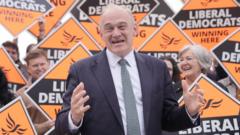
The Liberal Democrats’ current electoral positioning rests on the exploitation of a widening ideological vacuum within the British political center. By branding the Reform UK and Green parties as "extremes," Ed Davey is not merely engaging in rhetorical signaling; he is executing a Triangulation Framework designed to capture low-propensity voters and disillusioned moderates. This strategy functions by positioning the Liberal Democrats as the only "rational" actor in a three-dimensional political space where Reform occupies the populist-right axis and the Greens occupy the radical-left/environmental axis.
The Mechanics of Centrist Differentiation
The Liberal Democrat strategy relies on three distinct structural pillars to differentiate their platform from what they define as the "fringes."
- Economic Pragmatism vs. Fiscal Radicalism: The party positions its tax-and-spend policies as a middle path between Reform’s aggressive deregulation and the Greens’ massive public investment funded by wealth taxes.
- Institutional Stability vs. Disruptive Populism: While Reform challenges the foundational structures of the civil service and international treaties (such as the ECHR), and the Greens push for systemic shifts in the ownership of capital, the Liberal Democrats emphasize reform within existing democratic norms.
- Voter Elasticity: The party targets "orphan voters"—individuals who feel culturally or economically abandoned by the two primary parties but find the insurgent options too risky for governance.
The Tactical Pincer Movement
The "extremes" narrative serves as a psychological anchor for the electorate. In behavioral economics, the Decoy Effect suggests that consumers (or voters) will change their preference between two options when presented with a third, more "extreme" option. By framing Reform and the Greens as the outer boundaries of the political spectrum, the Liberal Democrats make their own policy suite—which includes significant interventions in social care and environmental regulation—appear conservative and safe by comparison.
The party’s success depends on its ability to maintain this perceived neutrality while simultaneously proposing radical changes to specific sectors, such as the NHS and the voting system. This creates an Asymmetry of Perception: the voter perceives the Liberal Democrats as "stable" even when their platform contains significant constitutional disruptions, such as Proportional Representation (PR).
Quantifying the Electoral Gap
To understand the Liberal Democrat trajectory, one must analyze the Efficient Voter Frontier. Unlike Reform, which sees a high concentration of votes in safe Conservative seats where they rarely win, the Liberal Democrats have historically mastered the art of "concentrated efficiency." They target specific geographic clusters—primarily the "Blue Wall" in Southern England—where the incumbent Conservative majority is brittle.
The logic of their current messaging is optimized for these specific demographics:
- The Disenchanted Conservative: High-income, socially liberal professionals who find Reform’s rhetoric on immigration distasteful but fear the Greens’ economic interventions.
- The Strategic Labour Supporter: Voters in constituencies where Labour has no path to victory and the Liberal Democrats represent the only viable vehicle for removing a Conservative incumbent.
The Risk of Policy Dilution
A significant bottleneck in this strategy is the Messaging Paradox. To remain the "alternative to extremes," the Liberal Democrats must often avoid taking hard-line stances on controversial cultural issues. If they lean too far into progressive social policy, they risk being grouped with the Greens by right-leaning swing voters. If they focus too heavily on fiscal restraint, they lose the progressive wing that views them as a more effective version of the Labour Party.
This creates a Fragility of Identity. The party is currently defined more by what it is not (not Reform, not Green, not Tory, not Labour) than by what it is. While this is an effective short-term mobilization tactic during a general election cycle, it lacks the ideological "stickiness" required for long-term party loyalty.
The Cost Function of Third-Party Insurgency
The Liberal Democrats face a unique cost function compared to the Greens and Reform. Because they have a history of governance (via the 2010-2015 coalition), they carry a "governance premium"—voters expect them to have costed, realistic plans. Conversely, Reform and the Greens benefit from a "protest discount," where their supporters are more interested in the direction of travel than the granular details of implementation.
- Lib Dem Cost Function: $C = I + (P \times R)$
- Where $I$ is the cost of infrastructure and campaigning.
- $P$ is the policy complexity.
- $R$ is the reputational risk of past governing decisions.
The party is currently attempting to minimize $R$ by focusing on localism and immediate, tangible issues like sewage discharge and GP waiting times. These are "low-friction" policies—difficult to argue against and highly emotive, allowing the party to bypass complex debates about macroeconomics or national security.
The Structural Barrier of First-Past-The-Post
The Liberal Democrats’ insistence on "fair votes" is not just a principled stance; it is an existential requirement. Under the current First-Past-The-Post (FPTP) system, a party can receive 15% of the national vote and gain fewer than 10 seats, while a party with 35% can gain a landslide majority.
The strategy of attacking the "extremes" is a direct attempt to solve the Spoiler Effect. In a multi-party system governed by FPTP, the Liberal Democrats must convince the electorate that a vote for the Greens or Reform is a "wasted" vote that inadvertently helps the party the voter likes least. By labeling these parties as extremes, they suggest that they are not just ideologically unpalatable, but mathematically non-viable.
Competitive Pressure and Tactical Voting
The Liberal Democrats are currently benefiting from an unprecedented level of tactical voting coordination. Data from recent by-elections suggests that the "Anti-Conservative" vote is becoming increasingly sophisticated. However, this creates a Dependency Trap. If the Liberal Democrats rely on Labour voters to win in the South, their parliamentary caucus becomes beholden to a platform that cannot deviate too far from the Labour mainstream without risking the collapse of their tactical coalition.
The Environmental and Social Care Pivot
Ed Davey has strategically narrowed the party’s focus to two primary domains: the environment (specifically water quality) and social care. These are not random selections. They represent a Targeted Competency Strategy.
- Environmental Ownership: By focusing on sewage and local ecology, the Liberal Democrats aim to outmaneuver the Greens on "practical" environmentalism. While the Greens focus on global systemic change and fossil fuel divestment, the Lib Dems focus on the river in the voter’s backyard.
- Social Care as Economic Security: By framing social care as an economic issue—freeing up hospital beds and allowing family members to return to the workforce—they appeal to the fiscal sensibilities of centrist voters while maintaining their "caring" brand identity.
This tactical narrowing reduces the "surface area" for attacks from Reform or the Conservatives. It is far harder to paint a party as "extreme" when its primary campaign platform is "cleaning up local rivers" and "helping the elderly."
Strategic Recommendation for Electoral Expansion
The Liberal Democrats must transition from a "party of protest" to a "party of the rational center" by formalizing their policy distinctions through a Negative Differentiation Audit.
- Action 1: Economic Decoupling. The party should publish a comprehensive fiscal framework that explicitly rejects both the "unfunded tax cuts" of the right and the "broad-based wealth taxes" of the left. This should be marketed as a "Stability Guarantee" to appeal to the risk-averse middle class.
- Action 2: Regional Sovereignty. To counter Reform’s populist appeal, the Liberal Democrats should double down on radical devolution. By offering power to local communities, they can co-opt the "take back control" sentiment without resorting to the nationalistic rhetoric used by Reform.
- Action 3: The Reform-Green Pincer. In campaign literature, the party should use a "Two Risks, One Choice" visual layout. On one side, list the inflationary risks of Reform’s tax plans; on the other, list the industrial risks of the Greens’ degrowth tendencies. Position the Liberal Democrat plan as the median point on a bell curve of economic outcomes.
The current window of opportunity is narrow. As the two major parties gravitate back toward the center to win general elections, the Liberal Democrats’ "rational alternative" space will compress. Their survival depends on entrenching themselves in the Blue Wall now, using the "extreme" labels to disqualify competitors before the national conversation shifts back to a binary choice. Success will not be measured by their national vote share, but by their ability to maintain a high "conversion rate" of votes to seats in the 60 to 70 key constituencies where they are the primary challenger.



