For years, if you lived in the urban heart of Salt Lake City, your vote traveled a very long, very strange distance.
Imagine walking out your front door in the shadow of the Wasatch Mountains. You share a neighborhood, a transit system, and a distinct air-quality basin with the people down the block. Yet, when Election Day arrived, an invisible cartographic knife sliced your community into four pieces. One sliver of the city was tethered to the livestock ranches of the Nevada border. Another was lumped into the red-rock desert communities hundreds of miles south. The urban core was systematically diluted, packed into four massive, rural congressional districts designed to ensure that a left-leaning city could never elect a representative of its own choosing.
It was a masterful piece of political engineering. It worked perfectly. Until a judge threw out the map.
Now, the lines have snapped back like a rubber band. Following a fierce legal battle over partisan gerrymandering, Utah’s Third Judicial District Court enacted a radically redrawn map for the 2026 midterms. Instead of being quartered, the deep-blue capital city and its surrounding suburbs have been gathered back into a single, compact home: the new 1st Congressional District.
Suddenly, a state that has sent an all-Republican delegation to Washington since 2021 is looking at a guaranteed anomaly. The new district is so heavily Democratic that political forecasters estimate Kamala Harris would have carried it by 60% in the last presidential election. The Republican primary was canceled because the general election here is no longer the real contest.
The real war is happening right now, within the Democratic Party itself.
The Ghosts of Moderation
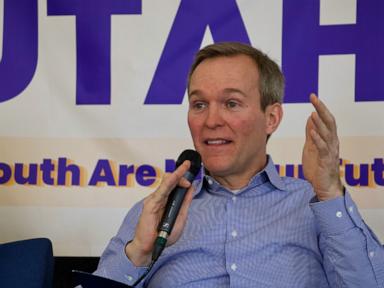
To understand the tension fracturing Utah Democrats today, you have to look at Ben McAdams. He is a familiar face in the valley, a former Salt Lake City mayor who managed to win a congressional seat back in 2018 by walking a razor-thin tightrope. To survive in a deeply conservative state, McAdams positioned himself as the ultimate moderate. He voted with his party when necessary but took pride in bucking leadership, earning a reputation by one national analysis as the single most conservative Democrat in the entire House of Representatives.
When the old, fractured map caught up with him in 2020, he lost his seat.
Now, McAdams wants back in. He has the name recognition, and he has a war chest that triples his nearest competitor’s fundraising haul. But the ground beneath his feet has shifted. The moderate stance that was once a shield in Utah politics has suddenly become a liability. In a district that no longer requires Democrats to beg for conservative crossover votes, the party's progressive base is eager to flex its muscles.
Consider the dilemma of the modern Utahn progressive. For decades, they voted defensively. They picked candidates who promised not to make too much noise, candidates who could speak the language of fiscal conservatism and religious tradition just well enough to avoid a blowout.
The new map changes the psychological calculus. It offers a rare, intoxicating luxury: the chance to vote for what they actually want, rather than the least objectionable alternative.
The Push to the Left
McAdams is not blind to this shift. He has spent the campaign trying to recast his political identity, dialing back the conservative rhetoric of his past term to align more closely with a energized urban electorate. But his opponents aren't letting him forget his voting record. They see this primary as a historic opportunity to send Utah’s very first unapologetic progressive to Washington.
Three challengers are crowded into the lane to McAdams's left. There is Nate Blouin, a savvy state senator who understands the mechanics of local power. There is Michael Farrell, a sharp tax attorney who brings a technocratic edge to progressive policy. And there is Liban Mohamed, a former policy analyst for tech giants like TikTok and Meta whose background gives him a distinct perspective on the modern economy.
The strategy among the challengers has been explicit, almost desperate: they have publicly urged one another to drop out of the race. They know the danger of a fractured progressive vote. If three left-leaning candidates split the anti-establishment electorate, McAdams can coast to victory on the strength of his name recognition and institutional backing.
It is a classic political paradox. The very wealth of options created by this new, safe Democratic haven might ultimately pave the way for the most conservative Democrat in the field to win it.
The Higher Stakes
While the national media watches the drama in the 1st District as a proxy war for the soul of the Democratic Party, the implications stretch far beyond the borders of Salt Lake County.
This isn't happening in a vacuum. The national map is a brutal game of inches. Republicans currently hold a razor-thin majority in the U.S. House, and the party in the White House historically loses ground during midterm elections. At the urging of national leadership, Republican-led legislatures across the country—in Texas, Missouri, and North Carolina—have aggressively redrawn their own maps mid-decade to lock in every possible advantage.
Utah was supposed to be a safe, quiet piece of that national puzzle. The decision by Judge Dianna Gibson to reject the legislature's map because it "unduly favors Republicans" threw an unexpected wrench into those national plans. It gave national Democrats one of their few clean, highly probable pickups on the entire 2026 board.
The fury from Utah's conservative establishment has been white-hot. State Representative Matt MacPherson went so far as to call the judicial redraw a "gross abuse of power" and opened a bill to pursue impeachment against the judge. The state is moving forward with the new map because the clock dictates they must, but an emergency appeal still hangs over the entire process like a dark cloud.
The remaining three congressional districts in Utah have been compressed, pushed outward from the city center. By draining the blue voters out of those districts and concentrating them in Salt Lake, the rest of the state has actually become significantly more conservative. Incumbents like Representative Blake Moore are fighting off their own primary challenges from the hard right, facing criticism from within their party just for having historical ties to the very anti-gerrymandering groups that sparked this legal revolution.
The Weight of the Pencil
Democracy is often discussed in grand, abstract terms—ideals of freedom, representation, and the will of the people. But the reality of political power is much more mundane. It lives in the precise coordinates of a digital boundary line. It lives in the way a single neighborhood is tethered to a desert or an urban center.
For the voters walking the streets of Salt Lake City, the primary election is a strange, novel experience. For the first time in a generation, their votes will not be swallowed up by the vast, conservative expanses of rural Utah. Their voices will stay right here in the valley, concentrated and amplified.
The lines have been redrawn, the characters are on the stage, and a community is about to find out exactly what it looks like when it finally gets to speak for itself.