International disaster response operations consistently fail or succeed based on resource velocity, structural mechanics, and supply chain integrity. When two back-to-back earthquakes measuring 7.2 and 7.5 magnitude struck Venezuela, collapsing dense urban infrastructure, they triggered a predictable logistical bottleneck. The initial 72 hours following a structural failure represent the critical window for sub-rubble survival, known operationalized as the golden hours of extraction. Within this window, the deployment of highly specialized, low-footprint Urban Search and Rescue (USAR) assets, such as the seven-member volunteer team from Burnaby, British Columbia, serves as a study in asymmetrical impact.
Understanding the mechanics of these operations requires analyzing the exact structural and biological constraints that dictate international disaster relief. The standard narrative of disaster response focuses on the emotional urgency of aid; an analytical assessment focuses on the physics of structural voids and the mathematical limitations of search vectors.
The Structural Void and the Survival Decay Function
The primary challenge of an earthquake rescue mission is locating and extracting individuals trapped within structural collapses. When concrete and steel buildings fail, they do so according to distinct engineering patterns, primarily creating three types of spaces: lean-to voids, V-shape voids, and pancake collapses.
The probability of finding survivors decreases exponentially over time, governed by a survival decay function driven by three biological variables:
- Asphyxiation Risk: The immediate restriction of oxygen due to dust inhalation or confined spatial volume.
- Dehydration and Exposure: The physiological limit of human endurance without water, typically capped at 72 to 96 hours under ambient conditions.
- Crush Syndrome: The systemic release of toxins into the bloodstream once pressure is relieved from compressed muscle tissue, requiring immediate advanced medical intervention at the point of extraction.
Because regional emergency medical infrastructure is often compromised or overwhelmed during a dual-quake event, local authorities cannot scale operations fast enough to match the decay function. This operational deficit is what foreign technical teams are engineered to address.
The Operational Blueprint of a Lean Technical Asset
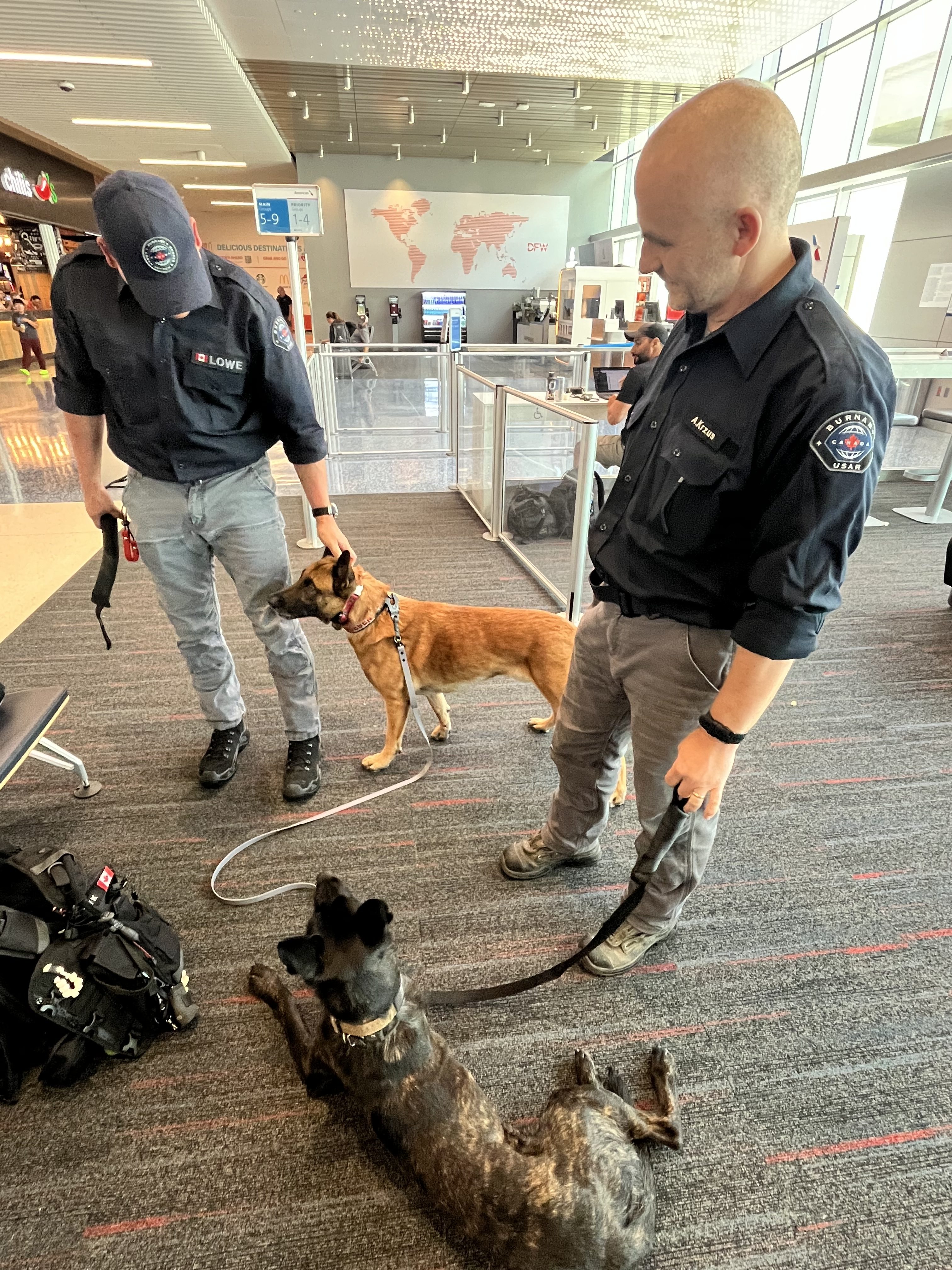
The deployment of a small, seven-member team from Burnaby USAR—comprising two firefighters, advanced paramedics, law enforcement personnel, and two specialized canine assets—demonstrates a precise tactical configuration designed to minimize logistical friction while maximizing search efficiency.
Large-scale international task forces, such as the 71-person USA-2 team from Los Angeles County or assets from Fairfax County, bring massive structural breaching capability but require significant logistical footprints. They demand extensive transport capacity, field hospitals, and large quantities of food and water, which can inadvertently strain compromised local supply lines.
Conversely, a lean team operates via a specific three-part technical framework:
1. The Biological Search Vector
Canine assets represent the fastest method for scanning large surface areas of collapsed material. While technical search equipment like acoustic geophones and fiber-optic snake cameras are highly precise, they are slow to deploy. A trained search dog covers thousands of square feet of unstable terrain in minutes, identifying the scent of live human breath emanating through micro-fissures in the concrete. This narrows the excavation zone from an entire block to a specific coordinate.
2. Triage and Stabilizing Paramedicine
The presence of paramedics within the search team ensures that the transition from location to extraction does not result in mortality. Trapped victims often suffer from severe trauma or crush syndrome. Treating these pathologies before the structural load is lifted prevents sudden cardiac arrest caused by the sudden influx of potassium and myoglobin into the victim's circulatory system.
3. Structural Analysis and Law Enforcement Integration
Firefighters and law enforcement specialists evaluate the stability of the surrounding rubble pile before personnel enter a void space. In a dual-quake scenario, the risk of powerful aftershocks is severe. The team must calculate load-bearing paths and apply specialized shoring techniques using available timber or mechanical struts to prevent secondary collapses during extraction.
Supply Chain By-pass and Infrastructure Bottlenecks
The arrival of international aid frequently creates a secondary crisis: logistical convergence. When multiple nations and NGOs simultaneously send personnel and cargo to a disaster zone, the remaining functional transport hubs become choked. In this specific crisis, Venezuela’s primary commercial airport infrastructure suffered severe structural damage, rendering standard cargo flights non-viable.
The Burnaby deployment overcame this bottleneck through an optimization strategy: bypassing public logistical networks entirely. By securing a private aircraft donation, the team eliminated the administrative and operational delays associated with commercial hubs or military transport backlogs.
This maneuver exposes a critical law of disaster logistics: Velocity beats mass in the acute phase of response. A massive rescue team delayed by 48 hours at a transit choke point yields lower survival outcomes than a compact, highly agile technical team that achieves entry into the impact zone within the initial 24 hours.
Technical Constraints and Operational Realities
Despite the high efficiency of lean USAR teams, their operations are bound by stark limitations that prevent them from serving as standalone solutions.
The Burnaby team’s deployment window is strictly bounded at five to seven days. This duration is not arbitrary; it is precisely calibrated to the limits of human and canine endurance in high-stress environments, alongside the expiration of the biological survival window for trapped individuals. Past day seven, the mission profile shifts from rescue to recovery, a transition marked by a steep decline in the utility of live-scent canines and a required shift toward heavy earth-moving machinery.
Furthermore, a small volunteer unit lacks the heavy hydraulic breaching tools required to cut through thick reinforced concrete slabs. Their role is strictly foundational: find the voids, confirm life, stabilize the environment, and direct local or larger international teams equipped with heavy machinery to execute the physical extraction.
The strategic integration of these independent volunteer groups into the broader UN-coordinated International Search and Rescue Advisory Group (INSARAG) framework is what ultimately determines total operational efficacy. Without rigid coordination, overlapping search vectors lead to redundant efforts, while more remote or complex collapse sites remain uninspected. Success depends entirely on matching the rapid scouting data of small teams with the brute force capability of larger state-sponsored units.
To optimize future international responses to catastrophic seismic events in complex geopolitical environments, deploying agencies must institutionalize private-public aviation agreements prior to disasters. Waiting for ad-hoc private flight donations creates a variable delay that directly degrades the survival curve. Establishing a pre-cleared, rapid-deployment network of private executive aircraft capable of utilizing short, secondary airstrips is the single most effective way to guarantee that technical search assets achieve ground entry within the non-negotiable 24-hour window.