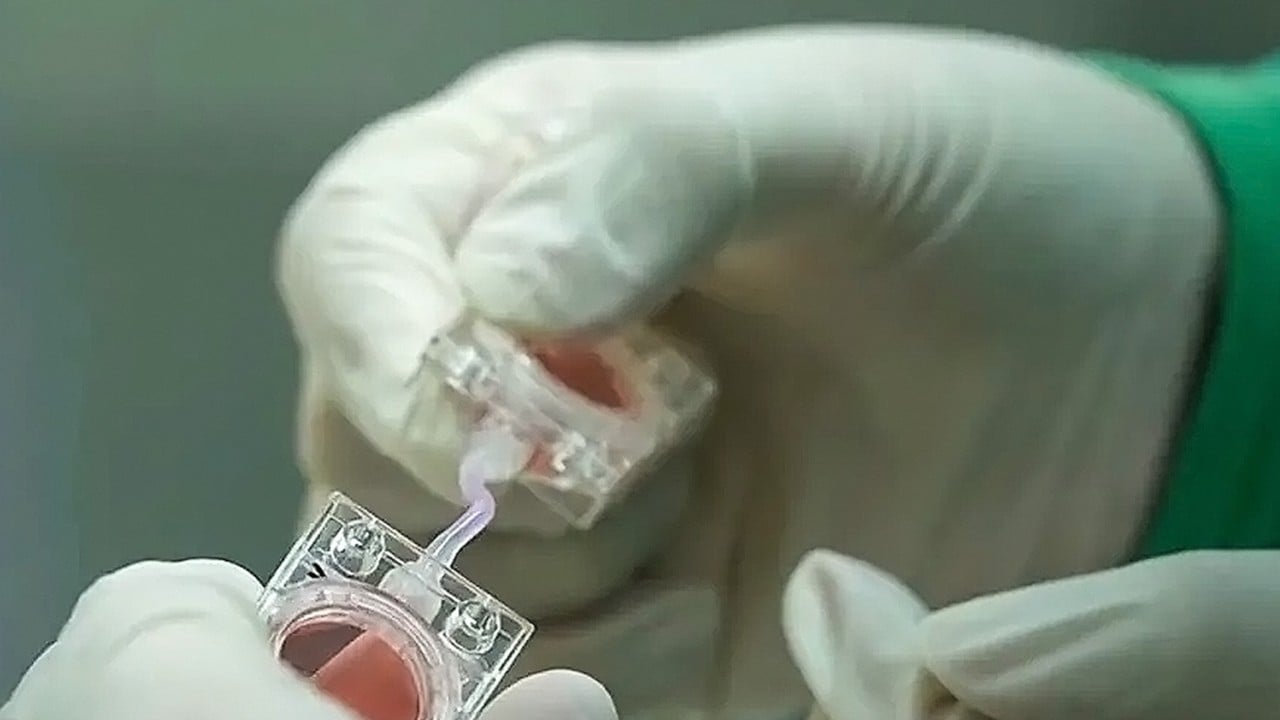
Four hundred kilometers above the Gobi Desert, tucked inside a titanium shell the size of a microwave, life is trying to figure out how to be.
There are no lullabies here. No rhythmic thrum of a mother’s heartbeat or the gentle, pressurized warmth of a biological womb. Instead, there is the sterile hum of a life-support system and the eerie, weightless silence of the thermosphere. Inside this metallic box, Chinese scientists have placed several thousand mouse embryos, frozen in the earliest stages of development.
They are the first pioneers of a frontier we rarely discuss in polite company: the biological reality of becoming a multi-planetary species.
We talk endlessly about the physics of Mars. We argue over fuel ratios, radiation shielding, and the sheer mechanical audacity of landing a starship on a dusty red rock. But we rarely talk about the softest, most vulnerable part of the equation. If humanity is to ever leave this cradle, we have to know if we can actually grow new humans in the dark between the stars.
The Sj-10 satellite isn't just a feat of engineering. It is a high-stakes interrogation of nature itself.
The weight of weightlessness
Gravity is more than just the force that keeps your keys on the table. It is an architect. From the moment a sperm meets an egg, gravity acts as a silent conductor, telling cells where to migrate, how to fold, and which end of the organism should be the head or the tail.
When you remove that conductor, the orchestra falls apart.
Scientists have known for decades that microgravity wreaks havoc on the adult body. Astronauts return to Earth with brittle bones, flattened eyeballs, and hearts that have physically changed shape because they no longer have to pump blood against the constant pull of Earth’s mass. Now, imagine those same chaotic forces acting on a cluster of cells that doesn't even have a nervous system yet.
http://googleusercontent.com/image_content/221
In the SJ-10 mission, the embryos began as two-cell organisms. Under the watchful eye of high-resolution cameras, these tiny clusters attempted to divide into blastocysts—the stage where cells begin to differentiate into what will eventually become specialized tissues. On Earth, this is a choreographed dance. In orbit, it is a desperate scramble.
The early results from the Chinese Academy of Sciences were startling. For the first time, researchers observed mammalian embryos successfully developing into blastocysts in space. It proved that, at least in the very first few days, the spark of life isn't immediately extinguished by the absence of gravity.
But the victory is a quiet one, shadowed by a much darker set of questions.
The radiation lottery
Gravity is only half the battle. Outside the protective hug of Earth’s magnetic field, the universe is a shooting gallery of high-energy particles.
Space radiation isn't like the X-ray at your dentist's office. It is a constant bombardment of galactic cosmic rays—heavy ions moving at nearly the speed of light that can tear through DNA like a bullet through a spiderweb. For an adult, this increases the long-term risk of cancer. For an embryo, where a single cell might be the precursor to an entire organ system, one well-placed hit from a cosmic ray can be catastrophic.
Consider a hypothetical colonist named Elena, living in a pressurized dome on the Martian surface fifty years from now. Elena is healthy, a product of rigorous screening and top-tier fitness. But her DNA, and the DNA of the child she hopes to carry, is being pelted by subatomic particles that have traveled across the galaxy just to collide with her biology.
The SJ-10 mission is the first step in understanding the "dose" that life can truly withstand. By sending these mouse embryos up, China isn't just looking for a "yes" or "no" on space pregnancy; they are mapping the threshold of survival. They are looking for the point where the cellular damage becomes so great that the blueprint of a living being becomes unreadable.
A question of ethics and ego
There is a coldness to this research that makes many people uncomfortable. There is something inherently jarring about the image of a laboratory-grown lifeform drifting through the void, far removed from the warmth of a nest or a womb.
Critics argue that we are putting the cart before the horse—or rather, the infant before the atmosphere. Why are we worried about space-born nurseries when we haven't even figured out how to keep a colony from starving?
The answer is as old as the Silk Road. Ambition doesn't wait for total certainty.
The Chinese space program, CNSA, operates with a brand of long-term thinking that spans generations. They aren't just looking at the next launch window; they are looking at the next century. If the goal is a permanent presence on the Moon or Mars, "permanent" implies a population that can sustain itself without a constant umbilical cord of supply ships from Earth.
To be a truly spacefaring civilization, we cannot be a civilization of temporary visitors. We cannot be a species that only lives in "hotels" built of aluminum and Teflon. We have to be able to put down roots.
But biology is stubborn. It spent four billion years perfecting itself for 1G of gravity and a nitrogen-oxygen atmosphere protected by a thick magnetic shield. We are trying to rewrite that four-billion-year-old contract in a single afternoon.
The silent data
During the SJ-10 mission, the cameras captured the embryos changing shape every four hours. Back on the ground, the lead researcher, Duan Enkui, described the moment they saw the cells divide as a milestone for the "reproduction of the human race."
It sounds hyperbolic. Until you look at the data.
The embryos that developed in space were physically different from the control group on Earth. They were "stressed." Their metabolic pathways were firing in ways that suggested the cells were working overtime to compensate for the lack of environmental cues.
This leads to a haunting realization. Even if we can successfully bring a pregnancy to term in space, the "human" that results might be fundamentally different from anything that has ever walked the Earth. Without gravity to stress the bones and muscles during development, a child born in low gravity might never be able to visit their ancestral home. Earth, with its "heavy" gravity, would be a death trap—a place where their heart would fail and their skeleton would snap under its own weight.
We are looking at the potential divergence of the human species. A future where the "Earthers" and the "Spacers" are separated not just by distance or culture, but by the very density of their marrow.
The long road to the stars
The SJ-10 satellite eventually returned to Earth, its precious cargo recovered from the brush of Inner Mongolia. The embryos were analyzed, sequenced, and tucked away into journals and databases.
The experiment didn't result in "space mice" running around a lab. The embryos were never intended to be implanted; the mission was purely about the first, fragile window of development. It was a proof of concept.
But the concept it proved is heavy with implication.
We are currently in the era of the "test pilot" in space. We send the best of the best—the most physically fit, the most mentally resilient, the most highly trained. We treat space like a hostile peak to be summited and then exited as quickly as possible.
But missions like China's embryos in orbit signal the end of that era. They mark the beginning of the era of the "settler." And the settler doesn't just need oxygen and water. The settler needs a future.
Somewhere in a cleanroom in Beijing or a launch pad in Wenchang, there are scientists already planning the next iteration. Perhaps next time, the embryos will stay up longer. Perhaps they will be shielded by new materials, or rotated in a centrifuge to simulate the gravity of Mars.
Slowly, through trial and error, through the sacrifice of thousands of microscopic clusters of mouse cells, we are learning the rules of the dark. We are finding out if the universe is a place where life can flourish, or if we are forever tethered to this one blue marble by the very requirements of our own creation.
The stars are beautiful, but they are cold. And for now, the only warmth in the vacuum is the heat generated by the machines we build to keep our smallest, most fragile hopes from freezing solid.