The neon of Hollywood Boulevard bleeds into the asphalt, washed out by a sudden, heavy drizzle that nobody in this city ever seems prepared for. It is Tuesday night. Most of Los Angeles is locked away behind the steering wheels of idling sedans on the 101, or ordering expensive salads through an app, insulated from the friction of actual human contact.
But step down into the basement of this nondescript, slightly damp venue on the fringes of East Hollywood, and the air changes. It smells of cheap beer, clove cigarettes, and wet denim.
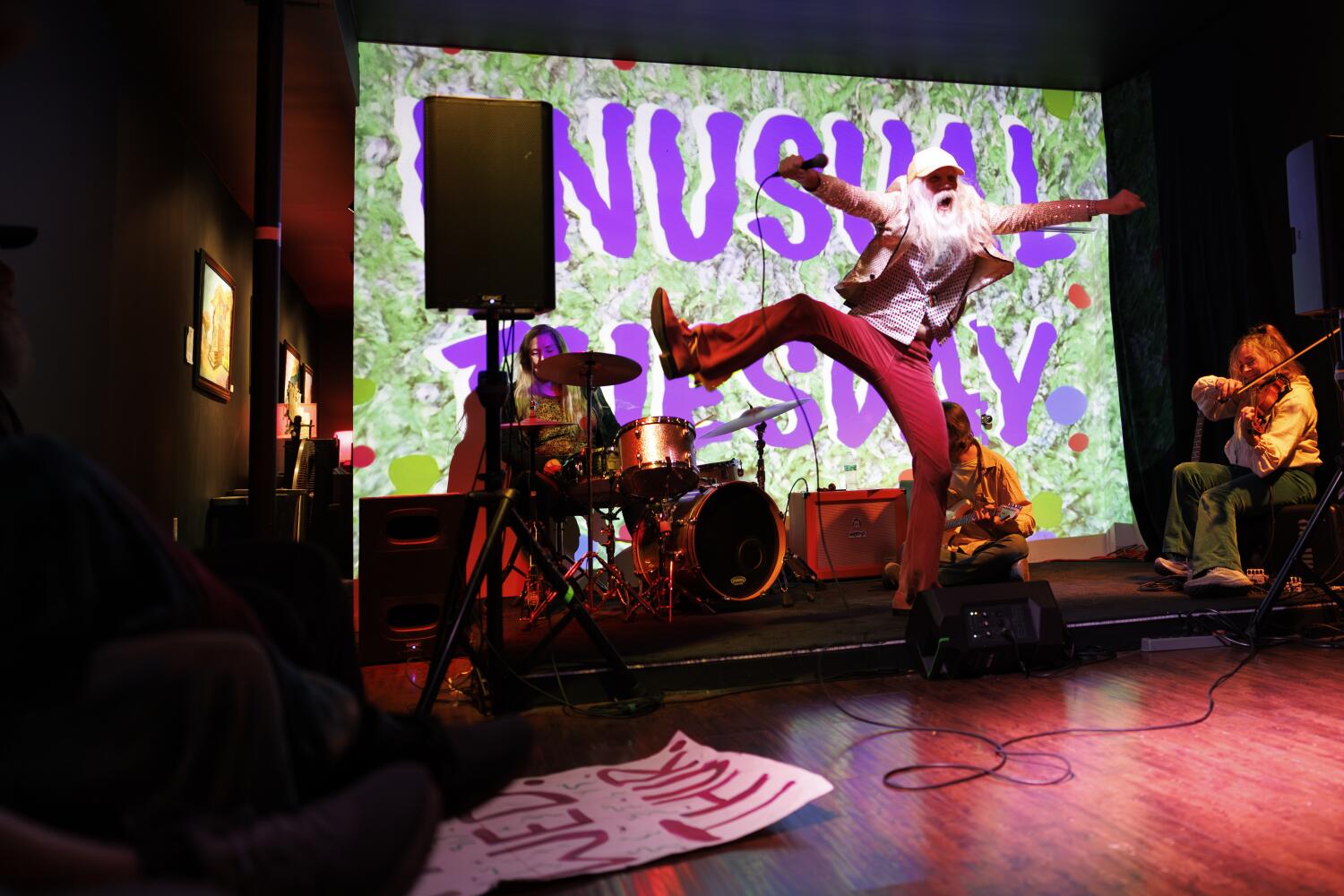
A woman with a cello is tuning her instrument next to a man who is meticulously arranging a collection of vintage, circuit-bent children’s toys that squeal when you touch them. In the corner, a poet stares at a crumpled piece of loose-leaf paper as if it contains the secret to reversing time.
This is Unusual Tuesday. It has been called the closest thing to church for people who do not belong in churches.
In a city built on the brutal curation of human capital, where every conversation is an implicit audition and your worth is tied directly to your IMDb page or Spotify stream count, this room offers something terrifyingly rare.
Anonymity. Combined with radical, unconditional acceptance.
The Economy of Relevance
To understand why a room full of eccentric artists singing to an audience of thirty people matters, you first have to understand the specific, crushing weight of modern Los Angeles.
Consider a hypothetical artist. We will call him Julian. Julian moved to the Westside three years ago from Ohio, possessing a brilliant, jagged talent for surrealist puppetry. Back home, he was a visionary. In Los Angeles, he is a line cook at a vegan bistro who spends his rent money on foam and latex, trying desperately to get a five-minute meeting with a digital content manager who will ultimately ghost him.
Julian is experiencing what sociologists recognize as the alienation of the creative precariat. When culture becomes an industry, art becomes a product. If the product cannot be scaled, monetized, or optimized for a fifteen-second vertical video format, the industry deems it useless.
The psychological toll of this rejection is immense. It creates a quiet epidemic of isolation among the thousands of dreamers who arrive at LAX every month. They are surrounded by millions of people, yet completely alone.
Then, Julian finds the basement.
The rules of Unusual Tuesday are unwritten but absolute. You do not pitch your pilot. You do not ask for a business card. You do not judge the person on stage, even if their performance consists entirely of screaming into an empty tin can for four minutes.
It is an intentional sanctuary against the transactional nature of the city. Here, the currency is not influence. It is vulnerability.
The Ritual of the Unvarnished Stage
The lights dim to a bruised purple. The host—a local fixture with a voice like gravel scraping against silk—takes the microphone. There are no grand introductions. No credits are listed. The stage is open to anyone who put their name on a battered clipboard at the door.
A performer steps up. She is nervous; her hands shake against the acoustic guitar. She begins to sing a song about her grandmother’s dementia. The chords are occasionally clumsy. The melody falters in the bridge.
In a standard Hollywood showcase, the crowd would have already drifted toward the bar, their faces illuminated by the pale blue glow of their smartphones as they checked their social feeds.
But something else happens here. The room leans in.
People stop chewing their ice. They quiet their breath. When she hits a particularly raw, imperfect note, an older man in the front row lets out a soft, affirmative groan, the kind you hear in traditional Southern congregations when the preacher hits a painful truth.
This is the secular liturgy of the misfit. It functions exactly like a religious service because it fulfills the same fundamental evolutionary need: collective effervescence. That is the term coined by sociologist Émile Durkheim to describe the moments when a community comes together and simultaneously communicates the same thought and participates in the same action.
Humans require ritual to survive the chaos of existence. For decades, traditional religious institutions provided that structure. But as society secularizes, particularly among younger, urban demographics, those old altars are sitting empty.
The need for the altar did not disappear. It just migrated into the underground.
The Architecture of Creative Survival
There is a historical precedent for spaces like this. Think of the Cabaret Voltaire in Zürich during World War I, where the Dadaists gathered to create nonsense art as a direct, sanity-preserving response to the butcher’s bill of the Western Front. When the world outside becomes incomprehensible or hostile, the underground builds a smaller, kinder world inside.
Critics might look at Unusual Tuesday and dismiss it as a self-indulgent exercise in amateur expression. They miss the point entirely.
The value of the space is not measured by the aesthetic perfection of the output. It is measured by the safety of the input.
When an artist feels safe enough to fail spectacularly, without the fear of losing their livelihood or being ridiculed online, something shifts in their brain. The creative impulse, which had been choked by anxiety and economic pressure, begins to breathe again.
Consider the alternative. Without these pressure-valve spaces, the creative community of a major city curdles into cynicism. People give up. They pack their bags and go back to Ohio, or worse, they stay and let their talents rot into bitter resignation. The city loses its color, becoming nothing more than a giant corporate campus populated by content creators who look and sound exactly alike.
The Final Note
Back in the basement, the night is drawing to a close. The man with the circuit-bent toys is performing now. The noises he is coaxing from the plastic chassis of a 1990s educational computer are harsh, discordant, and strangely beautiful. They sound like a machine trying to remember a lullaby.
Everyone is watching. Nobody is recording this on a phone. The moment exists only within these four walls, fleeting and uncommodifiable.
When the performance ends, the applause is loud, sustained, and genuine. It is the sound of thirty people thanking a stranger for being weird in public so that they don’t have to feel quite so strange in private.
Outside, the rain has stopped, leaving the pavement slick and reflective under the streetlights. The patrons of Unusual Tuesday climb the stairs back up to the sidewalk, blinking against the neon glare of Hollywood. They will go back to their day jobs tomorrow. They will drive through the gridlock. They will endure the silence of their apartments.
But their shoulders are a little lower now. The air in their lungs feels a little lighter. They have spent a few hours in the basement, and they know that no matter how hostile the city becomes, the chapel will be open again next Tuesday.