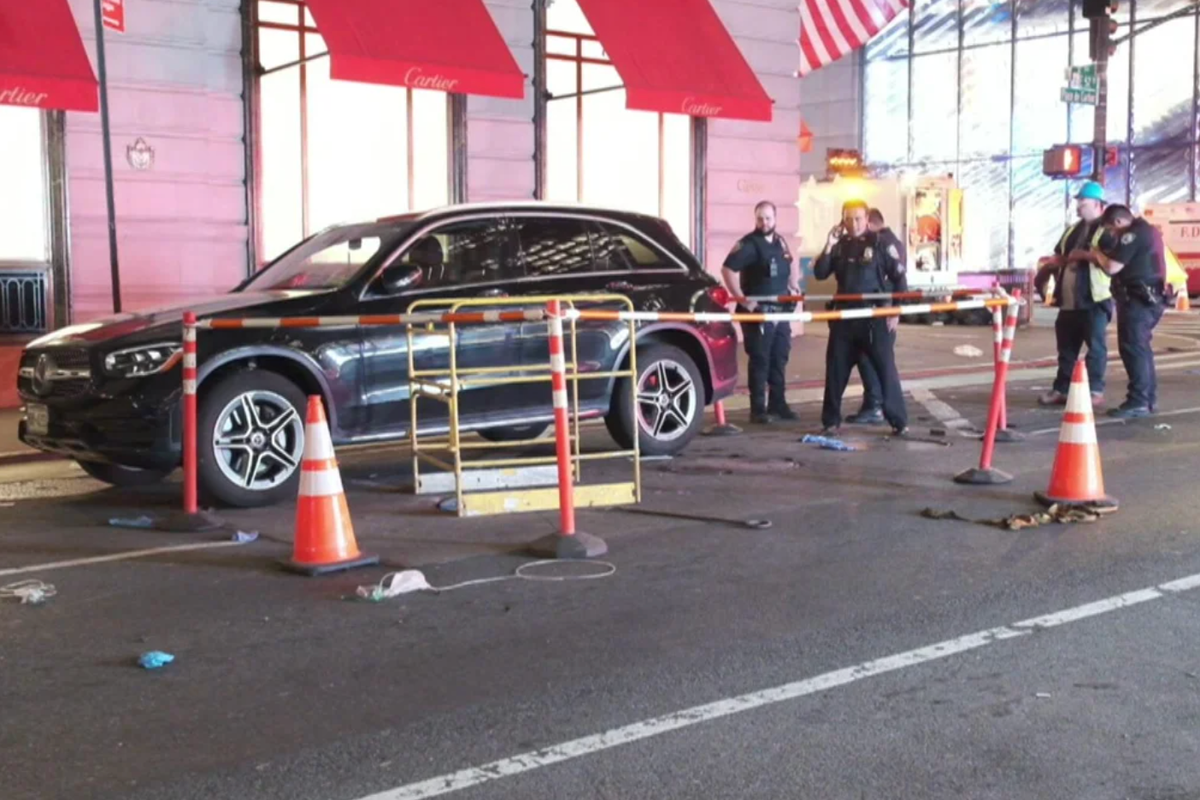
A tragedy occurs in Manhattan, and the script writes itself. A pedestrian falls into an open utility vault, the public reacts with justified horror, and the media immediately pivots to the easy narrative: bureaucratic negligence, failing city infrastructure, and demands for heads to roll. It is a comforting fiction. It suggests that with enough oversight, enough funding, and enough regulatory wrath, we can engineer a dense metropolis of over eight million people down to zero risk.
It is a lie.
The lazy consensus surrounding urban infrastructure accidents treats the city like a predictable, static machine. If a part breaks, someone forgot to grease it. If a vault is left open, a worker was lazy. But as anyone who has actually managed large-scale urban systems or worked in industrial risk assessment knows, New York City’s underground is not a neat grid of pipes—it is an anarchic, century-old ecosystem operating under chaotic constraints.
To prevent the next tragedy, we have to stop pretending we can regulate freak accidents out of existence. We need to look at the brutal math of urban risk management, acknowledge the trade-offs nobody wants to talk about, and completely redefine how we view public safety in modern cities.
The Mirage of the Open Vault Problem
When a fatal fall happens, the immediate reaction from the press and politicians is to ask, "How did this specific cover get left open?" They look for a broken latch, a distracted utility crew, or a missing warning cone.
This is a classic failure of root-cause analysis. It assumes the open hole is the anomaly. In reality, on any given business day in Manhattan, thousands of subsurface access points are open simultaneously.
Con Edison, Verizon, the Department of Environmental Protection, private contractors—they are all constantly peeling back the street surface. They have to. The city’s power grid, steam system, and fiber-optic networks require relentless, manual, physical intervention. The infrastructure is not solid state; it is a living organism that requires open-heart surgery every single day just to keep the lights on.
The premise that we can achieve perfect compliance across millions of annual maintenance hours is statistically impossible. Human error is a fixed baseline. When you run a system at the scale of New York City, a 99.99% compliance rate still guarantees dozens of critical failures a year.
The Deadly Cost of Risk Aversion
Let’s play out the standard regulatory response. After a high-profile incident, the city cracks down. They mandate triple-redundant locking mechanisms on every single vault cover. They require three-man crews for every standard inspection just to watch the hole. They implement hefty fines and stop-work orders for minor staging infractions.
Here is what happens next, based on decades of industrial safety data:
- Maintenance Velocity Plummets: When the bureaucratic friction to open a manhole doubles, routine preventative maintenance gets deferred. Crews do fewer inspections per shift. Minor gas leaks, fraying insulation, and structural degradation go unnoticed because the administrative burden of checking them is too high.
- The Law of Unintended Consequences Sparks: By over-indexing on the highly visible, low-probability event (a pedestrian falling), you inadvertently increase the probability of a catastrophic, low-visibility event (a massive subterranean steam explosion or a prolonged power grid failure during a heatwave).
- Cost Shifts to Consumers: Extra compliance requires capital. Utilities do not eat these costs; they pass them onto ratepayers or taxpayers. Millions of dollars are diverted from upgrading actual failing assets to pay for administrative theater.
In safety science, this is known as risk displacement. You haven't eliminated danger; you’ve just pushed it into a different, often more dangerous quadrant where the public can’t see it.
The Flawed Premise of "Zero Harm"
Look at the standard "People Also Ask" queries that inevitably trend after an incident like this: Who is responsible for checking NYC manholes? Can you sue the city for an open sidewalk vault? Why aren't all utility holes locked?
These questions are fundamentally flawed because they search for a single throat to choke. They operate under the assumption that "Zero Harm" is an achievable baseline.
It is not. Charles Perrow, a sociologist who revolutionized the study of industrial accidents, introduced the concept of "Normal Accidents." His core thesis was that in high-density, tightly coupled systems, unexpected interactions between multiple small failures are mathematically inevitable.
Imagine a scenario where a worker puts up a standard barricade. A delivery truck clips the barricade five minutes later, knocking it over. A heavy downpour reduces visibility for pedestrians, and a passerby, distracted by their phone or a sudden noise, steps into the path of the open vault. Who is the villain here? The worker who set the barricade? The truck driver who didn't notice the clip? The rain? The phone manufacturer?
When a system is tightly coupled, trying to assign total blame to a single node is a fool's errand. The accident is a property of the system itself, not the individuals within it.
Flipping the Script on Urban Safety
If we accept that absolute prevention is a myth, how do we actually make cities safer? We stop focusing entirely on prevention and start focusing heavily on mitigation and resilience.
1. Ditch the Barricades, Upgrade the Grates
The current standard for an open utility hole is a yellow plastic gate or a few orange cones. This relies entirely on human vision and compliance. Instead of relying on pedestrians to look up from their lives, we should mandate temporary, high-load mesh drop-in grates for every open hole. When a worker removes the heavy cast-iron cover, a lightweight, high-tensile steel mesh grid immediately drops into the collar. It allows light and air into the vault, but can support the weight of an adult. The worker can remove it when they need to climb in, but the default state of the open hole is "closed to humans." This shifts the safety mechanism from a behavioral control (watching where you walk) to an engineering control (making the hole physically un-fall-into-able).
2. Radical Transparency Over Fines
Right now, utilities hide their near-miss data because they fear litigation and regulatory fines. If a worker leaves a vault unsecured for ten minutes and notices it, they cover it up and say nothing. This starved the system of crucial data. The city should offer full immunity for self-reported safety anomalies within a digital, real-time logging system. We need a live map of every open subterranean access point in the city, updated by workers via a simple geofenced app. If a vault stays open without an active crew checked into that location for more than fifteen minutes, an automated alert triggers. Use tech to monitor the state of the streets, not more clipboard-wielding inspectors.
3. Educate the Public on Spatial Realism
This is the most controversial pill to swallow: urban residents need to regain a sense of situational awareness. We have engineered our environments to feel so sterile, so safe, that people walk through the most complex infrastructure hubs in human history with the spatial awareness of a toddler in a padded room. A city sidewalk is not a living room floor. It is the roof of a high-voltage, high-pressure, industrial factory. Treating it with the appropriate level of baseline respect and awareness isn't victim-blaming; it is a reality check for living in a mega-city.
The Trade-Off We Refuse to Admit
Every system has a price. If you want a city where absolutely no one ever falls into a hole, you have to accept a city where utility work takes three times longer, costs four times as much, and leads to rolling blackouts because the grid cannot be maintained efficiently.
We don't want that city. We want our high-speed internet, our instant hot water, our functional subways, and our cheap electricity. We have implicitly traded a microscopic veneer of physical risk for the massive benefits of living in a hyper-dense, hyper-efficient economic engine.
When someone dies in a freak infrastructure accident, the honest response is not to feign shock that the system is imperfect. The honest response is to acknowledge that we are operating a massive, aging machine on the ragged edge of possibility, and that sometimes, despite the best efforts of thousands of invisible workers, the machine breaks.
Stop looking for a scapegoat to fix a statistical certainty. Change the engineering, accept the inherent chaos of the concrete jungle, and watch your step.