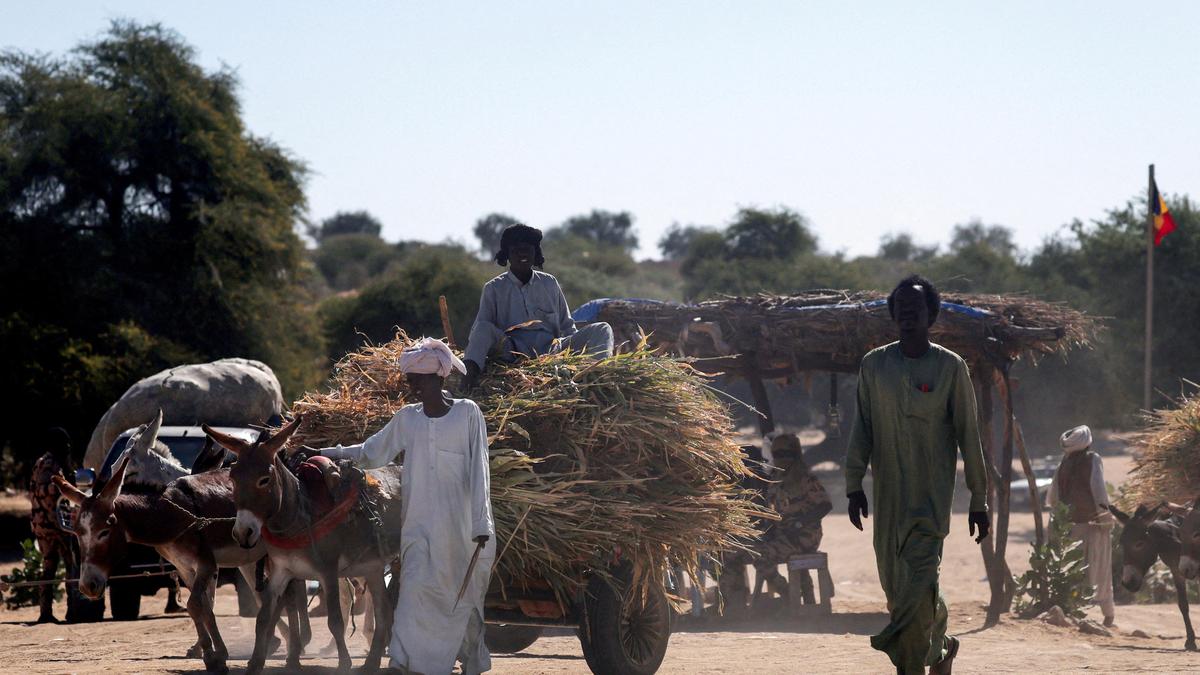
The dust in Renk doesn’t just settle; it colonizes. It finds the microscopic cracks in your phone screen, the back of your throat, and the thin, frayed fibers of a suitcase that has already traveled four hundred miles too far.
Amina is twenty-four, though her eyes suggest she has seen several lifetimes of geopolitical restructuring. She stands at a border that exists on a map but has vanished in reality, replaced by a wall of heat and bureaucracy. Behind her is Khartoum, a city she remembers as a series of jasmine-scented evenings and university lectures, now reduced to a smoking memory. In front of her is a line. Not a line of progress, but a line of suspension.
She is one of millions caught in the tectonic shift between Sudan and South Sudan. We often talk about borders as if they are solid, dependable things—the hard edges of a jigsaw puzzle. But for those fleeing the intensified shelling in the north, the border has become a ghost. It is a place where the world stops moving, even as the people within it are desperate to run.
The Mechanics of a Stalling Heart
When a country breaks, it doesn’t happen all at once. It starts with a shuttering of windows. Then, the banks go quiet. Finally, the roads turn into traps.
The conflict in Sudan isn’t just a war between generals; it is a systematic dismantling of the exits. For the civilians caught in the crossfire, the geography of escape is shrinking. To the north, the desert offers nothing but a slow death. To the east and west, neighboring nations are already buckling under the weight of their own internal pressures. That leaves the south.
South Sudan, a nation still nursing its own fresh wounds from a decade of civil strife, is the only logical destination. Yet, logic is a luxury the dispossessed cannot afford.
The border at Wunthou is a bottleneck of human misery. Imagine a funnel where the wide end is a war zone and the narrow end is a single, rusted gate. Thousands of people arrive daily. They bring with them the "invisible stakes"—the deeds to houses they will never see again, the diplomas that no longer carry weight, and the harrowing silence of children who have forgotten how to ask for a snack.
The Geometry of a Closed Door
We think of "closed borders" as a physical act—a fence, a guard, a padlock. In the context of the Sudans, it is more often a closing of the soul.
When a border is technically "open" but logistically impossible, it is effectively a wall. The infrastructure in South Sudan’s northern states is virtually non-existent. There are no paved roads to carry the hundreds of thousands of arrivals away from the transit centers. There are no surplus harvests to feed them.
Consider the math of a miracle. To move 10,000 people a day from a border town to a safe camp requires a fleet of trucks, thousands of gallons of fuel, and a road that doesn't turn into a river the moment the rainy season hits.
When those things are missing, the border doesn't just stop people; it traps them in a state of permanent "almost." You are almost safe. You are almost out. You are almost human again.
The Weight of a Plastic Tarp
Amina’s father is a man who used to obsess over the precise temperature of his tea. Now, he sits on a plastic crate, staring at a blue tarp that serves as their roof, their walls, and their entire inheritance.
This is the hidden cost of the conflict: the erosion of the middle class. The people fleeing are not just statistics; they are architects, teachers, shopkeepers, and musicians. They are people who, six months ago, were worried about their internet speed or their mortgage. Now, their entire world is measured by the liters of water they can carry in a yellow jerrycan.
The international community watches through a long-lens camera. We see the "clash," the "tensions," and the "humanitarian crisis." These are cold words. They are words designed to distance us. They turn a mother’s scream into a data point on a bar chart.
But if you sit in the dirt with Amina, the narrative changes. The crisis isn't a "landscape." It is the smell of unwashed bodies and the sound of a dry cough that won't go away. It is the realization that the international agencies are running on fumes, their budgets slashed by a world that has grown weary of "African problems."
The False Choice of Return
As the borders tighten and the transit centers overflow, a dangerous idea begins to circulate: the idea of return.
When the world makes it impossible to move forward, people begin to look backward, even if "backward" is a burning building. This is the ultimate failure of the global border system. When we fail to provide a path to safety, we are essentially telling people that their lives are worth less than the paperwork required to process them.
The South Sudanese government, already struggling to feed its own citizens, faces an impossible Choice. To keep the gates open is to risk total economic collapse. To close them is to sign a death warrant for their cousins across the line.
This isn't a policy debate. It's a family tragedy on a continental scale.
The Anatomy of a Forgotten Sky
The sun over the border doesn't care about sovereignty. It beats down with a ferocity that makes the air shimmer, turning the horizon into a lie.
There is a specific kind of sound that a crowd of thirty thousand people makes when they are waiting for food. It isn't a roar. It’s a low, rhythmic hum—a collective vibration of anxiety. It sounds like a hive that has lost its queen.
In this hum, you can hear the questions the news reports never ask.
Where is my brother?
Will I ever sleep in a bed again?
Who decided that this line in the sand was more important than my daughter's life?
The statistics tell us that over half a million people have crossed into South Sudan since the fighting began. But statistics are a way of lying without breaking any rules. A half-million is a number too large for the human heart to hold.
One.
One is a number we can understand. One woman named Amina, who is currently looking at her father and wondering if his heart will give out before the next truck arrives. One child named Samuel, who is drawing a picture of a tank in the dust with a broken stick. One border guard who is torn between his orders and his conscience.
The Echo of the Rain
The rainy season is coming. In this part of the world, rain isn't a blessing; it’s a sentence.
The dirt roads will turn into black cotton soil—a thick, viscous mud that can swallow a truck tire whole. When the roads go, the food stops. When the food stops, the border becomes a graveyard.
We often talk about "closed borders" as a political decision made in a capital city. But in the mud of the Sudans, the border is closed by the weather, by the lack of fuel, and by the sheer exhaustion of a people who have been running for forty years.
We have spent decades perfecting the art of the border. We have biometrics, heat-seeking drones, and sophisticated databases. We are very good at knowing who is moving. We are significantly worse at caring why.
The stake isn't just the survival of the people in Renk or Wunthou. The stake is the definition of what we are willing to accept as "normal." If we can look at a million people caught in a dead-zone between two wars and call it a "complex regional challenge," then we have lost the ability to see the world for what it actually is: a shared home.
Amina finally moves. Not across a border, but toward a small fire where someone is boiling water. She walks with a grace that the situation has no right to demand of her. She doesn't look at the guards. She doesn't look at the horizon. She looks at the ground, watching her feet move one after the other, because that is the only distance she can still control.
The map says she is in a new country. Her feet tell her she is still in the same dust, under the same sky, waiting for a world that has forgotten how to open its doors.