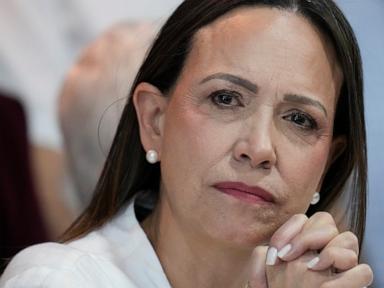
María Corina Machado is not merely planning a return to the Venezuelan political stage; she is attempting to dismantle the very logic of the Maduro administration’s survival strategy. From her current position in exile, Machado has reaffirmed her intent to claim the presidency she believes was stolen in the July 2024 elections. This is not the standard rhetoric of a defeated opposition leader. It is a calculated move to maintain the legitimacy of the Democratic Unitary Platform (PUD) while the internal machinery of Caracas begins to feel the weight of renewed international isolation and a hemorrhaging economy.
The central tension rests on a singular, undeniable fact: the opposition holds the physical tally sheets (actas) that prove Edmundo González Urrutia won by a landslide. By asserting her right to lead and her inevitable return, Machado is forcing the international community to choose between the cold pragmatism of dealing with a de facto dictator and the moral obligation of recognizing a documented democratic mandate. This isn't just about a seat in Miraflores. It is about whether the global financial system will continue to provide the lifelines Maduro needs to keep his military generals paid and his inner circle loyal. If you enjoyed this piece, you might want to read: this related article.
The Architecture of Power and the Price of Loyalty
To understand why Machado’s vow to return carries weight, one must look at the cracking foundations of the United Socialist Party of Venezuela (PSUV). Maduro’s grip on power is not fueled by ideology. It is fueled by access to hard currency. For years, the regime has survived through a patchwork of illicit gold mining, sanctions-evading oil shipments, and the quiet support of regional allies.
However, the 2024 election cycle changed the math. The sheer scale of the opposition’s victory—and the transparency with which they proved it—made it nearly impossible for even sympathetic neighbors like Brazil or Colombia to provide a full-throated endorsement of the official results. When Machado speaks of returning, she is signaling to the Venezuelan military that the current status quo is unsustainable. She is betting that the cost of protecting Maduro will eventually exceed the benefits. For another angle on this story, refer to the recent coverage from Associated Press.
The military remains the ultimate arbiter. While the top brass is deeply integrated into the state’s legal and illegal economies, the mid-level officers are watching their families struggle with the same hyperinflation and infrastructure collapse as the rest of the population. Machado’s strategy is to create a sense of inevitability. If she can convince the stakeholders in Caracas that Maduro is a dead end, the transition happens from the inside out.
The Oil Factor and the Shadow of Sanctions
Venezuela sits on the world's largest proven oil reserves, yet its production remains a fraction of its potential. This is the leverage Machado uses when speaking to foreign capitals. The global energy market wants Venezuelan crude, but the legal risks of dealing with an unrecognized government are mounting.
Major energy players have spent the last two years testing the waters through specific licenses. These licenses were predicated on the hope of a "fair" election. With that hope extinguished, the legal ground is shifting. Machado’s "return" is effectively a pitch to Western energy giants: "You can have stable, legal access to the Orinoco Belt, but only if you help clear the path for the rightful government."
- Production Stagnation: Without massive capital injection, PDVSA (the state oil company) cannot maintain current output.
- Infrastructure Decay: Decades of underinvestment have turned refineries into liabilities.
- The Debt Trap: Creditors are circling, and only a recognized, legitimate government can restructure the nation's massive sovereign debt.
This is the "why" behind her persistence. She isn't just a politician; she is the face of a potential economic reset that the global financial elite desperately wants, even if they won't say it publicly.
The Exile Strategy and the Risk of Irrelevance
History is littered with opposition leaders who vowed to return from exile only to fade into the background of a comfortable foreign life. Juan Guaidó is the most recent and relevant example. The "interim presidency" experiment failed because it lacked control over territory and the tax-collecting apparatus of the state.
Machado is trying to avoid this trap by maintaining a hyper-active digital presence and a direct line to the street committees that organized the July vote. She is not governing from a distance; she is organizing. The risk, however, remains high. The longer she stays outside the country, the easier it is for the regime to paint her as a tool of foreign interests.
The Maduro administration uses a sophisticated propaganda machine to frame Machado as an "aristocrat" disconnected from the "pueblo." They rely on the exhaustion of the citizenry. After years of protests, arrests, and economic hardship, many Venezuelans are simply tired. Machado’s challenge is to convert that exhaustion into a disciplined, long-term resistance that doesn't rely on a single explosive moment of uprising, but rather a steady erosion of the regime's authority.
The Mechanics of a Return
How does she actually get back? A physical return without a prior deal with the military would almost certainly result in immediate imprisonment. Therefore, her vow is less about a plane ticket and more about a diplomatic pincer movement.
- Diplomatic De-recognition: Forcing more nations to officially recognize the July results.
- Asset Freezes: Targeting the private wealth of the "Bolichicos"—the young elite who have profited under the regime.
- The ICC Pressure: The International Criminal Court’s investigation into crimes against humanity serves as a ticking clock for the Maduro inner circle.
The Demographic Time Bomb
There is a factor often overlooked in the standard political analysis of Venezuela: the diaspora. More than 7 million Venezuelans have fled the country. This is not just a humanitarian crisis; it is a political weapon.
These millions represent a massive voting bloc and a source of remittances that keep the domestic economy afloat. Machado has tapped into this network unlike any leader before her. She has turned the diaspora into a global lobbying firm. Every Venezuelan in Madrid, Miami, or Bogotá is a node in her communications network.
This creates a unique pressure point. As neighboring countries struggle to absorb the influx of migrants, they become more incentivized to see a resolution in Caracas. Machado is effectively telling regional leaders that the only way to stop the migration crisis is to facilitate the transition she leads. It is a bold, perhaps even arrogant, position, but it is grounded in the reality of the regional "push factors."
The Counter-Argument: The Resilience of Authoritarianism
We must be honest about the obstacles. Autocracies are remarkably resilient when they are willing to use unlimited force. Maduro has shown that he is comfortable with being a pariah. If he can maintain the support of a few key allies—namely Russia, China, and Iran—he can ignore the West indefinitely.
These allies provide more than just vetoes at the UN. They provide surveillance technology, riot control equipment, and alternative banking systems that bypass the SWIFT network. Machado’s strategy assumes that Maduro cares about the "good of the nation" or "economic prosperity." If his only goal is the survival of the clique, then the economic misery of the population is a secondary concern, or even a tool of control. A hungry population is often too busy surviving to revolt.
The Empty Chair at the Table
In January 2025, the next presidential term begins. This is the "drop-dead" date for the opposition’s current strategy. Maduro will attempt to hold a lavish inauguration to project an image of total control. Machado, meanwhile, will likely hold a counter-ceremony, perhaps in exile or at a symbolic location.
The danger here is a "two-president" stalemate that mirrors the Guaidó years. To avoid this, Machado must do something Guaidó never could: she must induce a high-level defection within the Venezuelan High Command. This requires more than just speeches; it requires back-channel guarantees of amnesty and the protection of certain assets. It is the messiest, most morally gray part of realpolitik, and it is where the future of Venezuela will be decided.
Machado is betting that the data is on her side. The tally sheets don't lie, and the math of the Venezuelan budget doesn't add up for Maduro in the long run. She is playing a game of chicken with a man who has shown no hesitation in driving the car off the cliff, provided he has a parachute.
The "definitive run" for the presidency she describes is not a campaign in the traditional sense. There are no rallies or TV ads. It is a siege. She is tightening the knots on the international stage, waiting for the moment when the men with the guns in Caracas decide that the "Maduro era" is no longer profitable. Whether she can survive the wait—and whether the country can survive the transition—remains the most volatile question in the Western Hemisphere.
The legitimacy of the 2024 vote is a ghost that will haunt every contract signed by the Maduro regime from this day forward. Every oil deal, every gold shipment, and every diplomatic envoy is now tainted by the proof held in the opposition’s hands. Machado’s return is not a matter of if, but of under what terms the current occupants of Miraflores decide to negotiate their exit. The clock is not ticking for her; it is ticking for them.
Focus on the tangible shifts in the military's economic interests over the next six months.