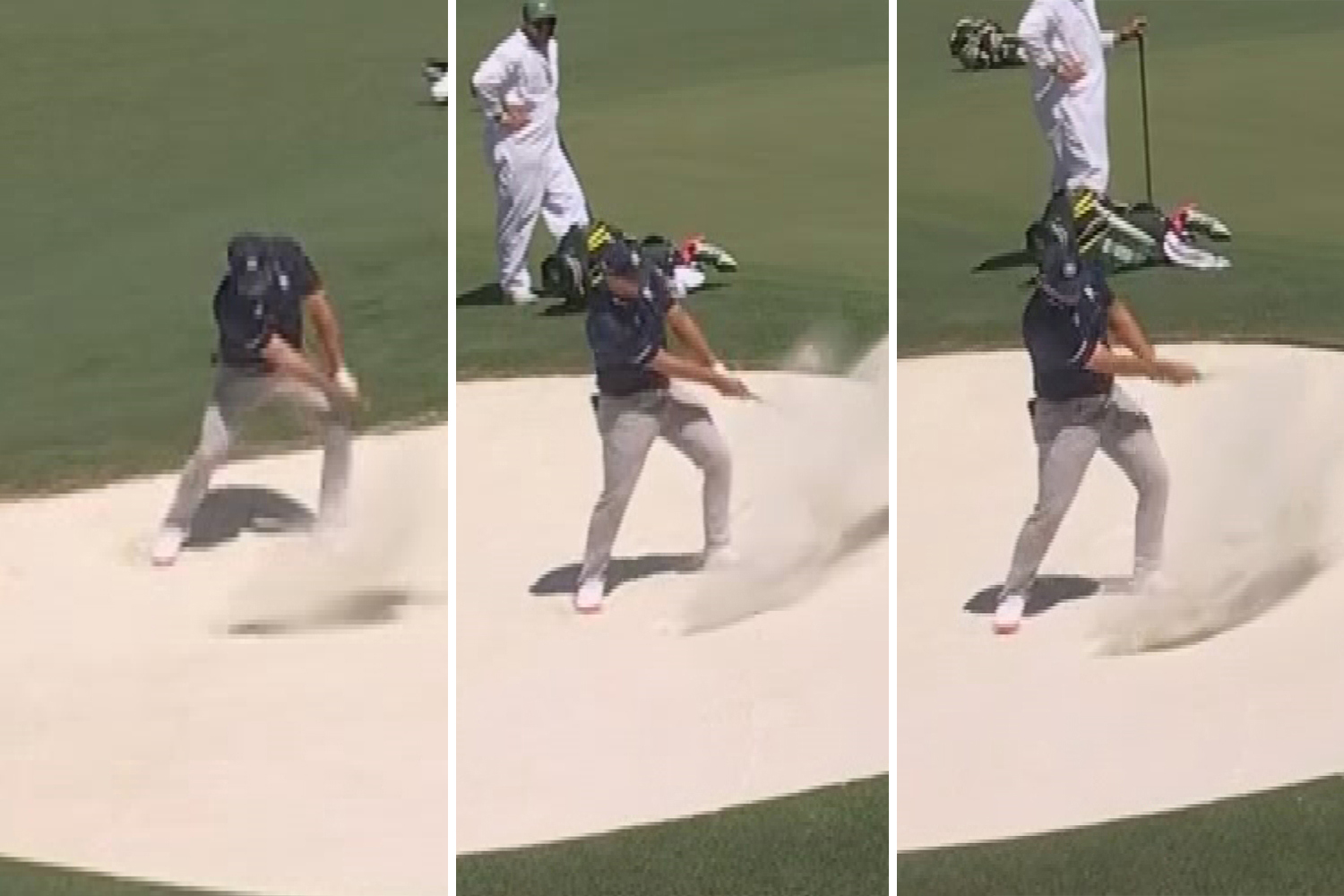
The sports media is currently feasting on the remains of a "collapsed" American star at Augusta National. You’ve seen the headlines. They use words like "catastrophe," "choke," and "meltdown" to describe a professional golfer leaving a ball in the sand or skulling a shot over the green. They paint a picture of a man losing his mind under the weight of the Green Jacket.
They are wrong. They are looking at the scorecard while ignoring the physics of elite performance.
What the armchair analysts call a "meltdown" is actually the necessary byproduct of the only strategy that actually wins at the Masters. If you aren't playing close enough to the edge to risk a triple-bogey, you aren't playing to win; you’re playing for a polite top-10 finish and a paycheck that nobody remembers. The "bunker disaster" isn't a failure of character. It’s a mathematical certainty when you refuse to play "safe" golf.
The Myth of the Conservative Champion
The standard narrative suggests that the winner of the Masters is the one who stayed patient, hit the middle of the greens, and waited for others to fail. This is a fairy tale told by people who have never stood on the 12th tee with the wind swirling like a poltergeist.
Augusta National is designed to penalize "smart" play. The slopes are too severe. The stimpmeter readings are too high. If you aim for the "safe" side of the pin on a hole like 11 or 15, you are often left with a forty-foot putt over a ridge that is statistically more likely to lead to a three-putt than a birdie.
The "meltdown" occurs because the elite player knows that a 68 requires taking lines that have a margin of error roughly the size of a razor blade. When that blade slips, the result is ugly. But the alternative—playing away from the trouble—is a slow, agonizing death by par.
I’ve spent years analyzing shot-link data and talking to caddies who have walked these loops for decades. The consensus among those who actually know the grass is simple: You can’t win the Masters by avoiding the bunker. You win by being the person who was brave enough to risk the bunker in the first place.
Why the Sand isn't the Enemy
The media focuses on the visual horror of the sand. They see a player hitting two or three shots to get out and assume the player has "lost it."
Let’s talk about the Coanda Effect and how it relates to bunker geometry. At Augusta, the bunkers aren't just hazards; they are structural components of the green's defense. They are often placed at the exact inflection point of a slope.
When a player "melts down" in a bunker, it’s usually because they are trying to play a high-spin landing on a downslope to a pin tucked three paces from the fringe.
- The "Safe" Shot: Hit it to the fat of the green, take your two-putt, move on.
- The "Winner's" Shot: Go for the hole.
If the winner's shot is off by two millimeters, the ball catches the lip and stays in. If the player then tries to "save" the par by getting even more aggressive with the second bunker shot, the risk of a "meltdown" triples.
We call this Compounded Risk Management. The player isn't "choking." They are doubling down on a high-variance strategy because they know that at the Masters, bogeys are irrelevant. Only birdies matter. If you are three shots back on Sunday, a "safe" par is functionally identical to a double-bogey. Both result in you losing the tournament.
Stop Asking "What Happened?"
The "People Also Ask" section of your search engine is filled with drivel like "Why did [Player] collapse at the Masters?"
The premise of the question is flawed. He didn't collapse. He reached the limit of a high-risk model.
In any other industry, we understand this. If a venture capitalist invests in ten moonshot startups and nine of them fail, we don't say the VC "melted down." We say they are playing the game correctly to find the one unicorn that pays for the rest. Golf is the only sport where we expect players to be "consistent" even when the reward structure heavily favors "volatile."
The Psychology of the "Aggressive Fail"
Let’s dismantle the idea of the "mental break."
The media loves to zoom in on a player’s face after a bladed bunker shot. They look for the sweat, the thousand-yard stare. They want to see a man breaking.
But talk to a guy who has actually won a Major. They will tell you that the moment of the "meltdown" is often the moment of greatest clarity. It’s the moment you realize the tournament is over, and the pressure vanishes. The "choke" usually happens before the disaster, when the player is trying to decide whether to be brave or be safe. Once the ball is in the sand for the third time, the decision has been made for them.
The real "chokers" are the ones who finish T-12 every year. They are the ones who never find themselves in a highlight reel of a disaster because they never took a line aggressive enough to cause one. They are the "reliable" players who are forgotten by Monday morning.
The Actionable Truth for the Amateur
You want to play better golf? Stop trying to avoid the "meltdown."
The average amateur golfer spends their entire round trying to minimize disaster. They aim away from the water. They aim away from the bunkers. They play "smart." And they consistently shoot 95.
If you want to actually improve, you have to embrace the variance. You have to be willing to look like an idiot.
- Stop Aiming for the Middle: If the pin is on the left, aim for the pin. If you miss left into the woods, so be it. You are practicing the skill of winning, not the skill of surviving.
- Learn the "Hard" Shot: Don't practice the easy splash shot out of the sand. Practice the long bunker shot. Practice the shot you're afraid of.
- Ignore the Scorecard: A round with four birdies and three double-bogeys is more valuable for your development than a round of 18 boring pars.
The Price of Greatness
The "meltdown" we saw this weekend wasn't a tragedy. It was the entry fee for the theater of the elite.
We watch the Masters because of the possibility of the disaster. If the course allowed for "safe" play to win, it would be as boring as a suburban office park. We need the bunkers to swallow the stars. We need the water to take the favorites.
But don't pity the man in the sand. He’s the only one who actually showed up to play for the trophy. The rest of the field was just playing for the stats.
Next time you see a "star" hitting a third shot from a greenside trap, stop looking for the "collapse." Look for the courage it took to hit the first one. Most people don't have the stomach to fail that publicly. That's why they're watching from the couch.
Golf isn't a game of misses; it's a game of how much you're willing to lose to find out if you're the best. If you aren't prepared to have a "meltdown" at the 12th, you have no business standing on the 1st tee.
Stop valuing consistency over brilliance. Consistency is for people who are afraid to find out how good they actually aren't. Burn the safe play. Aim for the flag. If you end up in the bunker, stay there until you learn how to get out with enough spin to stop the ball on a dime.
That’s not a meltdown. That’s an education.