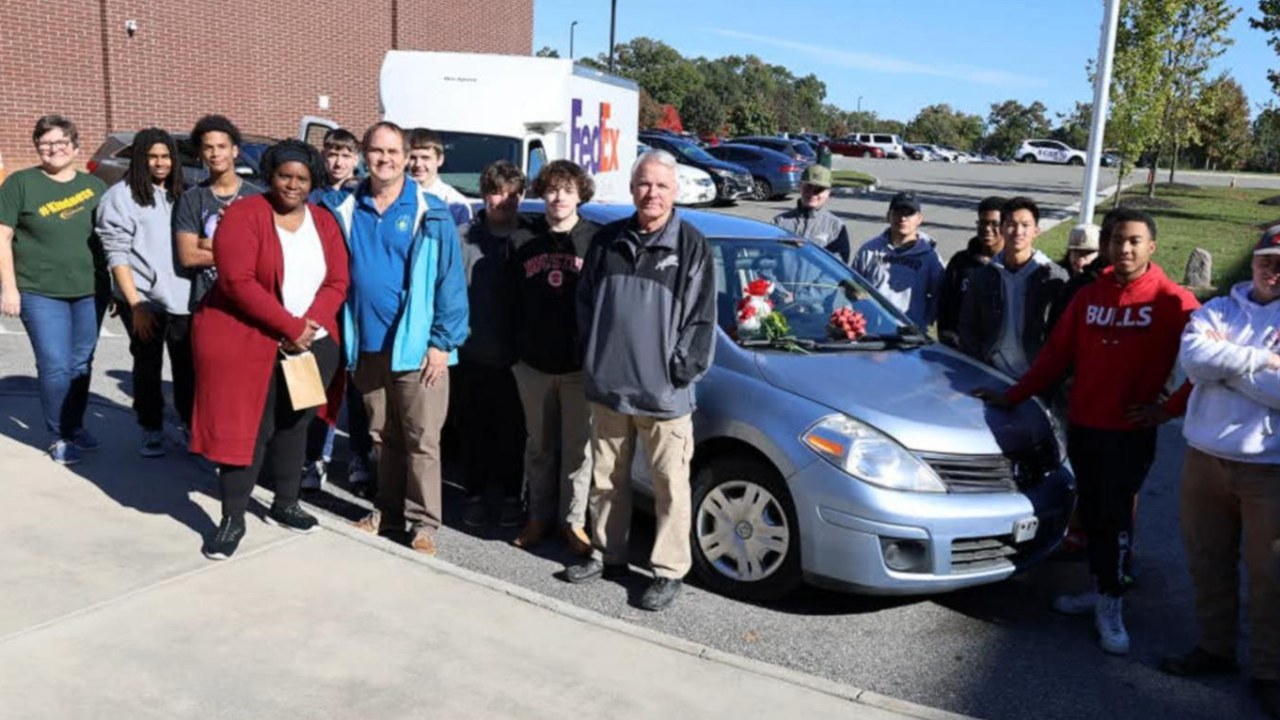
The correlation between reliable private transportation and upward economic mobility in non-urban environments is absolute. When a Virginia-based vocational program facilitates the refurbishment and transfer of decommissioned vehicles to single-parent households, it is not merely a charitable act; it is a sophisticated intervention in a high-friction labor market. Access to a vehicle reduces the "spatial mismatch" between affordable housing and high-yield employment opportunities, effectively expanding a participant's reachable job market by a factor of ten compared to public transit or pedestrian constraints.
The Tri-Lateral Value Exchange
To understand the efficacy of this model, one must categorize the stakeholders not by their emotional proximity to the cause, but by the tangible assets they contribute and capture. This program operates on a tri-lateral value exchange that stabilizes the local economic ecosystem.
1. The Educational Labor Force (The Students)
Students in these automotive programs are not performing "service work." They are engaging in high-stakes technical training where the quality of their output has a direct impact on human safety. This creates a feedback loop of accountability that standard classroom environments fail to replicate. The students acquire:
- Diagnostic Competency: Moving beyond theoretical components to identify failure points in aging mechanical systems.
- Supply Chain Management: Sourcing parts, managing timelines, and understanding the cost-benefit analysis of specific repairs versus vehicle replacement.
- Standard Operating Procedure (SOP) Adherence: Rigid alignment with safety standards required for vehicle roadworthiness.
2. The Capital Contributors (Donors and Partners)
Donors of vehicles often seek to offload depreciating assets that have high maintenance-to-value ratios. By donating to a certified educational program, the donor converts a liability (a non-functional or high-maintenance vehicle) into a structured tax advantage while bypassing the friction of private sale markets.
3. The End-User (The Single Mother)
For this demographic, a vehicle is a "force multiplier" for time. In a single-parent household, time is the scarcest resource. The acquisition of a vehicle creates a massive reduction in the "time tax" paid for basic survival tasks—childcare drop-offs, grocery procurement, and commuting.
The Cost Function of Mechanical Rehabilitation
The logistical bottleneck of such programs lies in the delta between a vehicle’s scrap value and its "reliable utility" value. A car donated in a state of disrepair requires a specific capital injection to become a viable asset for a single mother, who cannot afford the sudden $1,200 repair bill that an old vehicle might demand six months post-transfer.
Component-Level Assessment
Students must evaluate vehicles based on a "Service Life Remaining" (SLR) metric. If the drivetrain, transmission, or frame integrity is compromised, the labor hours required yield a negative return on investment. The program focuses on:
- Phase 1: Critical Systems: Braking, steering, and suspension. These are binary; they are either functional or the vehicle is grounded.
- Phase 2: Reliability Systems: Cooling, ignition, and fuel delivery. Failures here lead to stranded assets, which can result in job loss for the recipient.
- Phase 3: Efficiency Systems: Exhaust, sensors, and tires. These affect the ongoing operational cost (fuel economy) of the vehicle.
By prioritizing these phases, the program ensures that the recipient isn't being handed a financial burden disguised as a gift. The "hidden cost" of car ownership—insurance, fuel, and preventative maintenance—remains a barrier that requires secondary support structures or financial literacy training.
The Economic Multiplier of Commute Elasticity
The primary failure of standard poverty-alleviation strategies in rural and suburban Virginia is the assumption of geographic stasis. If an individual is limited to jobs within a 5-mile radius, they are subject to the local wage ceiling of that specific micro-economy.
Reliable transportation introduces Commute Elasticity. This allows the worker to travel 20 to 30 miles to reach industrial hubs, specialized medical facilities, or distribution centers that offer higher hourly wages and benefits.
Mapping the Opportunity Gap
The "Opportunity Gap" is the difference between the median income of the neighborhood where the recipient lives and the highest-paying job they can reach within 45 minutes of travel.
- Public Transit Constraint: In many Virginia counties, public transit either does not exist or operates on a spoke-and-hub model that doubles or triples commute times. This creates a "time-poverty" trap.
- Private Vehicle Advantage: The vehicle eliminates the "transfer friction" of public transit, allowing for "trip chaining"—dropping a child at daycare and reaching work in one fluid motion.
Operational Risk and Liability Mitigation
Transferring a student-repaired vehicle involves significant legal and safety risks. A rigorous analytical approach requires a robust inspection framework to prevent litigation and ensure recipient safety.
The Double-Blind Inspection Protocol
The most effective programs implement a two-tier verification system:
- Student Repair: Students perform the work under instructor supervision, logging all parts replaced and torque specifications met.
- Certified Third-Party Audit: Before title transfer, the vehicle undergoes a state inspection or a check by an ASE-certified technician who was not involved in the repair process. This decouples the educational intent from the safety guarantee.
Failure to maintain this separation creates a "survivorship bias" in the data. We only hear about the success stories, while the vehicles that break down three weeks later—further impoverishing the mother who spent her last $200 on new registration—are often omitted from the narrative.
The Scalability Bottleneck: Parts and Logistics
While student labor is "free" in an educational context, the cost of high-quality replacement parts is not. The scalability of these programs is limited by:
- Parts Procurement: Retail pricing for components like catalytic converters or head gaskets can exceed the vehicle’s book value.
- Storage and Inventory: Most schools lack the physical footprint to house fifty donated vehicles in various states of teardown.
- Technological Drift: As vehicles become more reliant on proprietary software and complex sensor arrays (ADAS), the "backyard" or "high school shop" repair model becomes increasingly difficult without expensive diagnostic equipment.
To bypass these limitations, successful programs must form direct partnerships with local dealerships and salvage yards. Dealerships can provide "dead stock" parts (new parts that are no longer in high demand) at cost, while salvage yards can offer discounted high-value components (engines/transmissions) from totaled late-model vehicles.
Quantifying the Social Return on Investment (SROI)
Measuring the success of a car-donation program requires looking past the number of "keys handed over." The true metric is the Household Income Velocity.
If a recipient’s income increases by $5,000 annually due to a higher-paying job made accessible by the car, and the program's cost to repair that car was $2,500 (parts + overhead), the program achieves a 200% SROI in the first year alone. When factored over the 3-to-5-year expected lifespan of the vehicle, the multiplier effect on local tax revenue and decreased reliance on social safety nets is significant.
The Maintenance Deficit
A critical flaw in the "gifted car" model is the lack of a "Maintenance Sinking Fund." A mother living paycheck to paycheck may not have the $60 required for an oil change or the $600 required for new tires. Strategic programs now include a "first year of maintenance" clause, where the student shop provides free or at-cost preventative maintenance for the recipient. This ensures the asset remains viable and protects the initial investment of labor and parts.
Strategic Recommendation: Moving Toward a Circular Vocational Economy
The Virginia model should move toward a "Circular Vocational Economy" to maximize long-term impact. This involves three specific tactical shifts:
- Tiered Vehicle Matching: Match vehicles with the shortest remaining lifespan to recipients with the shortest commutes. Reserve the most reliable, high-mileage-capable vehicles for those with long-distance commutes to industrial centers.
- The "Trade-In" Pipeline: When a recipient’s financial situation improves, the program should offer a trade-in credit. The recipient brings in the old vehicle (which can be used for parts or as a lower-tier project for new students) in exchange for a "tier-two" vehicle that has been refurbished to a higher standard. This creates a ladder of mobility rather than a one-time hand-out.
- Data Integration: Programs must track employment retention rates post-donation. If a recipient loses their job within six months, the vehicle is often repossessed or sold to cover basic needs. Integrating the vehicle donation with vocational coaching or job placement services ensures the car is used as a tool for income generation rather than just a convenience.
The objective is to transform the "auto shop" from a secondary elective into a primary engine of regional economic stabilization. By treating the vehicle as a high-yield capital asset and the students as the technical underwriters of that asset, the program moves from a human-interest story to a vital component of the local labor infrastructure.