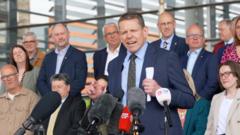
The political signaling of Rhun ap Iorwerth’s address from the Senedd steps represents a calculated pivot from defensive regionalism to a formalist challenge against the existing devolved structure. While the speech utilizes the optics of public protest, its underlying logic targets the specific administrative and electoral bottlenecks currently constricting Welsh legislative autonomy. To understand the trajectory of Plaid Cymru under ap Iorwerth, one must move past the rhetoric of "fairness" and examine the structural frictions between the Senedd’s expanding remit and its fixed fiscal constraints.
The Triangulation of Welsh Constitutional Friction
Ap Iorwerth’s strategy rests on three distinct operational pillars that seek to exploit the widening gap between the Welsh Government’s responsibilities and its actual agency. You might also find this similar story useful: Why Digital Migration Portals are a Gilded Cage for Global Labor.
- The Fiscal Floor Mismatch: The current funding model, largely dictated by the Barnett Formula, creates a lag between Welsh policy objectives and the capital required to execute them. By speaking directly from the steps of the legislature, ap Iorwerth frame the Senedd not as a failed body, but as a restricted one. The logic implies that the "cost of union" has transitioned from a theoretical debate to an quantifiable drag on Welsh public services.
- Electoral Reform as a Survival Mechanism: The expansion of the Senedd to 96 members and the transition to a closed-list proportional representation system is the primary tactical backdrop. Ap Iorwerth is positioning Plaid Cymru to capture the "systemic frustration" vote. This isn't merely about more politicians; it is about reaching a critical mass of legislative scrutiny that the current 60-member body lacks.
- The Sovereignty of Infrastructure: A recurring theme in ap Iorwerth’s doctrine is the decoupling of Welsh infrastructure—specifically energy and transport—from UK-wide crown estate management. He treats these as stranded assets. The speech serves to categorize these resources as the primary "revenue leakage" points for the Welsh economy.
The Economic Logic of the Independence Narrative
The transition from a cultural movement to a data-driven nationalist party requires a shift in how "independence" is defined. Ap Iorwerth’s recent communications focus on the comparative economic disadvantage. He utilizes a framework of "underfunding as an opportunity cost."
In the context of the Senedd steps speech, the argument focuses on the HS2 "consequential" funding gap. By quantifying the missing billions as a direct tax on Welsh connectivity, ap Iorwerth converts a complex accounting dispute into a tangible grievance. This creates a specific cause-and-effect loop: As extensively documented in recent reports by The Washington Post, the results are worth noting.
- Variable A: UK Government classifies major English infrastructure as "England and Wales" projects.
- Result B: Wales receives $0$ in Barnett consequentials.
- Outcome C: The Welsh transport budget sustains a multi-decade deficit relative to comparable European regions.
The Plaid doctrine suggests that the only way to break this loop is not through better negotiation within the current framework, but by changing the legal definition of Welsh fiscal identity.
Strategic Bottlenecks in the Ap Iorwerth Model
Despite the high-authority delivery, ap Iorwerth faces a significant "implementation gap." The primary limitation of the Plaid Cymru strategy is the dependency on the Labour-Plaid Cooperation Agreement, which has historically diluted Plaid’s distinct brand.
The second limitation is the fiscal reality of an aging demographic. Wales has a higher proportion of older citizens compared to the UK average, creating an inherent pressure on the health budget that structural reform alone cannot solve. Ap Iorwerth’s rhetoric often ignores the immediate "transition costs" of independence, focusing instead on the long-term "steady state" benefits. An analytical breakdown of the Welsh economy shows that the primary hurdle remains the tax base; the GVA (Gross Value Added) per head in Wales remains the lowest in the UK. Without a specific plan to stimulate private sector growth, the "Senedd steps" demands for more power remain decoupled from the capacity to fund those powers.
The Architecture of Political Signaling
The choice of the Senedd steps as a venue is a deliberate subversion of the "Chamber-only" politics. It is an attempt to merge the dignity of the institution with the energy of grassroots activism.
- Internal Party Alignment: The speech served to solidify ap Iorwerth’s leadership after a period of internal volatility. By focusing on the external "enemy" (Westminster), he minimizes factional disputes within the party regarding the speed of the independence roadmap.
- The Media Multiplier: Standard Senedd proceedings rarely capture the attention of the wider UK press. A "moment on the steps" provides a high-contrast visual that forces the Welsh Labour government to either defend the status quo or concede that the current devolved settlement is broken.
The second-order effect of this positioning is the pressure it exerts on the Welsh First Minister. If ap Iorwerth successfully frames the Senedd as an "underpowered engine," the incumbent government appears either complicit in that weakness or incapable of fixing it.
Resource Allocation and the Energy Paradigm
A critical component of ap Iorwerth’s address involves the devolution of the Crown Estate. The mechanism here is the capture of renewable energy rents. Currently, revenues from offshore wind in Welsh waters flow to the UK Treasury. The Plaid strategy treats this as a missed dividend.
- Mechanism: Reclaiming the Crown Estate in Wales.
- Direct Impact: An estimated annual revenue stream in the hundreds of millions.
- Strategic Utility: Using these funds as a sovereign wealth starter to de-risk green energy investments.
This is where the ap Iorwerth doctrine moves from protest to policy. He is betting that the electorate will respond to a "Wales as an energy powerhouse" narrative more effectively than a "Wales as a linguistic minority" narrative.
The Electoral Path to 2026
The 2026 Senedd election will be the first under the new 96-seat model. This change fundamentally alters the tactical landscape. The closed-list system rewards parties with a clear, unified message. Ap Iorwerth’s speech on the steps is the opening salvo in a campaign to define that election as a referendum on the competence of the Union.
The pivot points for the next 24 months will be:
- The Health Service Crisis: Linking wait times directly to the funding formula.
- Agriculture and Subsidy: Exploiting the post-Brexit friction in the rural heartlands.
- Constitutional Clarity: Pushing for a definitive list of "reserved" versus "devolved" powers that removes the current legal ambiguity.
The strategic play for Plaid Cymru is now to force a "constitutional convention" by making the current Senedd unworkable through constant legislative friction. By highlighting the mismatch between democratic mandate and fiscal reality, ap Iorwerth is attempting to make the status quo the most "expensive" and "unstable" option for the Welsh voter. The speech on the steps was not an end point; it was the formalization of a new, more aggressive analytical stance that views the UK’s constitutional arrangement not as a partnership, but as a solvable engineering problem.



