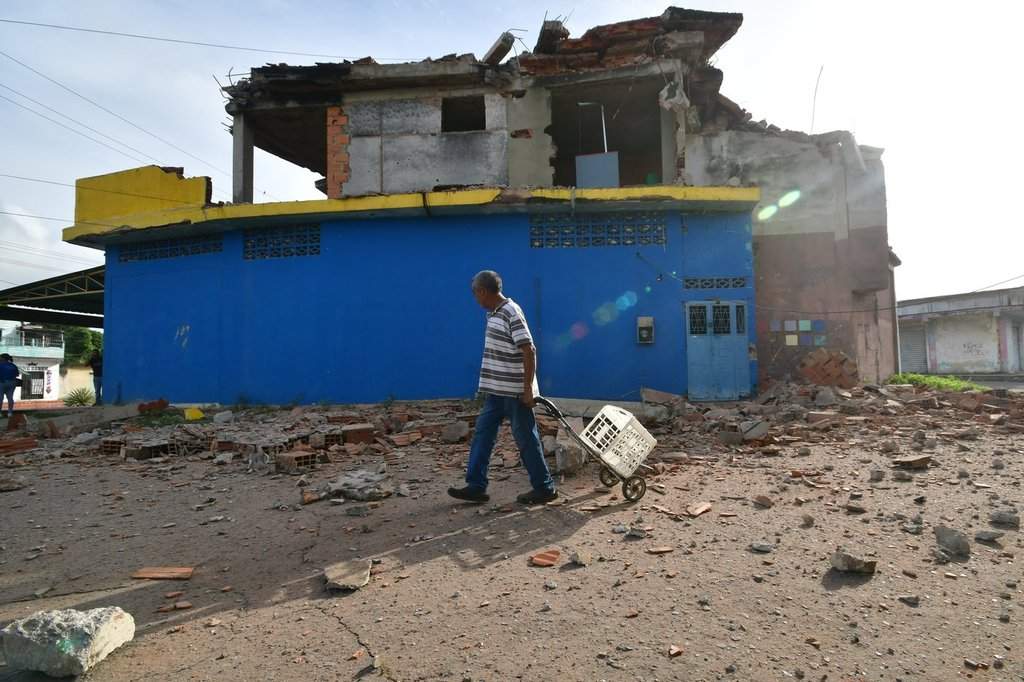
The escalating death toll following the recent seismic activity in Venezuela—now reaching 589 confirmed fatalities alongside thousands of severe injuries—is not merely a function of tectonic magnitude. It is the measurable output of a compounding structural failure. In disaster logistics, casualty velocity is determined by the intersection of built-environment vulnerability and supply-chain degradation. When an earthquake strikes an urban or semi-urban center, the immediate loss of life from structural collapse represents only the first wave of mortality. The second, often more preventable wave occurs when the local healthcare and logistical architecture fails to absorb the sudden surge in critical trauma patients.
To understand why the mortality figure has climbed so aggressively, we must look past the raw data and analyze the specific operational bottlenecks paralyzing the recovery efforts. The crisis can be deconstructed into three distinct vectors: structural vulnerability of the built environment, acute medical supply chain failure, and geographic isolation.
The Triad of Secondary Mortality
In high-consequence seismic events, mortality charts typically follow a bimodal distribution. The first peak occurs within minutes due to immediate trauma from collapsing masonry. The second peak develops over the subsequent 72 hours, driven by systemic failures in triage, extraction, and stabilization.
1. Structural Vulnerability and the Kinetic Payload of Informal Housing
The primary driver of the initial 589 fatalities is the high concentration of non-engineered reinforced concrete and unreinforced masonry structures. In many affected Venezuelan districts, informal housing units are built vertically on highly unstable slopes without seismic retrofitting or adherence to foundational engineering standards.
When a severe tremor occurs, these structures experience soft-story failure. The lower levels collapse entirely under the weight of the upper floors, creating a pancake effect. This specific failure mechanism dramatically reduces the volume of survivable void spaces within ruins, increasing the immediate lethality of the collapse and severely complicating search-and-rescue operations. The kinetic payload of heavy, brittle materials means that those who survive the initial impact are frequently trapped with crush syndrome, requiring advanced field medicine that cannot currently reach them.
2. The Critical Care Disconnection
The sudden influx of thousands of injured individuals has completely overwhelmed regional medical networks. In disaster medicine, the capacity of a healthcare system is governed by its surge ceiling—the maximum number of open ICU beds, operational surgical theaters, and trauma specialists available simultaneously.
The regional infrastructure was already operating near structural capacity before the seismic event. The sudden demand shock has caused a complete breakdown in the triage ladder. Patients requiring immediate surgical intervention to prevent exsanguination or organ failure are being held in improvised triage centers. Without rapid stabilization, secondary complications such as sepsis, acute renal failure from crush injuries, and hypovolemic shock are converting treatable injuries into fatalities. This operational bottleneck explains why the death toll continues to rise days after the initial event.
3. Logistical Stranding and Fuel Asymmetry
Even if medical supplies are available at national distribution hubs, they cannot reach the impact zones due to a total failure of the secondary transport network. Landslides triggered by the earthquake have blocked primary arterial roads, while bridge failures have severed critical transit corridors.
[National Distribution Hubs]
           │
           ▼
[Arterial Road Blockages / Bridge Failures]  <-- Primary Bottleneck
           │
           ▼
[Regional Hubs: Acute Fuel Deficit]          <-- Secondary Bottleneck
           │
           ▼
[Impact Zones / Field Hospitals]
This physical isolation is compounded by a severe deficit in localized fuel reserves. Search-and-rescue machinery, transport ambulances, and emergency power generators all compete for the same diminishing pool of diesel and gasoline. When fuel assets are misallocated or depleted, the entire rescue apparatus freezes, directly extending the time casualties remain trapped or untreated.
Quantifying the Damage Function
To optimize international relief and domestic allocation, resources must be deployed based on a rigorous damage function rather than emotional reactivity. The efficiency of a disaster response is dictated by the time-to-treatment variable ($T_t$).
$$T_t = T_e + T_t_{ransport} + T_w$$
Where $T_e$ is extraction time, $T_t_{ransport}$ is transit time over damaged infrastructure, and $T_w$ is the waiting period at the medical facility due to triage saturation. In a stable environment, $T_t$ is minimized. In the current Venezuelan context, every single variable in this equation has expanded exponentially.
The extraction time ($T_e$) is inflated because heavy lifting equipment cannot traverse broken roads, forcing rescue teams to rely on manual labor. Transit time ($T_t_{ransport}$) has doubled or tripled as vehicles take circuitous dirt routes to bypass collapsed bridges. Waiting time ($T_w$) is effectively infinite for non-immediate triaged individuals due to the lack of basic surgical consumables like anesthetics, sterile sutures, and blood products.
The current data indicates that the thousands of injured individuals are stratified into three operational cohorts:
- Red Tag (Immediate): Requiring life-saving surgery within 2 to 6 hours (e.g., internal hemorrhaging, severe head trauma).
- Yellow Tag (Delayed): Requiring systemic treatment within 24 hours but stable in the short term (e.g., open fractures without major arterial damage).
- Green Tag (Minor): Walking wounded requiring basic first aid.
The escalation in the death toll is primarily caused by Yellow Tag patients degrading into Red Tag status, and Red Tag patients dying before intervention. This systemic degradation is a direct result of supply chain starvation.
Systemic Limitations of the Recovery Effort
Any strategic intervention must acknowledge the baseline constraints of the operating environment. The response is currently restricted by two unyielding systemic limitations.
First, the centralized nature of national storage infrastructure means that critical assets are concentrated far from the tectonic fault lines. When an event shatters peripheral transport links, these central warehouses become strategic liabilities rather than assets. The inability to rapidly decentralize supplies prevents the deployment of functional field hospitals where they are most critically needed.
Second, communication asymmetry hampers real-time asset mapping. The loss of cellular towers and electrical grids across the worst-hit municipalities means that central command centers are operating on delayed, fragmented data. Relief convoys are being dispatched based on information that is 24 to 48 hours old, leading to misallocations where some field clinics receive duplicate supplies while others face absolute shortages of blood plasma and antibiotics.
Strategic Realignment for Casualty Mitigation
To halt the upward trajectory of the mortality rate, emergency command must abandon generalized rescue methodologies and pivot to a hyper-targeted, logistically insulated strategy.
Air-bridge operations must be prioritized over land transit. Given the degradation of the highway network, rotary-wing aircraft must be utilized exclusively for the insertion of forward surgical teams and the extraction of Red Tag casualties to undamaged Tier-1 trauma centers in adjacent regions. This bypasses the $T_t_{ransport}$ bottleneck entirely.
Simultaneously, fuel allocations must be strictly rationed and dedicated solely to two functions: running heavy extraction machinery at high-density collapse sites and powering the cold-chain refrigeration units necessary to preserve blood products and vaccines.
Finally, international aid must be restricted to standardized, modular trauma kits rather than bulk, unsorted medical donations. Unsorted supplies create an administrative burden at destination ports, as local personnel must waste valuable hours cataloging goods. Standardized modules allow immediate deployment directly from the tarmac to the field hospital, shortening the supply chain to the absolute minimum.


