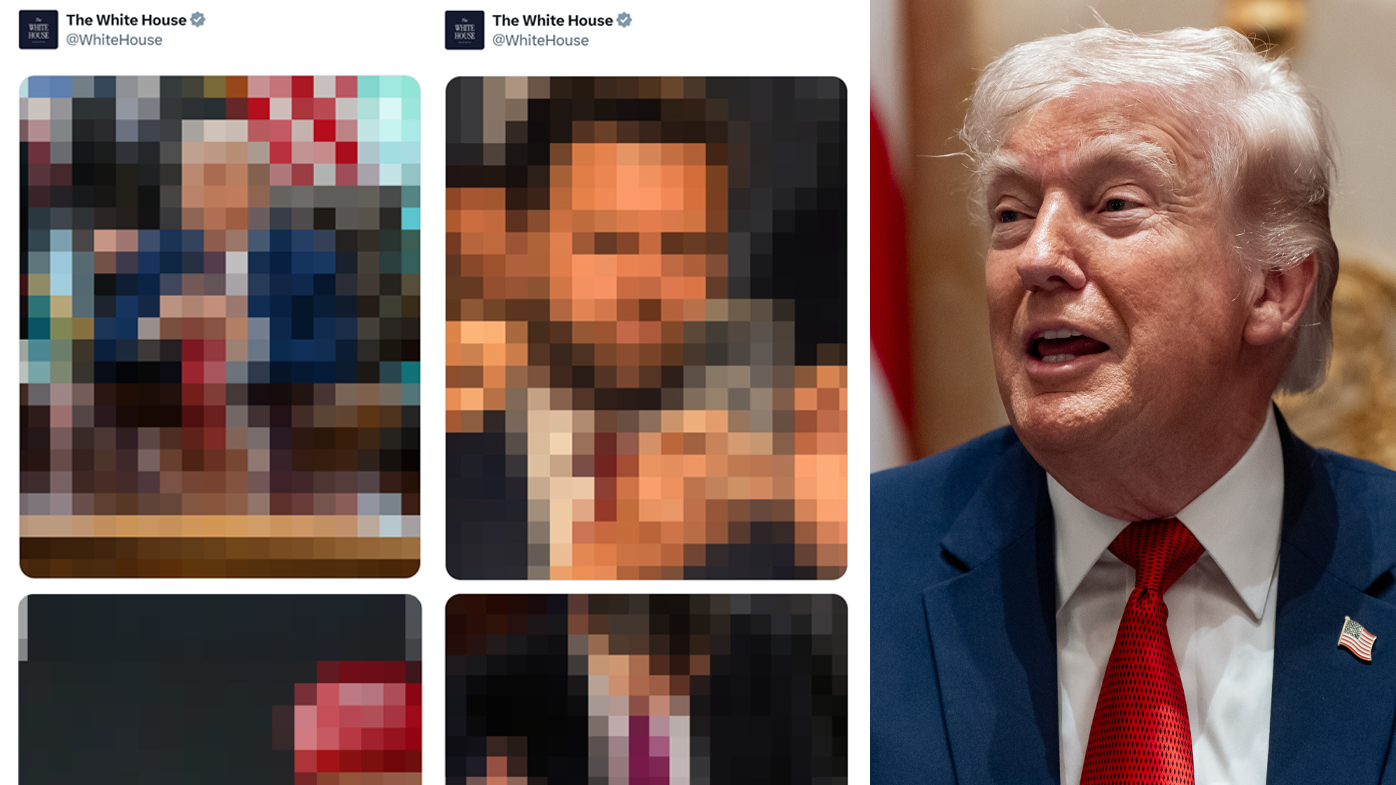
The recent deployment of low-fidelity, pixelated imagery by the White House on digital platforms is not a failure of hardware or bandwidth; it is a calculated execution of Information Security (InfoSec) protocols applied to the medium of social media. While casual observers mistake these visual artifacts for technical errors, they represent the intersection of high-stakes transparency and the rigid requirements of the Presidential Records Act. This strategy operates on a binary logic: the necessity to project presence while simultaneously mitigating the risk of inadvertent data leakage.
The Dual-Mandate Constraint Framework
Every piece of media released by the Executive Office must satisfy two conflicting mandates. This tension creates a bottleneck in the content pipeline, resulting in the "pixelated" aesthetic currently under scrutiny.
- The Transparency Mandate: Public demand and political strategy require a constant stream of "behind-the-scenes" content to humanize the administration and document history.
- The Operational Security (OPSEC) Mandate: Presidential environments are dense with Sensitive Compartmented Information (SCI). A single high-resolution photograph of a desk can inadvertently reveal classified schedules, secure hardware configurations, or the identities of non-disclosed personnel.
When these mandates collide, the administration utilizes Selective Resolution Degradation. This process involves identifying high-risk zones within a frame—such as computer monitors, documents, or reflecting surfaces—and applying a Gaussian blur or pixelation filter. When the risk density of a frame is too high to address through localized masking, the entire asset is downsampled. The result is a visual product that satisfies the record-keeping requirement but yields zero actionable intelligence to adversaries.
The Taxonomy of Visual Risks in Executive Spaces
To understand why an image is pixelated, one must identify the "Critical Information Elements" (CIEs) that the government is legally and strategically obligated to protect. Modern high-resolution sensors, often exceeding 45 megapixels, can capture legible text from a document sitting five feet away from the lens.
Document Legibility and Macro-Photography Risks
The most common trigger for pixelation is the presence of the President’s Daily Brief (PDB) or similar sensitive memos. Even a blurred edge of a document can reveal the color-coding used to denote classification levels (e.g., Top Secret/SCI). If an image is released where the "ragged right" edge of a paragraph is visible, linguistic forensics can sometimes reconstruct the content based on word lengths and sentence structures.
Forensic Reflection Analysis
Hard surfaces—windows, polished mahogany tables, and even the curvature of a human eye—act as mirrors. High-resolution photography allows for "non-line-of-sight" imaging. A photographer taking a picture of the President might unintentionally capture a high-definition reflection of a secure monitor located behind the camera. Pixelating the entire image is a fail-safe against these secondary and tertiary data leaks.
Signals Intelligence (SIGINT) and Hardware Fingerprinting
Specific hardware used by the White House Communications Agency (WHCA) carries a signature. Releasing clear images of secure telephone consoles or encrypted routing hardware allows foreign intelligence services to identify the specific models and firmware versions in use. This data provides a roadmap for cyber-exploitation. By degrading the image quality, the administration obscures the physical ports, serial numbers, and interface layouts of their secure infrastructure.
The Cost Function of Quality vs. Security
In strategic communications, there is a measurable trade-off between Narrative Resonance and Risk Exposure.
$R_n = \text{Narrative Resonance}$
$E_x = \text{Risk Exposure}$
As image resolution ($Res$) increases, $R_n$ follows a logarithmic growth curve—eventually, the public does not perceive a significant difference between 4K and 8K. However, $E_x$ follows an exponential growth curve. Once a certain threshold of clarity is reached, the probability of a catastrophic data leak increases dramatically.
The White House has determined that the "sweet spot" for social media distribution lies far below professional photography standards. By deliberately outputting images at low bitrates and resolutions, they effectively zero out the $E_x$ variable. The aesthetic cost—a "grainy" or "pixelated" look—is a marginal price to pay for the elimination of a national security vulnerability.
Digital Authenticity and the "Deepfake" Defensive Posture
A secondary, often overlooked driver for lower-quality official imagery is the rising threat of generative AI and synthetic media. High-fidelity, high-bitrate original images provide a perfect "ground truth" for bad actors to train Deepfake models or perform sophisticated "Cheapfakes" (manual edits of real footage).
By releasing degraded assets, the administration creates a Noise Floor. This makes it significantly more difficult for automated tools to isolate facial geometry and skin textures for the purpose of creating convincing forgeries. The pixelation acts as a form of digital watermarking; it signals that the image is for consumption, not for derivative manipulation.
The Problem of Metadata Scrubbing
Standard social media uploads often strip EXIF data, but they do not remove the inherent sensor noise or lens profiles that can be used to track a specific camera’s movements. Lowering the resolution is a physical method of stripping these technical identifiers, ensuring that the visual asset cannot be used to geolocate the photographer or time-stamp the event with sub-second precision.
Failure Points in the Obfuscation Strategy
While pixelation is a robust defensive tool, it introduces two distinct risks that the administration must manage:
- The Transparency Gap: When the public perceives an image as "censored," it triggers a psychological phenomenon known as the Streisand Effect. The focus shifts from the subject of the photo to the hidden elements. This creates a vacuum filled by speculation and conspiracy, which can be more damaging than the original data leak.
- Aesthetic Devaluation: In a digital economy driven by visual excellence, low-quality assets diminish the "authority" of the source. There is a risk that official communications will be ignored or dismissed as "fake" or "unofficial" because they lack the polished finish expected from a global superpower.
Comparative Analysis: Corporate vs. Executive Standards
Corporations often use similar tactics during product launches to hide prototypes. However, the corporate sector prioritizes Visual Allure, often using "beauty shots" with shallow depth of field (bokeh) to blur the background naturally.
The White House cannot rely on bokeh because it is a hardware-level solution that can be partially reversed through deconvolution algorithms. Pixelation and digital blurring are software-level destructive edits. Once the pixels are averaged or replaced by blocks, the original data is mathematically unrecoverable. This "Destructive Workflow" is the standard for government entities because it removes the possibility of "de-blurring" tools—which are becoming increasingly sophisticated—reconstituting the sensitive data.
Structural Requirement for Future-Proofing
The current reliance on pixelation suggests a transition phase in executive communications. We are moving toward a period where the environment itself must be "sanitized" before the camera arrives.
The Clean Room Protocol
Instead of relying on post-production blurring, high-stakes environments will likely adopt "Visual Clean Room" standards. This involves the use of E-ink displays that can be cleared with a single command, the removal of all reflective surfaces, and the implementation of "Privacy Glass" that turns opaque when a camera sensor is detected. Until these physical infrastructure changes are ubiquitous, the "pixelated" look will remain the primary defensive layer.
The Strategic Recommendation for Information Integrity
To mitigate the loss of authority caused by low-quality imagery, the administration should shift toward Vector-Based Graphic Communication and high-fidelity "Environmental B-Roll" that is pre-cleared for security. By separating the "Person" (The President) from the "Data" (The Desk), they can provide the high-resolution content the public expects without compromising the operational security of the office. The current "pixelated" trend is a temporary patch on an aging communication model that failed to account for the forensic capabilities of modern digital consumption.
The shift toward deliberate visual degradation is not a sign of technical incompetence; it is the first visible symptom of a world where high-definition data has become a liability. The strategic path forward requires a total decoupling of visual storytelling from the operational environment, moving away from "candid" photography toward a controlled, modular visual identity that is secure by design.