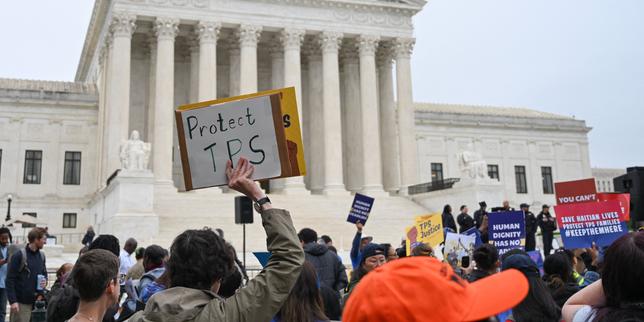
The US Supreme Court’s decision allowing the executive branch to rescind Temporary Protected Status (TPS) for hundreds of thousands of Haitian and Syrian nationals exposes a fundamental reality of immigration law: humanitarian relief granted via executive discretion is structurally temporary and legally precarious. The core of this legal shift does not lie in ideological friction, but in the statutory boundaries of the Immigration and Nationality Act (INA) and the strict limits of judicial review over executive agency actions.
Understanding the strategic and operational implications of this ruling requires breaking down the statutory mechanics of TPS, the administrative law doctrines that insulate executive decisions from judicial intervention, and the immediate socio-economic bottlenecks triggered by large-scale status revocation. If you found value in this article, you should read: this related article.
The Tripartite Vulnerability of Temporary Protected Status
Temporary Protected Status is fundamentally an administrative holding pattern, not a pathway to permanent residency. Under 8 U.S.C. § 1254a, the Secretary of Homeland Security possesses the statutory authority to designate a foreign state for TPS if ongoing armed conflict, environmental disaster, or other extraordinary and temporary conditions prevent its nationals from returning safely.
The structural fragility of this status is governed by three distinct operational pillars. For another angle on this event, refer to the latest coverage from Associated Press.
1. Absolute Statutory Discretion
The statutory language governing TPS explicitly grants the Secretary of Homeland Security the sole power to both designate and terminate a country’s status. Because the statute uses permissive language rather than mandatory directives, the executive branch maintains the unilateral authority to determine when the initial conditions that justified the designation have sufficiently mitigated.
2. The Statutory Bar on Judicial Review
Section 1254a(b)(5)(A) contains an explicit jurisdiction-stripping provision. It dictates that no court has the jurisdiction to review any determination by the Secretary regarding the designation, termination, or extension of TPS. This creates a high legal barrier for plaintiffs, forcing litigation away from the merits of the country conditions and onto narrow procedural grounds under the Administrative Procedure Act (APA).
3. The Absence of Vested Reliance Interests
Unlike permanent residency or citizenship, TPS does not confer a vested property interest or a guaranteed future status. The statute explicitly states that a period of TPS maintenance does not count as part of the physical presence required for cancellation of removal, unless the Secretary determines extreme hardship exists. This lack of statutory permanence undermines traditional due process claims based on long-term residency.
Administrative Procedure Act Friction vs. Executive Plenary Power
Litigation challenging the revocation of TPS for Haitian and Syrian nationals primarily relied on the APA, specifically arguing that the Department of Homeland Security (DHS) acted in an "arbitrary and capricious" manner. The legal strategy attempted to mirror the successful defense of the Deferred Action for Childhood Arrivals (DACA) program in DHS v. Regents of the University of California, where the Supreme Court ruled that the agency failed to adequately consider reliance interests.
The failure of that strategy in this instance highlights the critical differences between distinct categories of executive immigration relief.
The DACA program was created via an internal agency memorandum exercising prosecutorial discretion regarding enforcement priorities. Because it lacked a specific statutory blueprint, its abrupt termination was subject to standard APA review, requiring a comprehensive assessment of how the termination would disrupt the lives of those enrolled.
Conversely, TPS is a formal, statutorily defined program with explicit termination mechanisms baked into the text of the INA. When DHS terminates a TPS designation, it is executing a statutory mandate to review country conditions every 6 to 18 months. If the agency provides a facially plausible record showing that the specific triggering conditions (e.g., the immediate aftermath of the 2010 Haiti earthquake or specific combat zones in Syria) have evolved, courts applying Chevron-style deference or post-Chevron statutory interpretation lack the authority to substitute their own judgment for that of the agency.
This structural reality creates an operational bottleneck for legal challenges. Plaintiffs cannot legally argue that Haiti or Syria are completely stable; they must prove that DHS completely ignored its own administrative record or violated its own internal procedural regulations during the review process. When the Supreme Court removes judicial stays on these terminations, it signals that the executive branch has met the bare minimum procedural thresholds required to execute its statutory discretion.
Socio-Economic Depletion and Labor Market Friction
The revocation of status forces an immediate transition from legal authorization to undocumented or deportable status, triggering measurable economic disruptions across specific geographic and industrial sectors.
The Separation Cost Function
For employers, the termination of TPS removes valid Employment Authorization Documents (EADs) from a predictable segment of the workforce. The construction, healthcare, hospitality, and logistics sectors experience immediate workforce friction. The cost of replacing an experienced worker includes recruitment costs, productivity losses during the onboarding phase, and increased regulatory scrutiny regarding I-9 compliance.
Macroeconomic Concession
The sudden removal of authorization alters consumer spending and tax revenue metrics. TPS holders contribute to payroll taxes, Social Security, and local economies. When status is revoked, individuals either exit the formal labor market into an informal economy—reducing tax compliance and lowering aggregate wage power—or face deportation, which incurs direct enforcement costs for the state.
The Remittance Pipeline Collapse
Haiti and Syria rely heavily on capital inflows from expatriate communities. Remittances function as a non-governmental safety net that stabilizes fragile local economies. Terminating the legal capacity to earn US dollars directly reduces these capital flows, deteriorating the economic stability of the home nations and potentially exacerbating the very push-factors that drive unauthorized migration cycles.
Immediate Strategic Imperatives for Affected Populations and Employers
Because judicial remedies have reached a structural dead end, entities affected by the termination of TPS must shift from litigation-focused strategies to rigid operational adjustment.
For Employers of TPS Beneficiaries
- Execute Immediate I-9 Audits: Identify every employee currently operating under a TPS-linked EAD. Determine the exact expiration date of the automatic extensions frequently granted during wind-down periods.
- Assess Alternative Visa Pathways: Evaluate whether specific high-skilled or specialized workers qualify for transition to employer-sponsored non-immigrant visas (such as H-1B, L-1, or O-1) or permanent labor certification (PERM), though these pathways are highly constrained by statutory caps and strict eligibility requirements.
- Develop Workforce Contingency Blueprints: Model the operational impact of a sudden 5% to 15% reduction in specialized labor within specific regional hubs to mitigate sudden supply chain or service delivery failures.
For Impacted Individuals
- Screen for Derivative Relief: Evaluate eligibility for alternative forms of immigration relief that exist independently of TPS. This includes adjusting status via immediate family sponsorship, applying for asylum if independent individualized persecution metrics are met, or seeking non-immigrant status changes.
- Execute Defensive Legal Planning: In the absence of legislative intervention, individuals who remain in the US post-revocation enter standard removal proceedings. Securing experienced legal counsel to prepare for immigration court review is the only viable mechanism to contest immediate deportation.