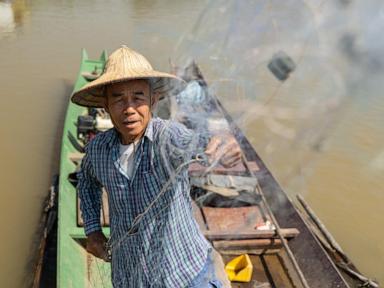
The "World’s Kitchen" is not dying. It is being renovated.
For years, the narrative surrounding rare earth mining in Southeast Asia, particularly along the Mekong tributaries, has been a masterclass in alarmist pearl-clutching. Activists and armchair environmentalists paint a picture of toxic sludge devouring rice paddies and poisoning the fish that feed millions. They call it an ecological death sentence.
They are wrong.
What we are witnessing isn't the destruction of a region; it’s the birth of a localized industrial superpower. The choice isn't between "clean water" and "toxic minerals." The choice is between being a perpetual agricultural servant to the West or becoming the backbone of the global energy transition.
The Myth of the Virgin River
The competitor narrative relies on the romanticized notion that the Mekong was a pristine, untouched Eden before the first drill hit the soil. This is a fantasy. The Mekong has been an industrial artery for decades, choked by overfishing, unregulated dams, and massive agricultural runoff from the very "kitchen" everyone is so desperate to protect.
Nitrates and pesticides from intensive rice farming have been doing far more systemic damage to the river’s long-term health than localized leaching from rare earth projects. Yet, we don’t see headlines screaming about the "toxic rice industry." Why? Because rare earths involve China, high-tech magnets, and the messy reality of the "Green Revolution." It makes for a better villain.
Rare earth mining—specifically ion-adsorption clay mining—is messy. Nobody is disputing that. But let’s be precise about the chemistry. We aren't talking about nuclear waste. We are talking about ammonium sulfate leaching. Is it ideal? No. Is it manageable? Absolutely. To suggest that these specific mining sites are "poisoning" the entire Mekong system is a geographic and hydrological absurdity. It’s like saying a spill in a bathtub in London is going to kill the fish in the English Channel.
The High Cost of Your Moral Superiority
The West loves the "Green Transition" until they see the bill. You want wind turbines? You want EVs? You want the smartphone you’re using to read this? You need Neodymium, Praseodymium, and Dysprosium.
These elements don't just appear out of thin air in a laboratory in Cupertino. They are ripped from the earth. By attacking mining operations in Southeast Asia, Western critics are effectively practicing "environmental NIMBYism" (Not In My Backyard) on a global scale. They want the carbon-free future, but they want the "dirty work" to happen somewhere they don't have to look at it.
When you shut down a regulated or semi-regulated mine in a Mekong tributary due to public outcry, the demand doesn't vanish. It just moves to even less regulated, more opaque operations in regions with zero oversight. By screaming for a total shutdown, activists are actually incentivizing worse environmental outcomes. They are trading a localized, fixable problem for a systemic, invisible disaster.
The Economic Reality: From Farmers to Technicians
The "World’s Kitchen" label is a trap. It’s a polite way of saying "The World’s Low-Value Commodity Producers."
Relying on subsistence fishing and rice farming is a one-way ticket to permanent poverty in the 21st century. Rare earth mining offers a bridge to a high-value industrial economy. I have seen regions where the introduction of mining—when coupled with even basic infrastructure investment—has skyrocketed local GDP, provided the capital for modern healthcare, and built the schools that take children out of the paddies and into technical roles.
Critics argue that the "locals" don't benefit. That’s a failure of local governance, not a failure of mining. If the wealth isn't trickling down, the enemy isn't the mineral; it's the corruption. Blaming the mine for a crooked local official is like blaming the car for a drunk driver.
The Nuance of In-Situ Leaching
The competitor article likely leans heavily on the "devastation" of the landscape. They show photos of brown pits and yellow water. It’s evocative. It’s also outdated.
Modern in-situ leaching (ISL) is becoming the standard. Instead of stripping the topsoil and creating massive open pits, ISL involves pumping a leaching solution through the ore body and recovering the minerals via a closed-loop system. When done correctly, the surface remains largely intact.
The "lazy consensus" says mining equals total destruction. The reality is that the industry is moving toward "invisible mining." Are there bad actors? Yes. Are there illegal mines in Myanmar and Laos that dump chemicals directly into streams? Yes. But the solution isn't to kill the industry; it's to formalize and scale the professional operators who can afford the high-end filtration and reclamation tech.
The China Factor: Geopolitical Hypocrisy
Much of the outcry about Mekong mining is thinly veiled geopolitical anxiety. Because Chinese firms dominate the processing and supply chains in this region, Western media outlets are incentivized to frame every project as a "toxic debt trap."
If a Canadian junior mining firm were doing the exact same work with the exact same environmental footprint in Australia, the coverage would be about "securing the supply chain for a sustainable future."
We need to stop pretending this is purely about the environment. It’s about who controls the magnets that power the 21st-century military-industrial complex. If you care about the Mekong, you should be advocating for more investment and more transparency, not a retreat that leaves the door open for the most desperate, least regulated players to fill the vacuum.
The "Food Security" Fallacy
Let’s address the "People Also Ask" favorite: "Will rare earth mining cause a famine in Southeast Asia?"
The answer is a resounding no. The total acreage occupied by rare earth mines in the Mekong basin is a literal rounding error compared to the total arable land. Even in a worst-case leaching scenario, the impact on the total caloric output of the region is negligible.
The real threat to food security in the Mekong isn't a Neodymium mine; it's climate-induced saltwater intrusion in the Delta and the dozens of massive hydroelectric dams built by China and Laos that actually disrupt the sediment flow and fish migration patterns. But dams provide "clean energy," so they get a pass. Mining provides "scary chemicals," so it gets the pitchforks.
The Actionable Truth
If you actually want to protect the Mekong while supporting the tech that keeps you alive, stop donating to "Stop the Mine" campaigns. They are useless. Instead, demand two things:
- Traceability Mandates: Support legislation that requires tech companies to prove their rare earths weren't sourced from "wildcat" illegal mines. This forces the market toward large, regulated players who can't afford a scandal.
- On-Site Processing: Currently, the raw ore is often shipped elsewhere for processing. Pushing for local, high-tech processing hubs in Southeast Asia forces the environmental costs to be centralized and managed, rather than spread across a thousand tiny, leaky holes in the ground.
The Risk of Being Right
The downside to this perspective is obvious: it requires admitting that there is no such thing as a "clean" energy transition. It requires acknowledging that some trees will be cut and some soil will be moved so that you can drive your Tesla. It’s uncomfortable. It doesn't fit on a protest sign.
But the alternative—staying "pure" while the region stagnates and the climate warms—is a far greater sin.
The Mekong isn't a museum. It's a living, breathing economic zone. Stop treating the people who live there like they are part of a scenic backdrop for your environmental anxieties. They deserve the wealth that sits beneath their feet. If a few tributaries get muddy in the process of lifting a generation out of poverty and saving the planet from carbon collapse, that is a trade we should have the guts to make.
Stop apologizing for the industrialization of the world. Start managing it.
Build the mine. Filter the water. Move on.