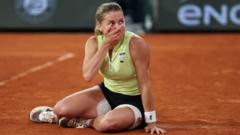
The tennis media is lazy. It runs on a predictable formula of overnight sensations, grit-and-determination qualifiers, and teenage prodigies destiny-bound for glory.
Right on cue, Maja Chwalinska’s run through the qualifiers to set up a French Open final against Mirra Andreeva has triggered the usual flood of breathless, sentimental prose. The pundits are calling it a miracle. They are calling it a testament to the romance of clay-court tennis.
They are wrong.
What is happening in Paris is not a fairytale. It is a cold, mechanical case study in modern tactical optimization, baseline attrition, and a staggering lack of variety on the WTA Tour. If you think Chwalinska is a starry-eyed underdog or that Andreeva is a once-in-a-generation phenom, you are falling for the marketing.
Let us strip away the romanticism and look at the actual physics and psychology of what is about to happen on Court Philippe-Chatrier.
The Qualifier Illusion: Why Low Rankings Fooled You
The mainstream narrative frames Chwalinska as a massive shock. It assumes that because a player comes through qualifying, they are inherently outmatched by the elite. This ignores how flat the talent distribution is in the modern women's game.
I have spent decades watching players burn through their savings on the ITF circuit, and the difference between world number 150 and world number 30 is rarely about raw ability. It is about scheduling, momentum, and health. Chwalinska, a player whose career has been repeatedly derailed by severe injuries and mental health battles, did not suddenly discover how to hit a tennis ball last week.
She has always possessed an elite, unorthodox skill set. Her game is built on low-slice variations, sudden drop shots, and frustrating opponents by changing the height of the ball. On clay, this is kryptonite for the current crop of baseline bashers who train exclusively to hit flat balls at hip height.
The media calls her run a surprise. In reality, the top 30 players she faced simply forgot how to move forward. They were exposed by a style that used to be standard but is now treated like a magic trick. Chwalinska did not rise above her station; she merely exploited a massive tactical blind spot in the modern tour.
The Mirra Andreeva Hype Machine
Now look at the other side of the net. Mirra Andreeva is being fitted for a crown she has not earned yet.
Yes, her movement is exceptional. Yes, her backhand down the line is a weapon. But the narrative that she is an unstoppable force of nature ignores the structural advantages handed to teenage prodigies today.
Andreeva is the product of a highly sophisticated, heavily funded academy system that molds players to peak physically at 17 or 18. They play with zero pressure because the public expects nothing but youthful exuberance. They hit without consequence.
The real test of a prodigy is not the initial ascent; it is the second year on tour when coaches have a thousand hours of high-definition video to analyze every hitch in your serve. Andreeva’s second serve is highly vulnerable. She leaves it short far too often, a flaw that elite returners usually punish mercilessly. The fact that she coasted into the final says less about her immortality and more about the psychological fragility of the seeds she bypassed.
Dismantling the "People Also Ask" Nonsense
If you search for insights on this matchup, you will find a list of fundamentally flawed questions dominating the discussion. Let us correct the record.
Is clay the ultimate equalizer for smaller players?
No. This is an outdated concept from the 1990s. Modern clay-court tennis is dominated by heavy, topspin-laden groundstrokes that push opponents through the back canvas. Players like Iga Swiatek proved that extreme athletic defense combined with high-RPM forehands is the baseline for success.
Chwalinska is succeeding not because clay naturally favors her size, but because she is actively denying her opponents the rhythm they need to generate that heavy spin. She is winning despite the surface trends, not because of them.
Can a qualifier realistically win a Grand Slam in the modern era?
Emma Raducanu already proved that the answer is yes, but the industry learned the wrong lesson from 2021. The takeaway should not have been "anyone can win." The takeaway should have been "the top 10 is incredibly unstable."
When the elite lack defensive versatility, a hot hand with nothing to lose can cut through a draw like a knife through butter. Chwalinska winning would not be a victory for the underdog; it would be an indictment of the top seeds who refuse to adapt their linear strategies.
The Cost of the Contrarian Style
Lest this sound like unconditional praise for Chwalinska’s tactical rebellion, we must acknowledge the brutal physical reality of her game.
Playing with variety and using the drop shot as a primary weapon requires an immense amount of physical exertion. You are constantly changing direction, bending low for slices, and sprinting to the net. It is an exhausting way to play tennis.
Imagine a scenario where Andreeva simply refuses to miss for the first forty-five minutes. She does not need to hit winners; she just needs to hit deep, heavy balls to the center of the court, denying Chwalinska the angles required to construct her points. In that scenario, the qualifier’s game plan collapses under the weight of its own complexity.
That is the downside of being a disruptor. When your game relies on precision and trickery rather than raw power, your margin for error is razor-thin. One bad service game can shift the momentum permanently.
The Unpopular Truth About the Final
This final will not be a classic. It will be an ugly, grinding affair determined by whoever manages their nerves worse.
The media wants you to tune in for a beautiful exhibition of contrasting styles. What you will actually see is a teenage prodigy trying to manage her first taste of genuine expectation, facing an opponent whose body has been pushed to the absolute limit just to get to the starting line.
Stop looking for fairytales in the sports pages. Tennis is an industry of physical attrition and tactical exploitation. Chwalinska did not get here on good vibes, and Andreeva is not a flawless savior. They are two flawed, fascinating competitors who have exposed the monotonous reality of the modern game.
Turn off the commentary, ignore the human-interest profiles, and watch the ball. The reality is far more brutal than the fiction they are selling you.