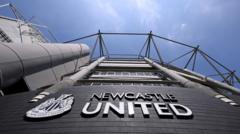
The hand-wringing over Newcastle United is reaching a fever pitch. You’ve read the articles. You’ve seen the pundits clutching their pearls over Profit and Sustainability Rules (PSR). They tell you the Saudi "Vision 2030" project is hitting a brick wall in the North East of England. They claim the "system" is successfully throttling the ambition of the Public Investment Fund (PIF).
They are wrong.
The current narrative suggests that because Newcastle couldn't spend £300 million in the last two transfer windows, the project is failing. This assumes the goal was to buy the Premier League trophy like a child buying a toy. It treats the PIF like a lottery winner with no plan. In reality, the "restraints" of PSR aren't a cage for Newcastle; they are the ultimate proof of concept for a sovereign wealth fund that plays the long game while the rest of the league plays checkers.
The PSR Trap is a Fairy Tale for Traditional Powers
Let’s dismantle the "system" argument first. The established "Big Six" didn't build a system to ensure fair play. They built a moat. By the time Newcastle was acquired, the rules had been retrofitted to prevent exactly what Manchester City did a decade prior.
The lazy consensus says Newcastle is "stuck." I’ve watched owners of mid-tier clubs celebrate PSR as if it’s a victory for the underdog. It isn't. PSR is a protectionist racket designed to keep the status quo in place by capping investment based on existing revenue. If you didn't have a global commercial footprint in 2010, the rules say you aren't allowed to build one now.
But here is the nuance the "Vision 2030 is unrealistic" crowd misses: PIF knew this. You don’t manage $900 billion in assets without reading the fine print.
The restriction on spending is actually the best thing that could have happened to the Newcastle project. It forced a pivot from "Buying Greatness" to "Building Infrastructure." While the media waits for a marquee signing to gossip about, PIF is busy verticalizing an entire sporting ecosystem. They aren't just buying players; they are buying the data, the sponsorships, and the geopolitical leverage that makes the players secondary.
Soft Power Doesn't Need a Champions League Trophy (Yet)
Critics point to the lack of "on-pitch progress" this season as evidence that the Saudi vision is stuttering. This is a fundamental misunderstanding of what Newcastle represents to Riyadh.
Newcastle United is a billboard, not the product.
Vision 2030 is about diversifying the Saudi economy away from oil. It’s about tourism, tech, and global integration. Every time "Newcastle" and "Saudi" appear in a headline together—even a negative one—the brand integration deepens. The goal isn't necessarily to win the Premier League by 2026; it’s to ensure that when a businessman in London or New York thinks of "Saudi," they think of a Premier League club rather than a desert oil rig.
The "system" can stop Newcastle from signing a £100 million winger. It cannot stop the Saudi Arabian national airline from becoming the club's primary partner. It cannot stop the mid-season warm-weather camps in Jeddah that serve as networking events for global CEOs.
Imagine a scenario where Newcastle finishes 8th for three years straight. To a football fan, that’s a failure. To a sovereign wealth fund, that’s three years of prime-time advertising and diplomatic soft-power exercises at a fraction of the cost of a traditional global marketing campaign.
The Fallacy of the Three-Year Cycle
The competitor's view focuses on the three-year PSR monitoring period. They argue that because Newcastle’s losses are nearing the limit, the project is capped.
This is short-termism at its finest.
Revenue is the only metric that matters for PSR, and Newcastle’s revenue is on a vertical trajectory. Between 2021 and 2024, the commercial growth has been astronomical. We are seeing a masterclass in "related party" sponsorships—deals that are technically market value but are driven by the owners' ecosystem.
- Sela (Events company)
- Noon (E-commerce)
- Saudia (Airline)
The traditional powers are terrified because they know they can't compete with an owner that owns the sponsors. The Premier League tried to block these "Associated Party Transactions," but you can only legislate against the market for so long. Eventually, the talent follows the money, and the money is currently flowing toward the Gulf.
I have seen clubs like Everton and Aston Villa try to "win" by spending beyond their means and praying for Europe. That is a gamble. Newcastle isn't gambling; they are scaling. They are happy to sell a star player like Bruno Guimarães if it balances the books because the institution is what matters, not the individual.
Why Your Questions About "Fairness" Are Irrelevant
People often ask: "Is it fair that a state can own a team?"
Wrong question. The question you should be asking is: "How did we allow a system where only six teams are allowed to be profitable?"
The "fairness" argument is a smokescreen. If the Premier League actually cared about fairness, they would implement a hard salary cap and a draft. Instead, they implemented PSR, which effectively says: "You can only spend what you already make." This guarantees that the rich stay rich.
Newcastle is disrupting this not by breaking the rules, but by exposing how flimsy they are. When the PIF eventually wins—and they will—it won't be because they outspent the "system." It will be because they outlasted it.
The 2030 Vision isn't about one club in the North of England. It’s about the total colonization of global sports. Look at LIV Golf. Look at the ATP tennis investments. Look at the 2034 World Cup. Newcastle is simply the flagship in a much larger fleet.
The Downside No One Wants to Admit
Is there a risk? Of course. The biggest threat to the "Vision" isn't the Premier League's lawyers; it's the volatility of the project itself. If the PIF decides tomorrow that football isn't providing the ROI they expected, the "Newcastle project" could become a ghost ship.
But betting against a sovereign wealth fund with a 50-year horizon based on a one-year PSR calculation is the height of arrogance.
The media wants a "Newcastle v The System" narrative because it sells papers. It frames the Premier League as a brave defender of tradition against an unstoppable force. But the truth is much more cynical. The Premier League is a business, and Newcastle is its most lucrative, albeit controversial, new partner.
The system isn't fighting Newcastle. It’s negotiating its price.
Stop looking at the league table and start looking at the balance sheet of the 21st century. The Saudi vision isn't unrealistic; it’s already the reality. You’re just still looking at the world through a 20th-century lens.
The trophies are inevitable. The influence is already here.
Accept it. The game didn't change; the owners did.